Reviewed July 22, 2026
HVAC Rescue Editorial Team
Editorial StandardsWhen you need mini-split repair
Mini-split repair is the right starting point when a ductless system that used to work now stops cooling, stops heating, leaks water, shows an error code, or runs without bringing the room to the set temperature. This also fits zone-specific problems, such as one indoor head acting up while another room still works normally, or an outdoor condenser that will not start or shuts off too quickly.
This page is for repairing existing ductless equipment, not planning a new system. If you are adding a mini-split where none exists, that is installation. If the issue is a central furnace or air conditioner with ductwork, that belongs on a general HVAC repair page. If the main problem is choosing or adding a thermostat, use a thermostat service page instead. A mini-split repair visit focuses on the indoor head, outdoor unit, drain path, controls, and communication between them.
The decision this service should answer
Determine whether one head, one zone, or the shared outdoor system has an airflow, drainage, sensor, control, electrical, refrigerant, or fan fault.
Mini-split repair should preserve error-code and zone context, compare affected and unaffected heads, inspect filters and drainage, and test model-specific controls and sealed-system performance.
Common problems
Start with the symptom you notice
Common causes
- Clogged drain line
- Mini-splits pull moisture from the air in cooling mode, and that water has to leave through a small drain path. If the condensate line backs up, water can collect inside the indoor head and drip onto the wall or floor even if the unit still runs.
- Dirty filters or coils
- Restricted airflow across the indoor head changes how the unit moves heat. The system may run for long periods, blow weakly, or struggle to reach the set temperature because the coil cannot exchange heat properly.
- Refrigerant charge problem
- If the refrigerant level is off, the system may cool weakly, heat poorly, or ice up on the lines. This is a sealed-system issue, so the important symptom for a homeowner is changing performance, not trying to diagnose the charge.
- Outdoor unit part failure
- A failed capacitor, fan motor, or control board can keep the condenser from starting, make it hum without fully running, or cause it to shut off quickly. When the outdoor unit cannot do its part, the indoor head may still blow air that is not actually cooled or heated.
- Sensor or wiring fault
- Mini-splits rely on sensors and communication wiring to decide when to run and how hard to run. When that signal is wrong, the system may flash a code, ignore commands, or cycle strangely even though no obvious mechanical part looks broken.
What you can safely check first
Homeowner checks should stay at the level of settings, airflow, and visible obstructions. They can rule out a simple problem, but they should not involve opening electrical compartments, handling refrigerant parts, or taking the unit apart beyond normal filter access described in the owner's manual.
Confirm mode and setpoint
Check that the remote or wall control is set to the correct mode for the season and to a sensible temperature. If cooling is selected but the temperature is set too high, or heating is selected by mistake, the system may seem faulty when it is actually following the command it received.
Try fresh remote batteries
If the remote display is dim, blank, or slow to respond, replace the batteries first. A weak remote can make the head appear unresponsive or stuck in the wrong mode even though the equipment itself is still working.
Clean the indoor filters
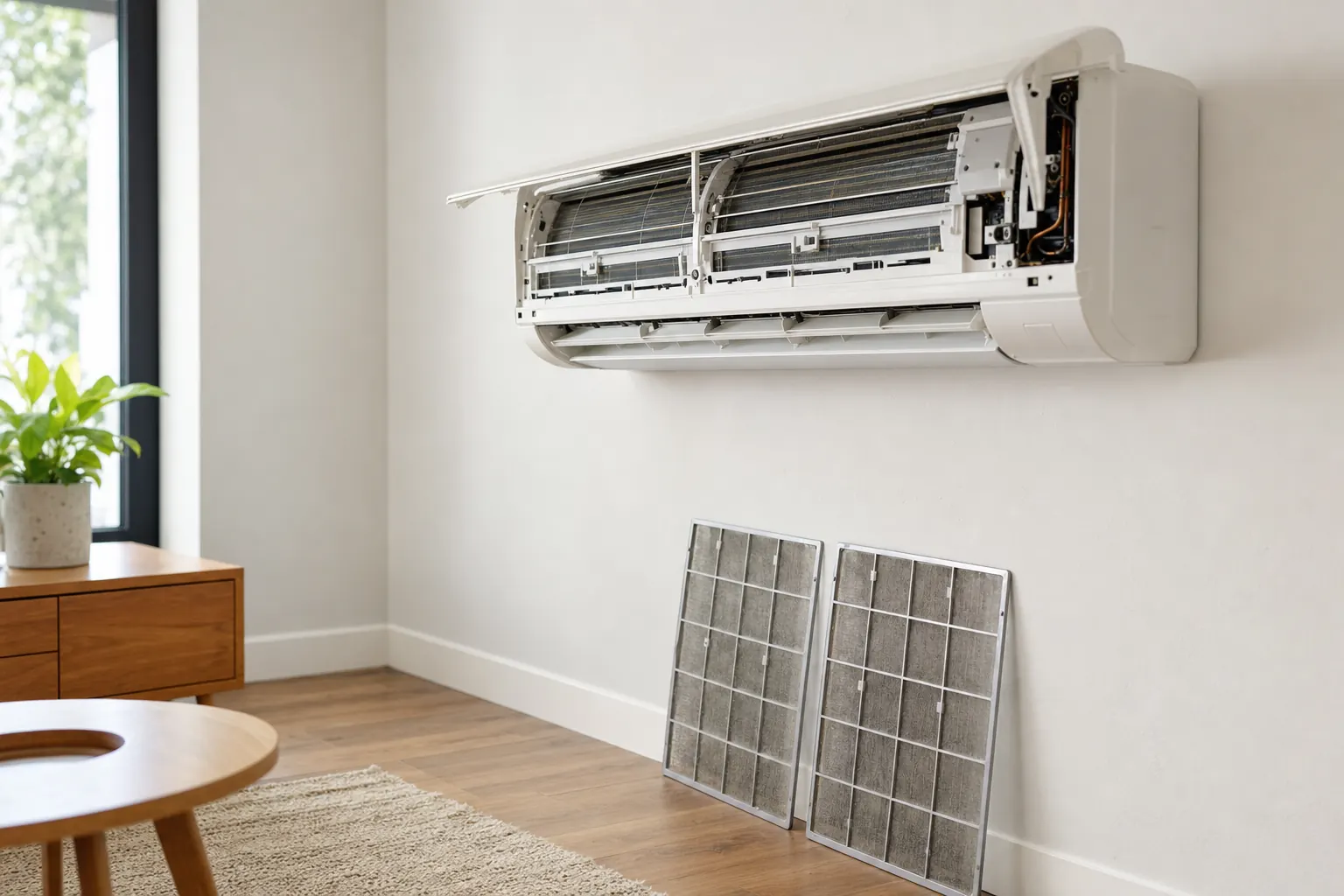
Slide out the washable filters and clean or replace them as the owner's manual directs. If airflow improves and the room starts getting closer to the set temperature, restricted airflow may have been part of the problem. If nothing changes, the fault is likely deeper than basic maintenance.
Check breaker and outdoor clearance
Make sure the breakers for both the indoor and outdoor sections have not tripped, and reset a tripped breaker once. Then clear leaves, grass, and debris from around the outdoor condenser. A breaker that trips again or a unit that still will not run points to a repair issue rather than a simple blockage.
When to call a professional
Call for diagnosis when the problem keeps returning after these basic checks, when the unit is leaking, or when the signs point to refrigerant, controls, or electrical components. Those faults need testing to find the actual cause before any part is replaced.
- Recurring error code
- If an error code or blinking light returns after a basic reset, the system is detecting a fault it cannot ignore. Continued operation may be unreliable, so it makes sense to stop using that zone until the cause is identified.
- Ice or weak cooling
- Ice on the lines or ongoing weak cooling can signal an airflow or refrigerant problem. Running the system in that condition can make performance worse, so shut it off and have it checked rather than trying to push it through the problem.
- Outdoor unit will not run
- If the condenser is silent, only hums, or keeps tripping the breaker, the issue may involve electrical parts or controls. Do not keep resetting the breaker repeatedly. Leave the system off and have the outdoor unit diagnosed.
- Water keeps leaking indoors
- If the indoor head still leaks after the filter is cleaned, the drain path, pan, or related parts may need service. Shut the unit off if water is reaching the wall, trim, or floor to limit damage while the cause is checked.
Repairing vs. Replacing a Mini-Split
Many mini-split problems are straightforward repairs, especially when the system is newer and the fault is a dirty filter, a clogged drain line, or a single failed part. A professional can often restore cooling or heating without touching the rest of the system.
When a unit is older, has a failing compressor, or needs repeated repairs to keep working, replacement may make more sense over the long run. An HVAC professional can compare the cost and lifespan of fixing your current system against installing a new one so you can decide what fits your home and budget.
Repair often makes sense when
- The system is relatively new and still under warranty
- Only one part has failed, such as a capacitor or fan motor
- The drain line or filters are clogged and easily cleared
- Repair costs are modest compared with the value of the unit
Consider replacement when
- The compressor has failed on an older system
- The unit needs frequent or escalating repairs
- Cooling and heating performance has dropped noticeably with age
- A professional finds widespread wear across major components
Get help with mini-split repair
One quick call connects you with HVAC pros who service your area. No pressure, no obligation.
What happens during service
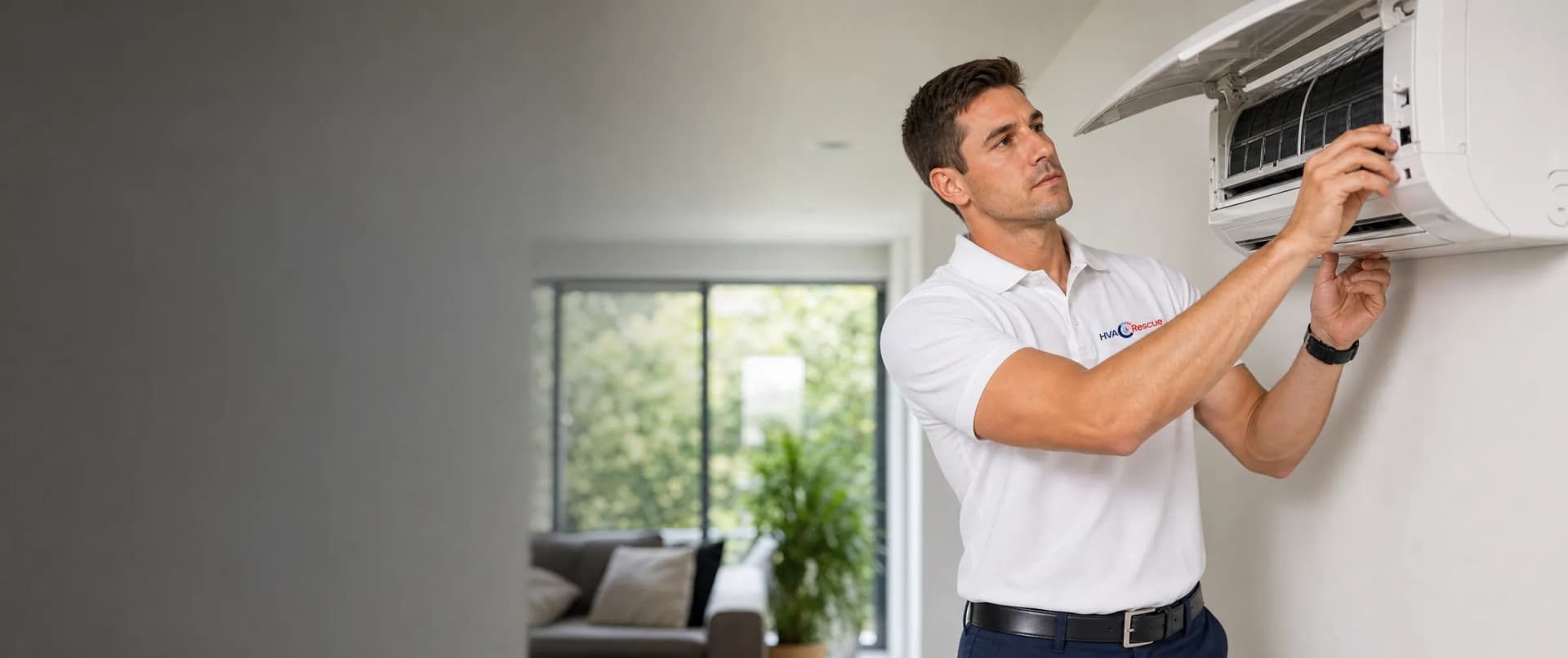
A qualified technician starts with diagnosis rather than guessing at parts. On a mini-split, that usually means checking the control response, fault indicators, drainage, airflow, indoor and outdoor operation, and the communication between components. Measurements and inspection help narrow the problem to a drain issue, sensor, motor, board, wiring fault, or sealed-system problem before repair options are explained.
- 1
Tell us what is happening
Describe the symptoms, whether it is cooling, heating, or both, and any error codes you can see on the head or remote.
- 2
Get connected locally
We help match you with HVAC professionals that service your area so a ductless specialist can take a look. Availability may vary by location and provider.
- 3
On-site diagnosis
A professional inspects the indoor head, outdoor unit, drain line, and controls to find the actual cause rather than guessing.
- 4
Repair options explained
You receive an explanation of what is wrong and the repair choices before any work begins, so there are no surprises.
- 5
Repair and verify
Once you approve, the system is repaired and tested across its operating modes to confirm it is cooling or heating as expected.
Why homeowners use HVAC Rescue
- One call connects you with HVAC pros who service your area
- Help for repair, maintenance, replacement, and emergencies
- Plain-English guidance on what is likely wrong before anyone visits
- No pressure and no obligation to book
- Available nationwide, year-round
- We point you to the right service for your system, not an upsell
Mini-Split Repair: common questions
Why is my mini-split running but not cooling the room?
What does a blinking light or error code on a mini-split mean?
Is water leaking from the indoor head a serious problem?
Should I keep using my mini-split if the lines are icing up?
How is mini-split repair different from general HVAC repair?
Sources and fact-checking
Reviewed July 22, 2026. We favor primary government and standards sources for safety, efficiency, and regulatory claims. These references support the technical and consumer guidance on this page.
- Heating and cooling maintenance checklistENERGY STARProfessional tune-up scope, filters, airflow, coils, drains, and safety checks.
- ENERGY STAR heating and cooling guidanceENERGY STAREfficiency, replacement planning, qualified equipment, and contractor questions.
- Section 608 technician certification requirementsU.S. Environmental Protection AgencyFederal certification requirements for work that can release regulated refrigerants.
- How to avoid a home improvement scamFederal Trade CommissionWritten estimates, contractor verification, payment cautions, and fraud warning signs.