Reviewed July 25, 2026
HVAC Rescue Editorial Team
Editorial StandardsStart with safety and the basic difference
If you ever smell gas, hear a carbon monoxide alarm, or notice smoke or a burning-electrical smell, everyone should leave the building immediately and call the gas utility or emergency services from outside. Do not stay inside to investigate, and do not treat it as a routine HVAC problem. That warning matters no matter what type of comfort system you have in the home.
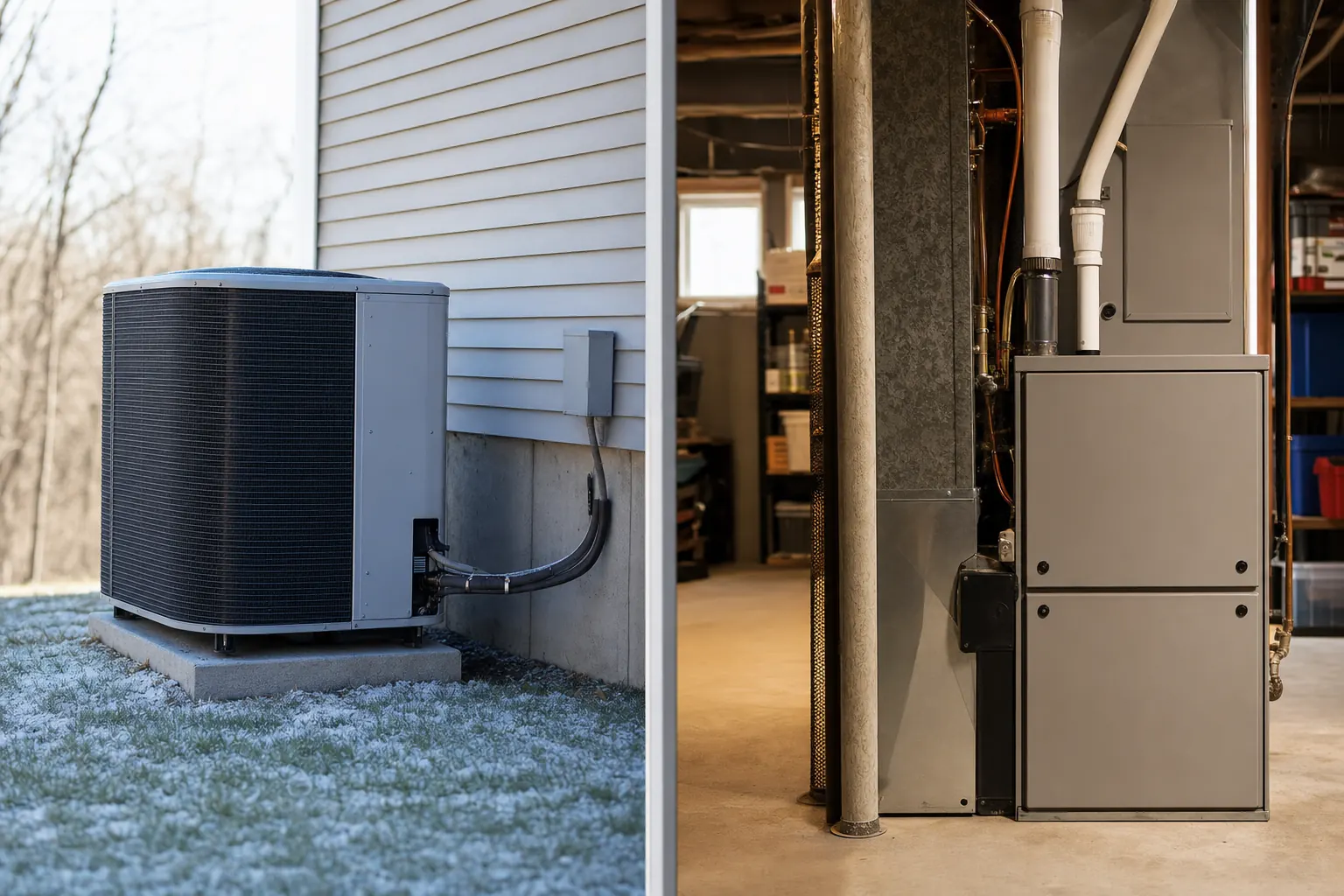
The basic difference between these systems is how they move cooling into the house. Central air conditioning cools air at an indoor coil connected to an outdoor condenser, then pushes that conditioned air through ducts to supply registers around the home. A ductless mini split uses one or more indoor heads connected by refrigerant lines to an outdoor unit, so cooling is delivered directly into each room or zone instead of traveling through ductwork. Both systems can cool well, but they solve comfort in very different ways.
That difference affects almost every buying decision: installation cost, energy use, appearance, filtration, noise, room-by-room control, and how evenly temperatures stay from one end of the house to the other. A central system usually treats the home as one large area unless it has true zoning with dampers and controls. A mini split is zoned by design. Each indoor unit can respond to the room it serves, which is why mini splits are often chosen for additions, bonus rooms, finished attics, garages, and older homes without existing ducts.
How each system works in a real house
A central AC system usually pairs an outdoor condenser with an indoor evaporator coil that sits above or beside a furnace or inside an air handler. The blower moves air through return ducts, across the cold coil, and back out through supply ducts. If the ducts are well designed, sealed, and insulated, central air can keep an entire home fairly even and unobtrusive. If the ducts are undersized, leaky, crushed, or routed through a very hot attic, comfort and efficiency can drop fast even if the equipment itself is new.
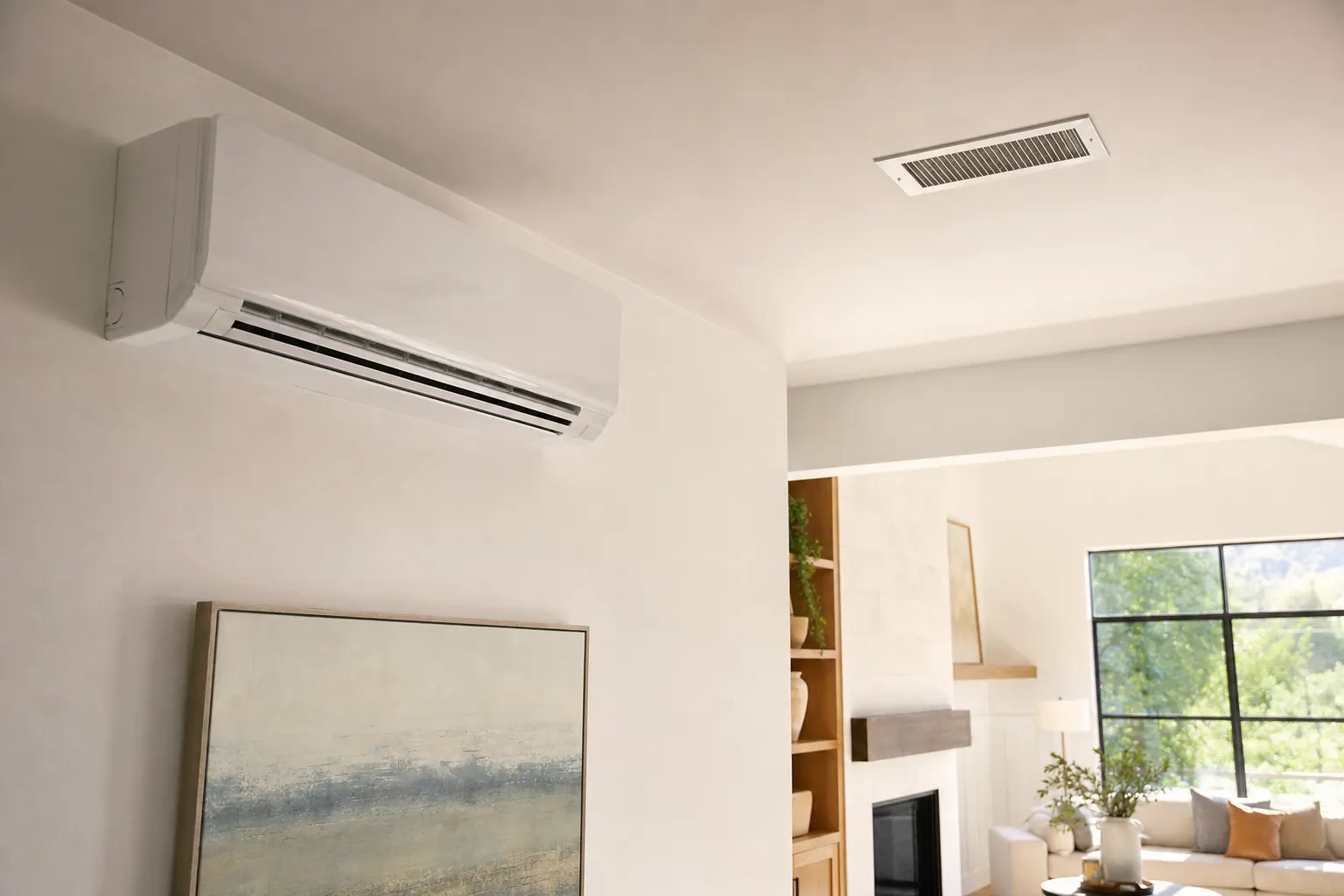
A ductless mini split still has an outdoor unit and refrigeration cycle, but indoors you see the delivery device. That may be a high-wall head, a ceiling cassette, a slim ducted unit for a small zone, or another compact indoor style. Each indoor unit has its own fan and coil and serves a specific room or group of rooms. Because there are no long duct runs for that zone, the system avoids duct losses and responds quickly. The trade-off is that coverage depends on indoor unit placement and air movement within the room.
In practice, central AC is usually best at making an entire house feel consistent from a single control point, while mini splits are best at letting different parts of the home behave differently. A bedroom can be cooler at night while a rarely used guest room stays warmer. A home office can be comfortable all afternoon without overcooling the rest of the house. That is useful, but it also means a mini split layout has to be planned carefully. One indoor head in a hallway is rarely a substitute for proper room-by-room design.
Comfort, zoning, and how rooms actually feel
Many homeowners assume central air always cools more evenly, but that is only true when the duct system is sound and the airflow has been balanced. In homes with long duct runs, a hot second floor, or rooms at the end of the line, one thermostat in a central location can hide big temperature differences. The thermostat may be satisfied while a back bedroom is still warm. That is why some central systems short-cycle in mild weather or run a long time on very hot days without making every room equally comfortable.
Mini splits handle that problem differently. Each indoor unit senses the conditions in its own zone, so a sunny room can call for more cooling than a shaded room. This is one of the biggest advantages of a mini split: targeted comfort without forcing the whole house to follow one room's needs. If one room is always too hot or too cold, a mini split can often solve that problem without replacing the main system. It is especially useful where the central system struggles to reach, such as finished basements, attic rooms, and enclosed porches.
There are comfort trade-offs on the mini split side too. Air comes out of an indoor head from a specific point in the room, so furniture layout, ceiling height, and door position matter. Bedrooms with doors closed may need their own unit rather than relying on air drifting from another room. Some people also notice the gentle fan sound or air movement from a wall-mounted head more than they would notice a quiet central register. For others, the ability to fine-tune each room outweighs that concern.
- Central AC usually works best for whole-house uniformity if the duct system is properly designed, sealed, and balanced.
- Mini splits usually work best for room-by-room control, additions, converted spaces, and chronic hot or cold spots.
- A single central thermostat cannot measure every room equally, especially in multi-story homes or homes with solar gain differences.
- One mini split head does not automatically cool several closed-off rooms well; door position and layout matter.
Efficiency and operating cost
Efficiency comparisons are more nuanced than many sales pitches suggest. Central AC equipment is commonly rated by SEER2, and many standard systems fall around 13. 4 to 17 SEER2, with higher-efficiency models available. Ductless mini splits often post higher efficiency ratings, and high-performance models can exceed the efficiency of many basic central systems. But equipment ratings are not utility bills. A very efficient mini split used to cool many separate rooms all day may cost more to run than expected, while a properly sized central system with tight ducts may perform better than its brochure suggests.
Duct losses are a real issue in some homes. If ducts run through a vented attic, crawlspace, or garage and are poorly sealed or insulated, the system can lose a meaningful amount of delivered cooling before air reaches the room. Mini splits avoid that kind of loss because there is no long duct network for the zone. That is one reason they often make sense in older homes without ducts or in additions where extending ductwork would be difficult. On the other hand, if your existing ducts are already in good condition and inside conditioned space, central air may give you strong performance without adding multiple visible indoor units.
How you use the home matters as much as the published efficiency number. A household that keeps only occupied rooms comfortable can benefit from mini split zoning. A household that wants the entire home at one stable temperature all day may find central AC simpler and not much more expensive to operate. Proper sizing is critical in both cases. Oversized equipment can short-cycle, remove less humidity, and waste energy. Undersized equipment may run constantly on design days and still struggle to hold setpoint.
Installation, appearance, and disruption
Installation is often where the decision becomes clear. If a home already has a usable duct system sized appropriately for cooling, central AC can be the more straightforward path. In many homes that means adding or replacing the outdoor condenser and indoor coil, and sometimes the air handler or furnace if the blower is incompatible or aging. If there are no ducts, however, installing central air can become a major remodeling project involving soffits, chases, ceiling or wall openings, register placement, and drywall repair. That can make central AC far more invasive than homeowners expect.
Mini splits usually require a smaller physical footprint for installation. The contractor still has to mount indoor units, route refrigerant lines and condensate drains, provide electrical service, and place the outdoor unit where clearances and noise are acceptable. There may be line-hide covers on exterior walls, or the lines may be concealed in a chase. Compared with full duct installation, disruption is often lower, especially in finished homes with limited access. But 'easier' does not mean trivial. Refrigerant piping length, vertical lift, drain routing, and service access all matter and should be designed by a qualified technician.
Appearance is a real deciding factor, not a superficial one. Central air hides almost everything except grilles and a thermostat. Mini split indoor heads are visible, and some homeowners never get used to that look. Ceiling cassettes and slim ducted mini split zones can reduce visibility, but they may raise installation complexity and cost. If aesthetics are high priority, ask early about indoor unit styles and exactly where they would go. Good placement affects both comfort and how noticeable the system feels in everyday life.
Costs, maintenance, and lifespan
Costs vary widely by region, home size, electrical capacity, equipment efficiency, and how difficult the installation is. For 2025-2026 planning purposes, replacing central AC equipment where suitable ducts already exist often lands roughly in the mid-thousands to low five figures. Full central air installation in a house without ducts can climb much higher because the ductwork is often the biggest part of the job. Ductless mini split pricing depends heavily on the number of zones. A single-zone system may be a moderate project, while a whole-home multi-zone design can rival or exceed the price of central AC.
It helps to think in cost categories instead of chasing one national average. The least expensive path is often replacing like-for-like equipment with minimal changes. The most expensive path is usually adding a new distribution system to a house that does not have one, or creating many mini split zones where several indoor units and long line sets are needed. Panel upgrades, condensate pumps, wall repair, and accessibility can also affect cost. A bid should spell out what is included, not just the equipment model.
Maintenance differs in a practical way. Central AC typically needs filter changes, coil cleaning as needed, drain maintenance, and periodic professional service. Mini splits also need regular filter cleaning, but each indoor head has its own filter and blower section. If neglected, those indoor units can accumulate dust and biological growth that affects airflow and odor. Lifespan depends on use and maintenance, but many homeowners can expect something like 12 to 20 years from either system under normal conditions. In coastal, very humid, or heavily used applications, life can be shorter.
- Typical cost depends more on the house and installation scope than on the equipment brand alone.
- Whole-home mini split systems are not automatically cheaper than central AC, especially with many zones.
- If ducts are missing or unusable, central air can become much more expensive because duct installation is labor-intensive.
- Ask what maintenance you will be doing regularly, because a four-head mini split has more indoor components to keep clean than one central air handler.
Best-fit scenarios and how to decide
Central AC is often the better fit when the home already has good ductwork, the goal is whole-house cooling from a simple control setup, and the household wants equipment mostly out of sight. It also pairs naturally with an existing forced-air furnace. If your current comfort complaints are minor and the duct system is fundamentally sound, central air replacement may be the most practical option. In a resale context, it is also the system many buyers expect in homes built around ducts.
A ductless mini split is often the stronger choice for homes without ducts, historic homes where adding ducts would be disruptive, additions and accessory spaces, and homes with chronic room-by-room comfort problems. It is also a good choice if occupancy varies a lot by room and you genuinely plan to use zoning. Homeowners sometimes like mini splits because they can solve one comfort problem now, then add zones later if the outdoor unit and design allow for it. That staged approach can be useful, but it should still be designed as a system rather than pieced together casually.
The right answer often comes from a load calculation and a frank look at the house rather than a generic preference for one technology. A contractor should evaluate insulation levels, window orientation, room usage, existing duct leakage and sizing, electrical capacity, and whether humidity control is a concern. HVAC Rescue can help you find independent HVAC contractors so you can compare assessments and quotes. Ask each company why the proposed system fits your layout, not just what efficiency number it has. The best choice is the one that matches the house, the comfort problem, and the way you actually live in the space.
Sources and fact-checking
Reviewed July 25, 2026. We favor primary government and standards sources for safety, efficiency, and regulatory claims. These references support the technical and consumer guidance on this page.