Reviewed July 25, 2026
HVAC Rescue Editorial Team
Editorial StandardsStart with safety and the real decision
At some point, most homeowners face the same question: should this HVAC system be repaired again, or is it time to replace it? There is no single rule that fits every house. The right answer depends on the equipment’s age and condition, the type of failure, repair history, utility costs, comfort problems, and how long you expect to stay in the home. A ten-year-old furnace with a bad igniter is a different decision from a nineteen-year-old air conditioner with a failed compressor and a history of leaks.
The goal is not to chase the lowest immediate bill. It is to compare short-term repair cost against the remaining useful life of the equipment and the benefits of replacement. Sometimes a repair buys several good years at a reasonable cost. Other times, a major repair only postpones a replacement that is already hard to avoid. A licensed HVAC contractor can inspect the system, identify the failed components, and explain the likely next costs instead of discussing the current failure in isolation.
Age matters, but age alone should not decide it
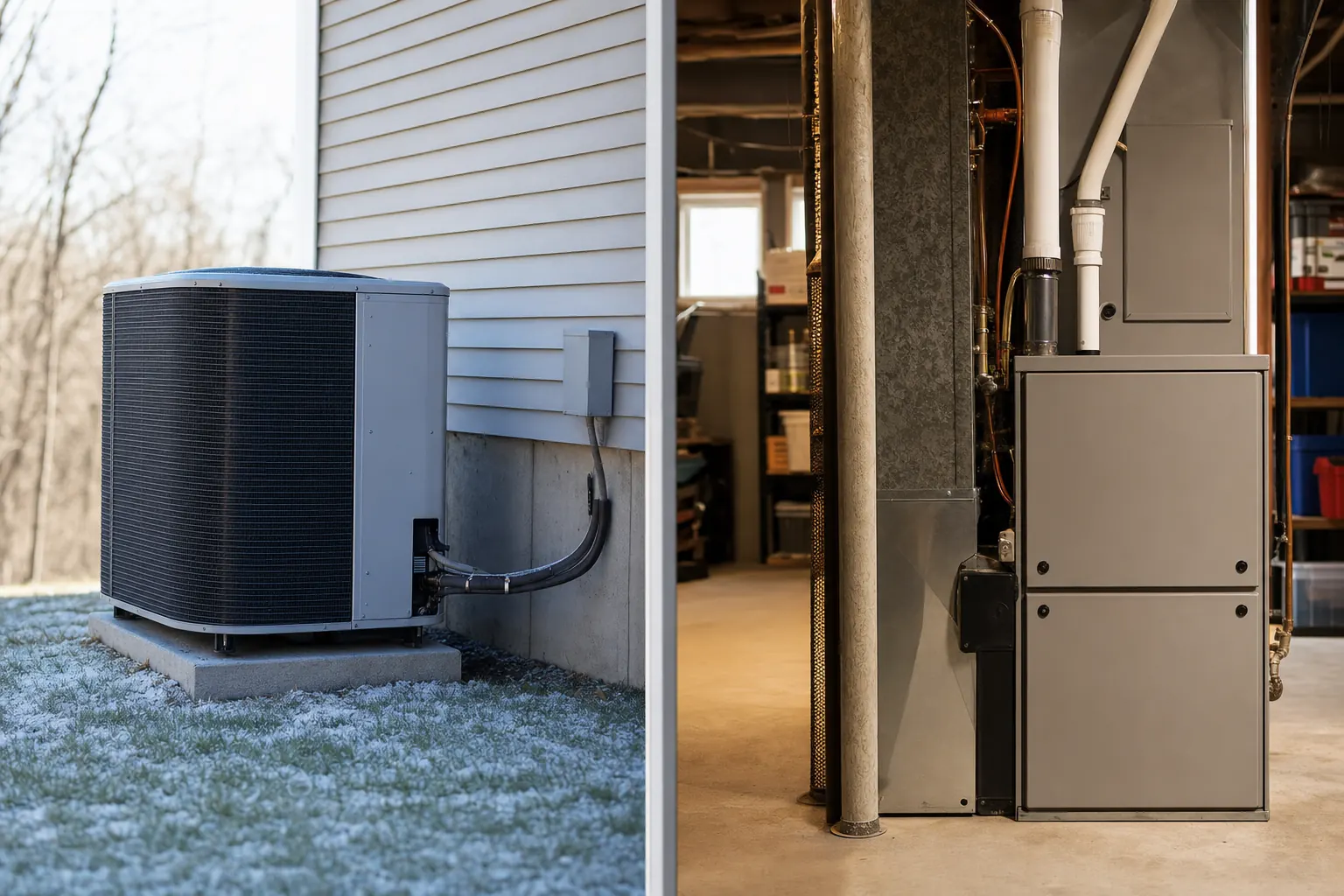
Age is one of the strongest signals because HVAC systems are collections of motors, controls, coils, burners, heat exchangers, and moving refrigerant. Parts wear out unevenly. Typical service life is often around 15 to 20 years for furnaces, about 10 to 15 years for central air conditioners and heat pumps, and sometimes 20 years or more for boilers if maintained well. Coastal environments, heavy use, poor maintenance, oversizing, and installation errors can shorten those ranges. Mild climates, clean equipment, and good maintenance can stretch them.
A newer system with an isolated failure is often worth repairing. An older system near the end of its expected life needs a harder look, especially if the failed part is major. A blower capacitor or contactor on a nine-year-old air conditioner is different from a compressor on a fifteen-year-old unit. Likewise, a pressure switch or igniter on a midlife furnace usually does not justify replacement by itself, while a cracked heat exchanger, obsolete control board, or repeated ignition problems on an old furnace may point the other way.
- Under about 8 years old, many systems are still strong candidates for repair unless the failure is severe, there are installation defects, or major parts are unavailable.
- Between roughly 8 and 12 years, the decision often depends on repair history, efficiency, refrigerant type, and whether the current issue is minor or major.
- After about 12 to 15 years for cooling equipment, replacement starts to make more sense when major components fail or comfort and energy use have clearly worsened.
- After about 15 to 20 years for furnaces, a major safety-related issue or repeated breakdown pattern often makes replacement the more practical path.
- If the manufacturer has discontinued key parts or lead times are long, even a technically repairable system can become a poor value to keep.
Look at the repair itself, not just the invoice total
The kind of repair matters as much as the price. Minor electrical repairs, drain line work, capacitors, contactors, relays, flame sensors, and igniters are usually very different decisions from compressor replacement, evaporator coil replacement, condenser coil replacement, induced draft motor replacement, or major control failures. A small repair on a healthy system can be sensible even if the equipment is older. A major repair on old equipment may restore operation without solving the bigger problem that more parts are aging behind it.
Typical 2025–2026 U. S. repair costs vary widely by region, equipment type, and access, but rough estimates help frame the choice. Homeowners commonly see several hundred dollars for simpler electrical or ignition repairs, often around $150 to $700. Blower motors, inducer motors, control boards, and some fan motor repairs often land roughly in the $400 to $1,500 range. Evaporator coils frequently run around $1,500 to $3,500 installed, and compressors often land around $1,800 to $4,000 or more, depending on warranty status, refrigerant, and labor complexity.
Cost ranges are estimates developed from standardized project scopes and reviewed pricing inputs. Government labor and regional cost data are used where applicable. See our Pricing Methodology for the exact sources, calculations, and review date. Actual prices vary by property, scope, materials or equipment, location, and provider.
If one repair restores dependable service and the rest of the system tests well, repairing is often rational. If the current failure is one of several larger repairs in the last two or three years, that invoice should be viewed in context. A contractor should be able to say not only what failed, but also what else shows wear, whether refrigerant pressures and temperature splits look normal, whether the heat exchanger or coil condition is concerning, and whether airflow problems are pushing the equipment harder than it should run.
Use repair history and remaining life as a simple decision filter
Many homeowners have heard versions of the old “50 percent rule,” meaning if a repair costs half as much as replacement, replace. That rule can be too crude on its own. A better way is to compare the cost of the repair, the expected remaining life if repaired, and the likelihood of near-future failures. A $900 repair that likely buys five more years is a much better value than a $2,500 repair that may buy only one or two unpredictable seasons on a worn-out system.
One practical framework is to total what has been spent recently and ask what the next failure is likely to be. If the system needed a capacitor last summer, a blower motor this winter, and now a coil repair is being discussed, the problem is not just the current bill. It is the pattern. On the other hand, a system that has run for years with little trouble and now needs one moderate repair may still be a good candidate to keep, especially if your budget is tight or you expect to move soon.
- Repair is usually easier to justify when the system has had few prior repairs, the current failure is limited, and the equipment still has several reasonable years left.
- Replacement becomes more attractive when breakdowns are becoming annual, parts are stacking up, and the system’s age puts it near the end of normal service life.
- A major repair right after another major repair is often a warning that you are paying for a series of end-of-life failures rather than one bad part.
- If a manufacturer warranty still covers a major component, repair may make more sense, but labor, refrigerant, shipping, and diagnostic charges can still be significant.
- If you plan to stay in the house for many years, long-term operating cost and reliability deserve more weight than if you expect to sell soon.
Efficiency, energy bills, and comfort can tip the balance
Older systems are usually less efficient than modern equipment, but efficiency gains matter differently from one home to another. If utility costs are moderate and the existing system runs acceptably, replacement may not pay back quickly on energy savings alone. If cooling or heating bills have climbed, the system short-cycles, rooms are uneven, humidity stays high in summer, or the equipment runs constantly in weather it used to handle better, replacement deserves stronger consideration. Comfort and runtime are part of the cost, even though they do not appear on a repair invoice.
For air conditioning and heat pumps, older efficiency ratings can be far below current equipment. New systems also often have better humidity control, quieter operation, and in some cases variable-speed blowers or inverter-driven compressors that run longer at lower output. For furnaces, higher AFUE ratings can lower fuel use, but duct leakage, poor return air, oversized equipment, and thermostat setup often affect real-world results as much as the nameplate rating. Replacing equipment without addressing airflow or duct issues can leave comfort problems only partly solved.
This is why the question should not be limited to “repair versus replace the box. ” Ask what problem you are trying to solve. If the home has hot upstairs rooms, weak airflow at distant vents, persistent humidity, loud starts and stops, or excessive dust, a system replacement quote should also examine duct condition, static pressure, filtration, return sizing, and equipment sizing. A new unit may improve efficiency, but it will not automatically fix comfort issues caused by the distribution system.
Replacement costs, refrigerant, and what changes the quote
Full replacement costs are high enough that homeowners need a scope-specific comparison. Central air conditioner replacement, heat pump replacement, furnace-only replacement, and a full furnace-and-AC replacement are separate standardized scenarios and should not share a blended range. Size, efficiency, line-set condition, electrical work, regional labor, and whether both heating and cooling equipment are included determine which pricing-table scenario applies. Premium or complex systems can extend beyond the standard scope.
Several factors swing the number. Tonnage, efficiency tier, single-stage versus two-stage or variable-speed equipment, brand, venting changes, condensate drainage, filter cabinet upgrades, thermostat compatibility, attic or crawlspace access, crane needs, code updates, and duct modifications all matter. So does refrigerant. Many older air conditioners use R-410A or, on older systems, R-22. R-22 is phased out and expensive to source, so major repairs on R-22 equipment often push the decision toward replacement. Refrigerant handling and sealed-system work should always be left to a qualified licensed technician.
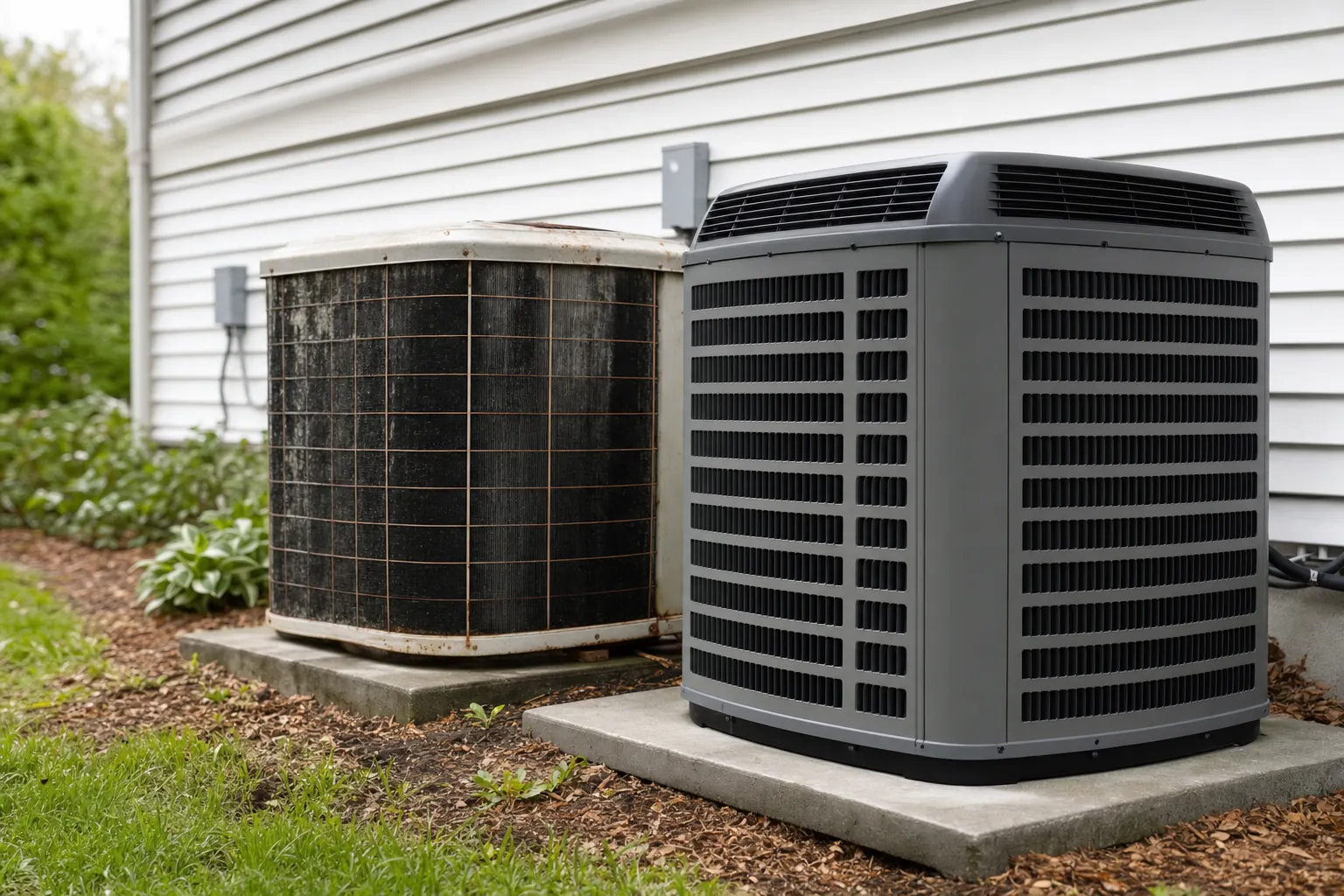
Replacement also creates a chance to right-size the system. Bigger is not better. Oversized cooling equipment can short-cycle, cool unevenly, and remove less humidity. Proper sizing should be based on load calculations, not only the size of the old equipment. If the existing system was oversized from the start, replacing it with the same capacity can repeat the same comfort and moisture problems for another decade or more.
How to make the decision and what to ask a contractor
A good decision is usually built from a short list of facts: equipment age, exact failed part, repair estimate, known condition of major components, refrigerant type, repair history, utility bills, comfort complaints, and how long you plan to remain in the home. Ask for the likely best-case and worst-case outcome of repair. A straightforward contractor should be willing to say, for example, that a repair may reasonably buy several years, or that it may restore operation but the compressor, heat exchanger, or coil condition makes additional failures likely.
If replacement is being discussed, ask for more than one option. A basic replacement and a higher-efficiency or better-featured option can help you compare value. Ask what accessories or corrections are truly needed versus optional. Ask what is included in writing, what permits apply, and whether the existing duct system appears adequate. HVAC Rescue can help homeowners find independent contractors for opinions and estimates, which is useful when the choice is expensive or the diagnosis involves a major component.
- What exactly failed, and is this a minor repair, a major repair, or a symptom of broader system decline?
- How old is the equipment, and what remaining service life would you expect if this repair is completed?
- Are there signs of additional wear such as coil corrosion, compressor stress, blower issues, heat exchanger concerns, poor combustion, or airflow restrictions?
- What refrigerant does the cooling system use, and how does that affect future repair cost and parts availability?
- If replacing, was the proposed size based on a load calculation and does the quote address duct or airflow problems if they exist?
- What are the total estimated costs of repair versus replacement, including likely near-term follow-up costs, not just today’s invoice?
In many homes, the answer is not emotional and not purely financial. It is a practical judgment about risk. Repair makes sense when the system is not too old, the problem is contained, and the equipment still has useful life. Replacement makes sense when expensive failures begin to stack up, comfort and efficiency have noticeably declined, or safety, refrigerant, and parts-availability issues make future repairs harder to justify. The better the diagnosis, the better the decision.
Sources and fact-checking
Reviewed July 25, 2026. We favor primary government and standards sources for safety, efficiency, and regulatory claims. These references support the technical and consumer guidance on this page.