Reviewed July 25, 2026
HVAC Rescue Editorial Team
Editorial StandardsHow do you maintain a mini-split without making it worse?
The short answer is this: clean the washable filters regularly, keep the indoor head and outdoor unit unobstructed, and have a qualified technician deep-clean the indoor coil, blower wheel, and drain system when airflow drops, odours start, or dirt has built up beyond the filters. Most mini-split problems that owners notice first are not refrigerant problems. They are airflow and moisture problems. Dust gets past the coarse mesh filters, sticks to the wet evaporator coil and blower wheel, and turns into biofilm that smells musty and reduces performance.
If you smell gas, hear a carbon monoxide alarm, or notice smoke or a burning-electrical smell, everyone should leave the building immediately and call the gas utility or emergency services from outside. Do not treat that as routine HVAC maintenance. For ordinary mini-split care, the owner-safe work is limited to washing filters, gently cleaning accessible plastic surfaces and louvers, and watching for signs of drainage trouble. Opening electrical compartments, working on high-voltage parts, or touching the sealed refrigerant system belongs to a qualified licensed technician.
The washable-filter routine most owners skip
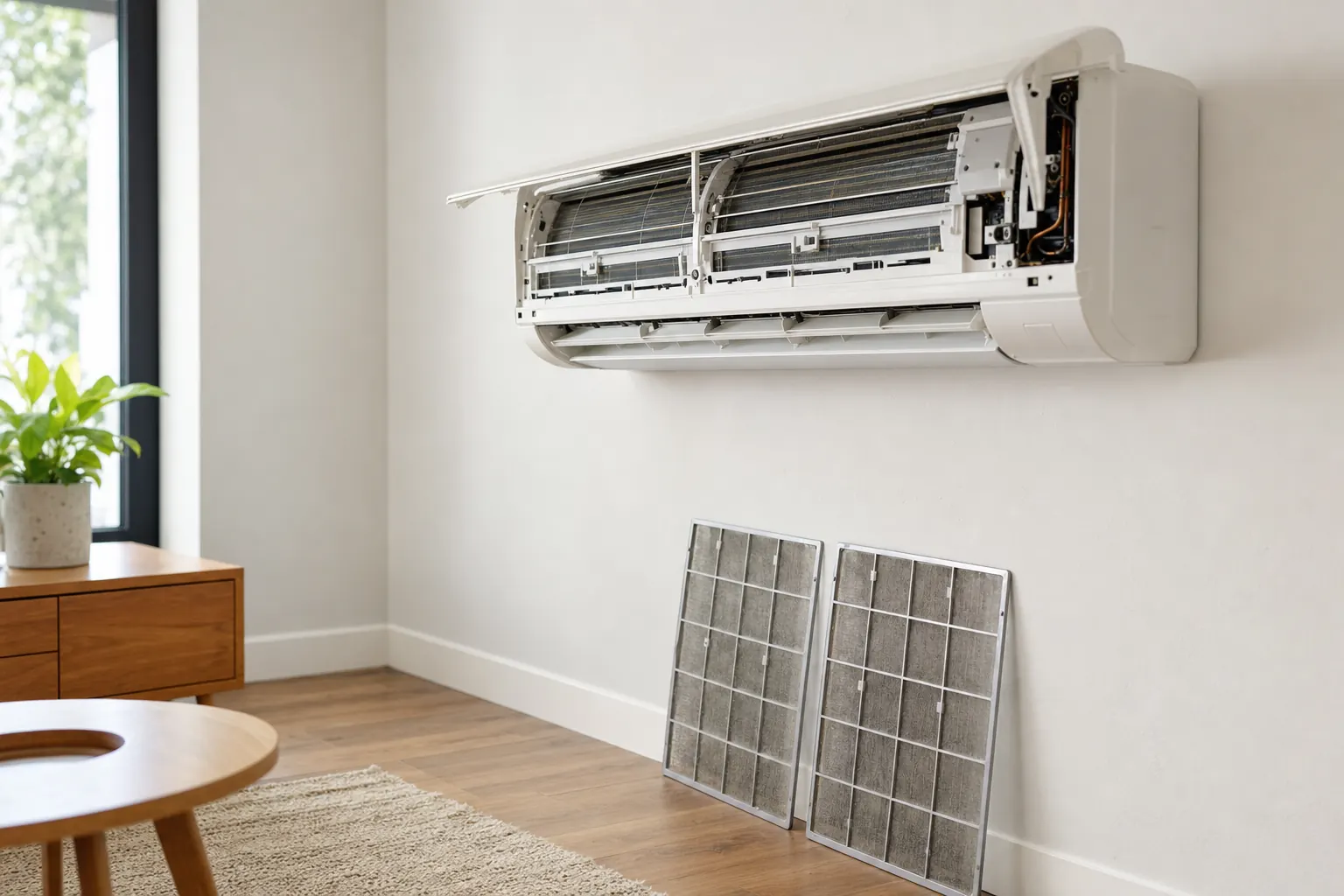
Many owners assume washable filters are low-maintenance because they are reusable. That is exactly why they get neglected. On a wall-mounted mini-split, the front cover lifts up to reveal one or two lightweight mesh screens. Those screens catch larger dust, lint, and hair, but they are much more open than a typical 1-inch pleated furnace filter. If they load up, airflow drops quickly. A drop in airflow means less cooling, poorer dehumidification, and a coil that stays wetter longer, which encourages odours.
A practical routine is every two to four weeks during heavy cooling or heating use, then monthly in lighter seasons. Homes with shedding pets, cooking residue, candles, renovation dust, or nearby traffic may need more frequent cleaning. Wash the mesh filters with lukewarm water and a small amount of mild dish soap if needed, rinse thoroughly, and let them dry completely before reinstalling. Do not use very hot water, aggressive brushes, bleach, or solvent cleaners. The frame and mesh are easy to warp, and a damaged filter can rattle or fit poorly.
- Check the filters every two to four weeks in peak season, not just when the unit starts looking dirty.
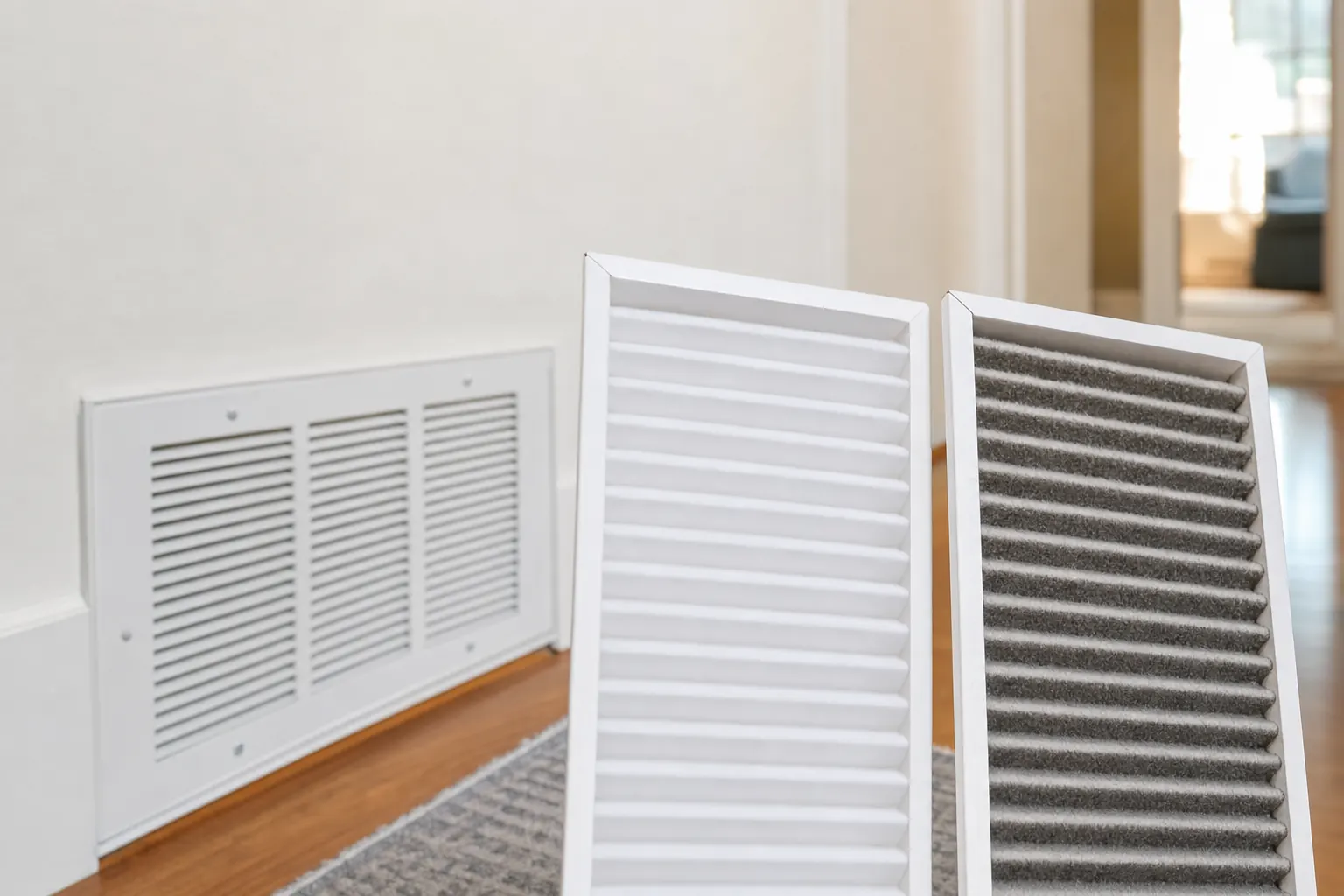
- If the filters look gray or fuzzy, airflow has already been reduced enough to affect performance.
- Let filters dry fully before putting them back, because trapped moisture can add to odour and biofilm growth.
- If your unit also has small add-on deodorizing or electrostatic inserts, follow the model instructions because those are often not washed the same way as the mesh screens.
Why blower wheels grow biofilm and create the classic musty smell
The smell many people describe as musty, sour, dirty sock-like, or damp-basement-like usually comes from microbial growth on the indoor coil, blower wheel, or drain pan area. The evaporator coil gets cold during cooling mode, so moisture from the air condenses on it. That moisture is normal. The problem starts when fine dust and oily residue make it past the filters and stick to wet surfaces. Inside the dark plastic cabinet, that mix can turn into slime or film. Every time the fan runs, air passes over it and carries the smell into the room.
The blower wheel is a common culprit because its many curved fins are hard to see and easy to ignore. As grime builds on the wheel, each fin moves less air. That can make the unit louder, weaker, and smellier at the same time. Some owners try to solve this with room sprays, disinfectant foggers, or stronger fragrance settings. Those do not remove the film. They usually mask the smell briefly while the underlying dirt remains. If the smell returns soon after the filters are cleaned, the blower wheel and coil likely need a deeper cleaning than the owner can do safely.
What you can clean yourself, and what deep cleaning actually involves
Owner-safe cleaning is mostly surface-level. You can wash the filters, wipe the exterior cabinet with a damp cloth, and gently dust the supply louvers and visible intake area. You can also keep furniture, curtains, and boxes away from the indoor head so it can breathe. Outside, the condenser should have open space around it, with leaves, weeds, and cottonwood fluff cleared away. That outdoor unit still should not be opened by a homeowner, because there are sharp fins, electrical components, and high-voltage parts inside.
A real mini-split deep cleaning is more involved than spraying the visible coil face with a can from the hardware store. A technician typically disassembles enough of the indoor head to access the evaporator coil, drain pan area, and especially the blower wheel. They may use a cleaning bib or catch bag around the unit, approved coil cleaner, low-pressure water, and tools to flush debris from the wheel fins and cabinet. The goal is to remove the film, not just perfume it. If contamination is heavy, the blower wheel may need to be removed for proper washing rather than cleaned in place.
Mini-split deep-cleaning quotes should identify the number of indoor heads, access conditions, and whether blower-wheel removal is included, with additional heads listed separately. A basic maintenance visit may cost less, but it may not include full blower-wheel cleaning. Asking exactly what will be cleaned matters. "Coil cleaning" and "deep clean" are not always the same thing.
Condensate-drain problems that are common on wall cassettes
Wall-mounted mini-split heads make condensate every time they cool and dehumidify. That water should collect in the drain pan and flow through a small condensate line to the outside or to a pump, depending on the installation. Because the unit is high on the wall, the drain setup can be more finicky than homeowners expect. A slight sag, partial blockage, algae or slime in the pan or tube, poor pitch, or a weak condensate pump can cause dripping from the front of the unit or water marks on the wall below.
One reason wall cassettes are prone to nuisance drain issues is that they are compact. The drain pan and outlet area are small, and the line routing may snake through a line-hide cover, wall cavity, or attic before it exits. If the installer relied on a pump, there is another component that can fail or clog. You may hear gurgling, see intermittent drips, or notice the unit leaks only on very humid days. That pattern often points to a drainage limitation rather than a catastrophic part failure.
What should an owner do? Watch for symptoms and shut the unit off if it is actively dripping indoors. Check the obvious things only: are the filters badly clogged, is the unit tilted oddly, and is there visible slime at the discharge point outside if the line is accessible? Beyond that, drain service is usually a technician job because reaching the pan outlet or pump often requires partial disassembly. A proper visit may include clearing the line, cleaning the pan area, testing pump operation, and confirming the drain slope is correct.
Signs your mini-split needs professional cleaning or service
A mini-split can run while slowly losing performance, so the warning signs are not always dramatic. The most common pattern is that the unit still turns on and responds to the remote, but the room takes longer to cool or heat, airflow feels weaker, and the smell gets worse when the fan starts. Some owners also notice dark specks near the discharge louvers, a wet or sour smell strongest after the unit cycles off, or small drips from the front edge of the indoor head.
Those symptoms usually justify a service call, especially if filter cleaning did not solve them. Other reasons include ice on the indoor unit, repeated pump alarms if your system has a condensate pump, loud fan imbalance that suggests a dirty blower wheel, or visible biological growth inside the discharge opening. Refrigerant issues are possible, but they are not the first or only explanation for poor cooling. A good inspection should separate airflow, cleanliness, and drainage problems from sealed-system faults.
- Call for service if the unit leaks indoors, even if the leak stops later, because intermittent drain problems tend to return.
- Call if odours persist after the filters were properly washed and dried, because the source is likely deeper inside the head.
- Call if airflow is uneven or much weaker than before, especially with a clean filter, because blower-wheel buildup is common.
- Call if the outdoor unit is buried in lint, leaves, or weeds and you cannot safely clear around it without opening the cabinet.
- Call if the system ices up, trips breakers, or shows error codes, because those issues can involve electrical or sealed-system faults.
How often to clean, what to ask a contractor, and how to prevent the smell from coming back
For most households, owner cleaning means checking filters every two to four weeks in heavy season and washing them whenever dust buildup is visible. Professional cleaning intervals depend on use and environment. A single-zone bedroom unit in a clean home may go a long time before it needs deep cleaning. A living-room unit that runs daily around pets, cooking grease, candles, or open windows may need attention much sooner. Time alone is not the best trigger. Smell, airflow, visible dirt, and drainage symptoms are better signals.
When you speak with a contractor, ask what the scope includes. Good questions are: Will the blower wheel be inspected directly? Is the drain pan and condensate line included? Will the indoor head be partially disassembled? Is the outdoor coil cleaning included too? If there is a leak, will the pump and drain slope be checked? These questions help you compare estimates that may otherwise sound similar. For budgeting, many homeowners see routine mini-split maintenance visits in the broad range of roughly $150 to $350, while more intensive cleaning is often higher.
Cost ranges are estimates developed from standardized project scopes and reviewed pricing inputs. Government labor and regional cost data are used where applicable. See our Pricing Methodology for the exact sources, calculations, and review date. Actual prices vary by property, scope, materials or equipment, location, and provider.
To reduce repeat odours, keep up with the filters, run the unit in a way that actually removes humidity, and avoid shutting it down for long stretches while the interior is still damp. Some systems have a fan-dry or coil-dry feature that runs the fan after cooling to help dry the coil; if your model has it, use it. Keep doors and windows closed during humid weather so the unit is not constantly overwhelmed. If a smell returns quickly after a claimed deep clean, that usually means the blower wheel, pan, or drain area was not thoroughly cleaned or there is an ongoing drainage problem.
Sources and fact-checking
Reviewed July 25, 2026. We favor primary government and standards sources for safety, efficiency, and regulatory claims. These references support the technical and consumer guidance on this page.
- Ductless (mini-split) heat pumpsU.S. Department of Energy Building America Solution CenterDuctless system design, zoning, installation tradeoffs, and appropriate applications.
- Heating and cooling maintenance checklistENERGY STARProfessional tune-up scope, filters, airflow, coils, drains, and safety checks.