Reviewed July 22, 2026
HVAC Rescue Editorial Team
Editorial StandardsFor most homes, the answer is: replace a standard 1-inch pleated filter every 60 to 90 days, and a 4- or 5-inch media filter every 6 to 12 months. Cheap 1-inch fiberglass filters need changing monthly. Cut those intervals roughly in half if you have shedding pets, someone with allergies or asthma in the house, or a system fan that runs continuously. And regardless of filter type, ENERGY STAR recommends checking the filter every month during heavy-use months — midsummer and midwinter — because that is when it loads up fastest.
The "90 days" printed on most filter packaging is a reasonable average, not a rule. The real schedule depends on the filter's thickness and filtration level, how many people and animals live in the house, and how hard the system is running. Getting it right matters more than most homeowners realize: the U. S. Department of Energy notes that replacing a dirty, clogged filter with a clean one can lower an air conditioner's energy consumption by 5% to 15%, and a badly neglected filter is behind a surprising share of frozen coils and overheating furnaces. This guide lays out an honest schedule by filter type, explains what actually goes wrong when filters sit unchanged, and covers how to pick a MERV rating without overloading your blower.
The Replacement Schedule, by Filter Type and Household
- 1-inch fiberglass (MERV 1-4): every 30 days. These flat, spun-glass filters cost about $2 to $5 and exist mainly to keep large debris out of the equipment; they do very little for air quality.
- 1-inch pleated (MERV 8-11): every 60 to 90 days in an average home, typically $5 to $15 each. This is the most common filter in American homes and the source of the standard 90-day advice.
- 2-inch pleated: every 3 months. The extra pleat depth adds surface area, so these load more slowly than 1-inch filters at the same rating.
- 4- to 5-inch media filters (MERV 11-13): every 6 to 12 months, at roughly $20 to $40 per filter. The deep pleats hold several times the dust of a 1-inch filter, which is why they last so much longer. Homes with pets or allergies should lean toward the 6-month end.
- One shedding dog or cat: shorten each interval by about a month — a 90-day filter becomes a 60-day filter.
- Multiple pets, or allergies or asthma in the household: change 1-inch filters every 30 to 45 days, and check media filters at the halfway point of their rated life.
- Continuous fan (thermostat fan set to ON), active remodeling dust, or wildfire smoke in the air: check every 2 to 4 weeks. Under these conditions a filter can load in a fraction of its normal life.
Cost ranges are estimates developed from standardized project scopes and reviewed pricing inputs. Government labor and regional cost data are used where applicable. See our Pricing Methodology for the exact sources, calculations, and review date. Actual prices vary by property, scope, materials or equipment, location, and provider.
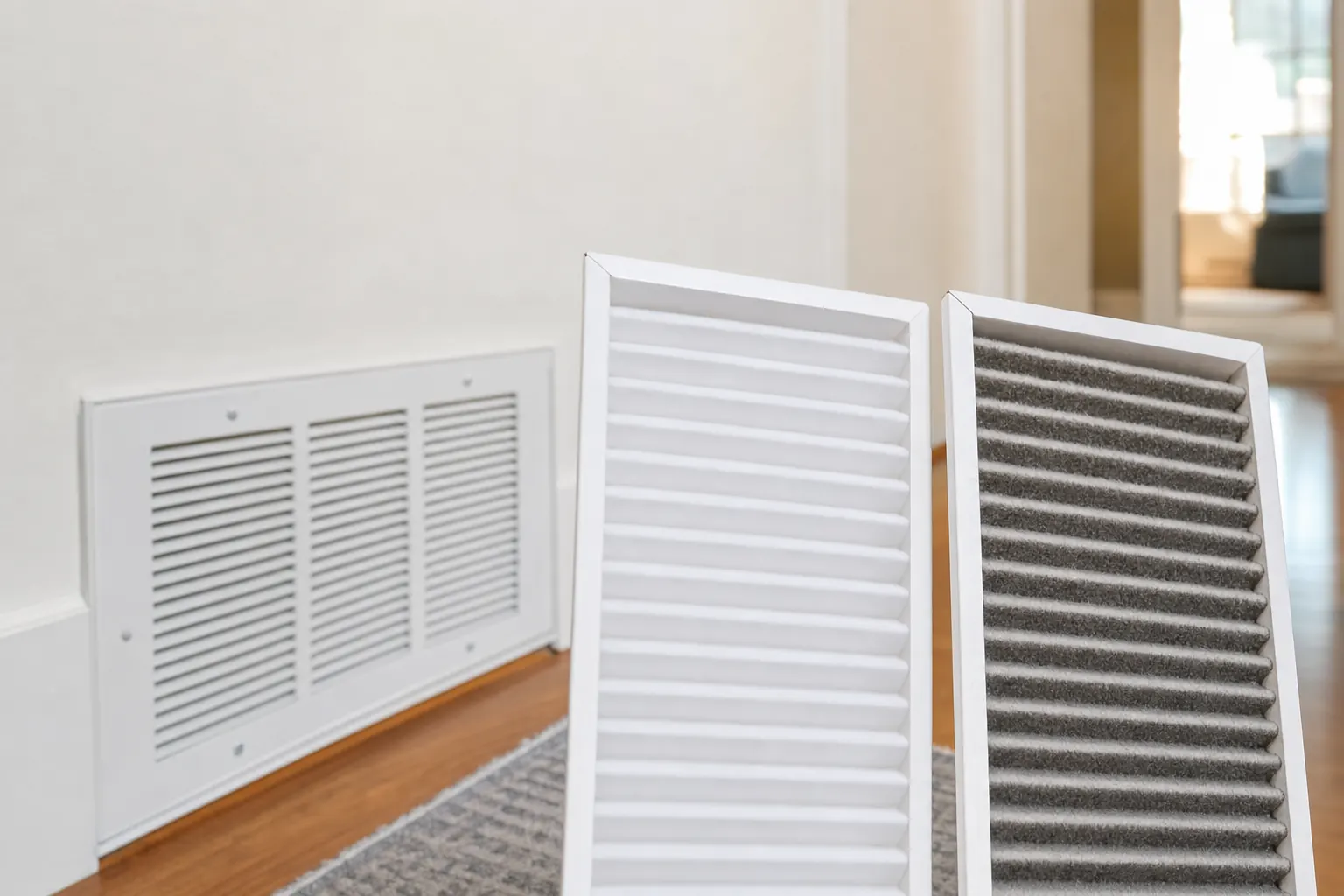
Treat every interval above as a starting point and let the filter itself have the final word. Pull it out and hold it up to a light: if you cannot see light passing through the media, it is done, whatever the calendar says. A 30-second monthly glance during summer and winter is the whole discipline. Some homeowners write the install date on the cardboard frame with a marker; others set a recurring phone reminder for the first of the month. Either beats trusting your memory.
What Actually Happens When a Filter Goes Unchanged
In cooling season, a clogged filter starves the indoor coil of airflow. With too little warm air moving across it, the coil's surface drops below freezing, moisture in the air freezes onto it, and the ice blocks airflow even further in a feedback loop. The symptoms are weak, lukewarm air from the vents, and sometimes water around the air handler when the ice thaws faster than the drain pan can carry it away. Meanwhile the system runs longer to reach the thermostat setpoint, which is where the Department of Energy's 5% to 15% energy penalty shows up on your bill. Repeated freeze-ups are also hard on the compressor — the most expensive component in the system.
In heating season, the same airflow starvation runs the other direction. A furnace that cannot move enough air across its heat exchanger overheats, and its high-limit switch shuts the burners down to protect it. You will notice short cycling — the furnace fires, runs a few minutes, and shuts off — while the house struggles to hold temperature. Years of repeated overheating stress the heat exchanger metal and are one of the contributors to cracking, a failure that can allow combustion gases, including carbon monoxide, to mix with household air. A dirty filter also forces the blower motor to fight extra resistance, shortening its life; blower repairs commonly run several hundred dollars. And whatever a saturated filter stops catching ends up on the coil and in the ducts, where professional cleaning costs far more than a $10 filter.
How to Find Your Filter Size and Change It Right
- 1
Locate the filter
Most systems have one filter, either behind a return-air grille on a wall or ceiling, or in a slot where the return duct meets the furnace or air handler. Some larger homes have a filter at every return grille — find them all.
- 2
Read the size on the frame
The size is printed on the cardboard edge, such as 16x25x1 or 20x25x4. That is the nominal size, which typically runs about a quarter to half an inch larger than the filter's actual measured dimensions — buy by the nominal size printed on the old filter.
- 3
Measure if the frame is unreadable
Measure length, width, and depth in inches and round each up to the nearest standard size. A filter measuring 15. 5 by 24. 5 by 0. 75 inches is a nominal 16x25x1.
- 4
Turn the system off before swapping
Switch the thermostat to OFF so the blower is not pulling unfiltered air — or tugging at the new filter — while the slot is open.
- 5
Point the airflow arrow the right way
Every filter has an arrow on the frame showing the direction of airflow: toward the furnace or air handler, away from the return grille. Installed backward, a filter holds less dust and can collapse into the duct.
- 6
Date it and stock up
Write the install date on the frame, buy filters by the multi-pack to cut the per-filter cost, and set a recurring reminder matched to your schedule from the list above.
Filters that turn filthy in a couple of weeks, or airflow that stays weak even with a fresh filter, usually point to a duct or blower problem worth diagnosing. HVAC Rescue can connect you with independent HVAC professionals who can measure your system's airflow and inspect the ductwork.
(866) 373-0169MERV Ratings Without the Oversell
MERV — Minimum Efficiency Reporting Value — rates how well a filter captures particles; residential filters generally run from MERV 1 to 16. MERV 8 handles household dust, pollen, and dust mites and is a sensible baseline for most homes. MERV 11 adds finer dust and pet dander, a reasonable step up for pet owners and mild allergies. MERV 13 captures a meaningful share of smoke and other fine particles, which is why the EPA recommends MERV 13 — or the highest rating the system can accommodate — for better indoor air quality. That qualifier is doing a lot of work, and it is the part filter marketing tends to skip.
Every step up in MERV increases the filter's resistance to airflow, called pressure drop, and the resistance climbs further as the filter loads with dust. A MERV 13 filter squeezed into a 1-inch slot can restrict airflow enough — especially on older systems with fixed-speed blower motors — to cause the very problems you change filters to avoid: frozen coils, overheating furnaces, and longer run times. The honest guidance is that in a 1-inch slot, MERV 8 to 11 is the safe zone for most systems. If you want MERV 13 filtration, the right way to get it is a 4- or 5-inch media cabinet, whose extra surface area delivers high filtration at low resistance. If you are not sure what your blower can handle, ask a technician to measure static pressure at your next maintenance visit — it is a quick test that tells you exactly how much filter your system tolerates.
Sources and fact-checking
Reviewed July 22, 2026. We favor primary government and standards sources for safety, efficiency, and regulatory claims. These references support the technical and consumer guidance on this page.
- Air cleaners and air filters in the homeU.S. Environmental Protection AgencyFilter performance, indoor-air limitations, and proper use of portable and HVAC filters.
- Heating and cooling maintenance checklistENERGY STARProfessional tune-up scope, filters, airflow, coils, drains, and safety checks.
- Clean heating and coolingENERGY STARCentral-system sizing, efficiency, replacement planning, installation, and maintenance.