Quick summary
Match what you notice to a safe next step
These observations can narrow the starting service, but they do not confirm which part has failed.
What you notice
High dust or fiber load inside the home
What it may point to
Recent remodeling, sanding, frequent vacuuming without a HEPA filter, many pets, or heavy foot traffic can overwhelm a filter fast, so you may need both better housekeeping and a filter choice matched to your system.
Safe next action
Note when the change began and whether the system is running
What you notice
Leaky return ducts or return plenum
What it may point to
Gaps on the return side can suck insulation, attic dust, crawlspace dirt, or wall cavity debris straight to the filter, which often makes the filter turn gray-brown much faster than normal.
Safe next action
Compare nearby rooms and keep vents open
What you notice
Wrong size filter or a poor seal around the filter rack
What it may point to
If the filter is loose, bowed, or the slot does not seal, air can whistle around it and leave dirt streaks, causing uneven loading and allowing debris deeper into the blower compartment.
Safe next action
Record any code, sound, smell, or weather event
What you notice
Blower airflow or static-pressure issue
What it may point to
A high fan speed, oversized return grille, or duct design that pulls a lot of particulate toward the return can make the filter look used up sooner and can raise system strain if the filter becomes restrictive too quickly.
Safe next action
Check the filter and arrange an evaluation if it persists
Safe things to check
- Confirm the thermostat mode and setpoint
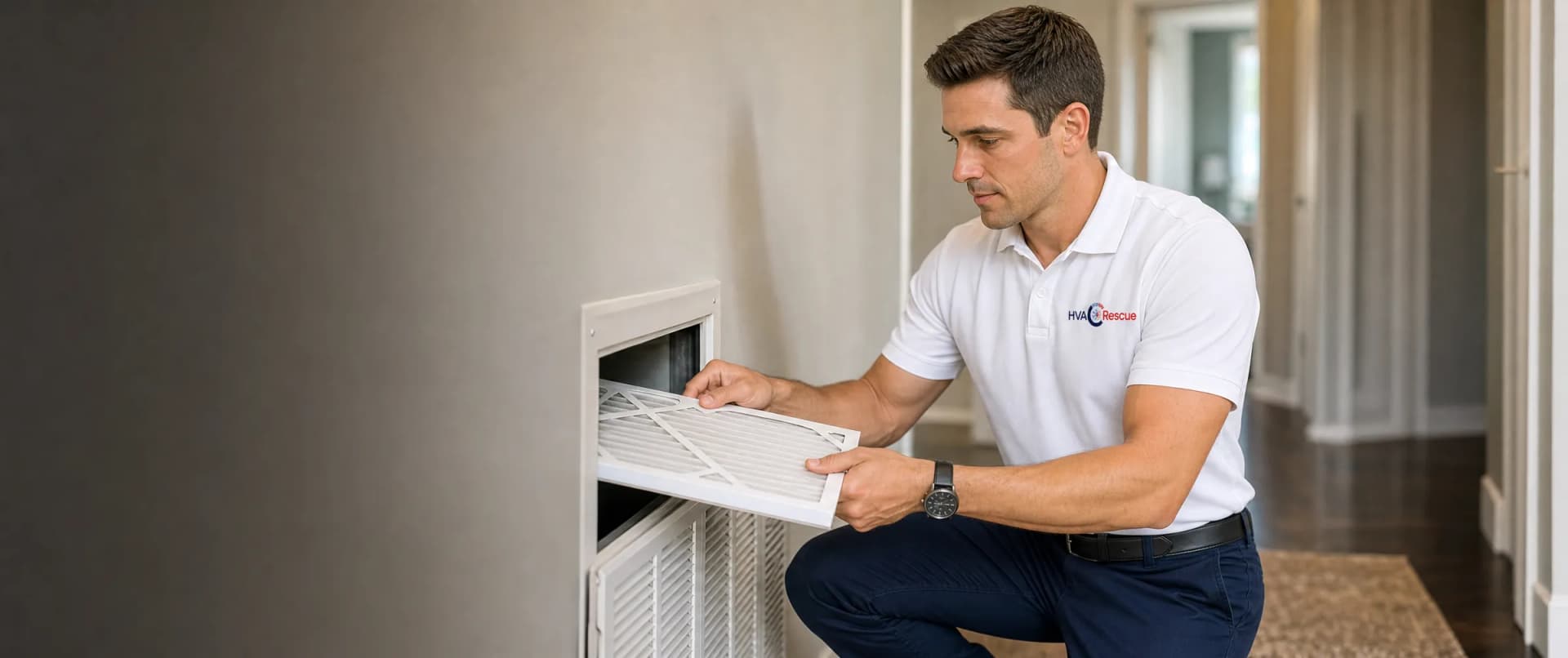
- Inspect the air filter and replace it if visibly dirty
- Make sure visible supply and return vents are open
Do not attempt
- Do not open sealed electrical or equipment panels
- Do not bypass a safety switch or force repeated restarts
A few quick questions
Refine the best next step
Question 1 of 3
- 1How much of the home is affected?
- 2What is the system doing right now?
- 3When did this begin?
What this symptom can mean
Use the evidence you can observe
What a too-fast dirty filter usually means
An air filter is supposed to collect dust gradually. When it gets dirty unusually fast, the system is either being fed more airborne debris than normal or the return side is pulling dirt from places it should not. That is different from a page about dust blowing out of vents: here, the clue is how quickly the filter loads up, not what you see coming from supply registers.
What you can check without opening the equipment
Look at the color and pattern on the filter after 2-4 weeks. A uniform blanket of lint usually points to heavy indoor dust, pet hair, or recent construction dust. Dark streaks along one edge, one corner, or the frame often point to air bypass from the wrong filter size or a filter rack that does not seal well. If the filter has bits of insulation, gritty dirt, or musty debris, return duct leakage is more likely than ordinary household dust.
Also notice where the symptom shows up. If the whole home seems dustier and every cycle leaves the return grille visibly fuzzy, think broad indoor dust load or return leakage near the air handler. If one room or zone has the issue and that zone has its own return, the problem is often specific to that return path, such as a wall cavity return, a disconnected branch, or a poorly sealed filter grille for that area.
What happens if you ignore it
A filter that clogs too quickly becomes restrictive before its normal replacement interval. That can reduce airflow across the furnace or evaporator coil, increase energy use, and in severe cases contribute to icing in cooling mode or high temperature limits in heating mode. The issue is not just buying more filters; it is that the system may be inhaling dirt from the wrong place or working against excessive resistance.
What a technician usually does on a service visit
For this symptom, a technician typically checks the installed filter size, MERV rating, and fit in the rack, then inspects the blower compartment and return plenum for dust trails that show bypass or leakage. They may measure static pressure across the filter and air handler, inspect return ducts in attics, basements, or crawlspaces, and look for disconnected returns, gaps at panned joists, or insulation being pulled into the airstream. If one room or zone is involved, they will focus on that return path rather than the supply vents.
What affects the cost
Costs depend on whether the fix is simple filter fitment or actual duct repair. A maintenance or diagnostic visit commonly runs about $99-$250, while sealing a filter rack or adding a proper media cabinet is often a few hundred dollars. Return duct sealing or reconnecting sections can range from roughly $300 to $1,500+, and larger duct corrections can go higher depending on access, insulation, and whether the leaks are in an attic, crawlspace, or finished walls.
Cost ranges are estimates developed from standardized project scopes and reviewed pricing inputs. Government labor and regional cost data are used where applicable. See our Pricing Methodology for the exact sources, calculations, and review date. Actual prices vary by property, scope, materials or equipment, location, and provider.
When to turn the system off
- Stop if you smell gas, see smoke or sparks, or hear a carbon-monoxide alarm
- Stop if water reaches powered equipment or a breaker trips again
- Stop if loud grinding, booming, or heavy ice appears
When to call for help
- Call when the symptom continues after the safe checks
- Call promptly when comfort is lost for the whole home
- Describe when it started and any water, ice, noise, odor, alert, or breaker activity
Cost guidance
What could this cost to fix?
Price depends on the actual cause, equipment, access, and local labor. Compare the national ranges in the HVAC Tune-Up Cost guide, or check service availability for your system.
Find local help for HVAC Maintenance
We will keep this problem and recommended service selected while you answer a few quick availability questions.
Browse HVAC help by stateFrequently asked questions
Air filter gets dirty unusually fast: common questions
Why is my AC filter black after only a month?
Is it normal to change an air filter every 2 weeks?
Can leaky return ducts make my filter get dirty faster?
Should I use a higher MERV filter if my filter gets dirty quickly?
What if only one return grille seems to collect dust and the filter clogs fast?
Sources and review standard
Last updated July 18, 2026. Last reviewed July 18, 2026. HVAC Rescue reviews problem pages for homeowner-safe boundaries, service routing, source quality, and unsupported claims. No named technical reviewer is shown unless a qualified HVAC reviewer has completed that review.