Quick summary
Match what you notice to a safe next step
These observations can narrow the starting service, but they do not confirm which part has failed.
What you notice
Clogged condensate drain line
What it may point to
Water from normal cooling cannot leave the indoor head, so it backs up into the drain pan and spills out of the unit or wall sleeve.
Safe next action
Turn the system off if water is spreading and note the source
What you notice
Failed or obstructed condensate pump
What it may point to
If your indoor unit uses a pump to lift water to a drain, a stuck float, dead pump motor, or blocked tubing can cause overflow even when the system itself is otherwise operating.
Safe next action
Leave cooling off and inspect the filter
What you notice
Indoor evaporator coil iced over and then thawed
What it may point to
A frozen coil can release more water than the drain system can handle when the ice melts, often along with weak airflow or visible frost before the leak appeared.
Safe next action
Do not touch wet equipment; shut power off only if safely accessible
What you notice
Indoor unit installed out of level or drain hose routed incorrectly
What it may point to
Mini-split drain pans depend on gravity and tilt; if the head is pitched the wrong way or the hose has a sag, kink, or uphill section, condensate can spill indoors.
Safe next action
Protect the area from damage and request an inspection
Safe things to check
- Clean the user-accessible filter as the owner manual directs
- Confirm the remote mode and setpoint
- Make sure the indoor and outdoor units are not visibly blocked
Do not attempt
- Do not handle, vent, or add refrigerant
- Do not open sealed electrical or equipment panels
- Do not bypass a safety switch or force repeated restarts
A few quick questions
Refine the best next step
Question 1 of 3
- 1How much of the home is affected?
- 2What is the system doing right now?
- 3When did this begin?
What this symptom can mean
Use the evidence you can observe
What water leaking from the indoor mini-split usually means
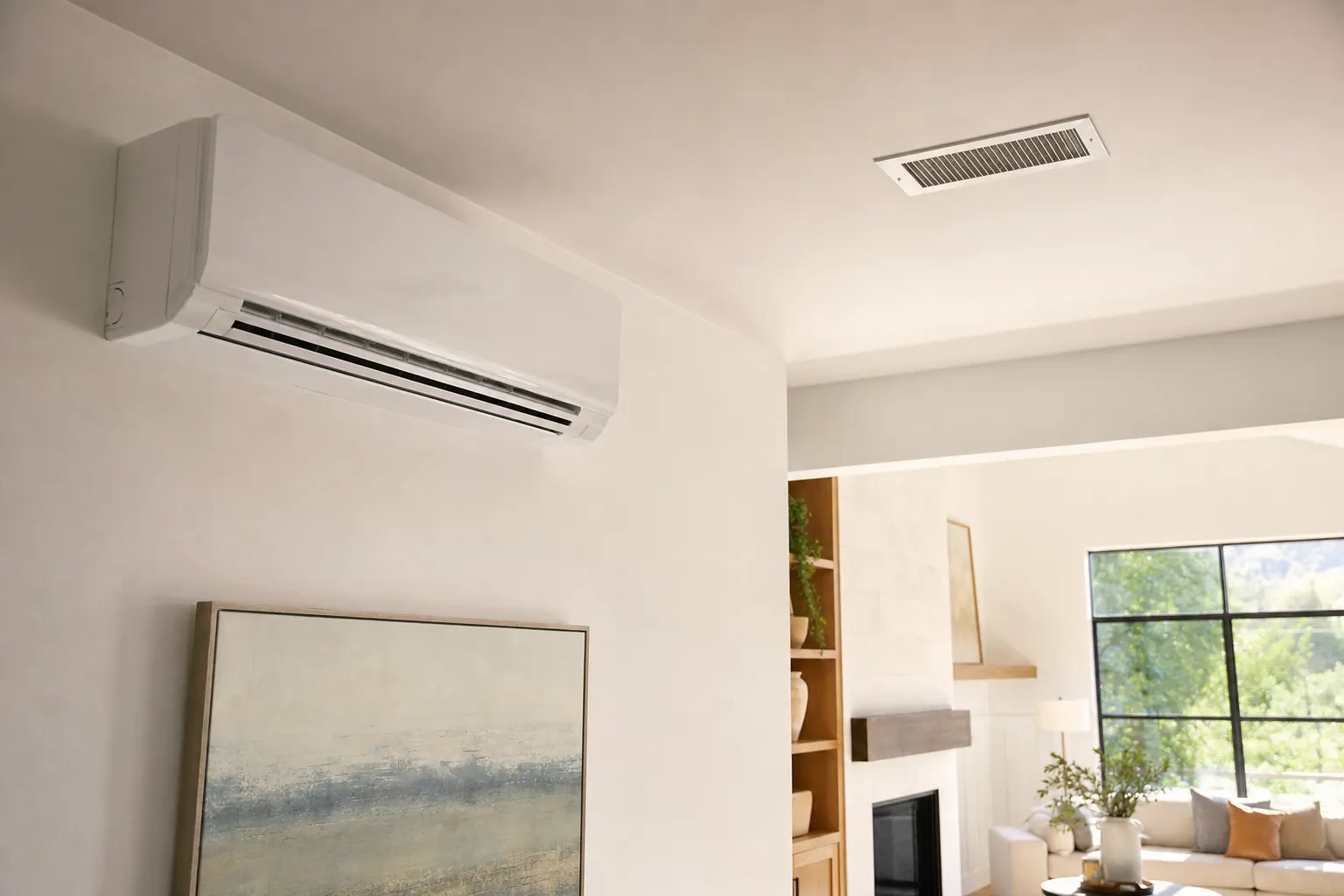
A mini-split indoor head makes condensate whenever it cools humid air. That water is supposed to collect in the internal pan and leave through a drain hose or a small pump, not drip onto the wall, floor, or equipment below. When you see water at the indoor unit, the problem is usually with condensate removal or with ice forming on the coil and then melting faster than the drain can carry it away.
What you can tell from what you see
A small puddle that appears only during cooling, especially near the drain exit or below the wall head, points first to a blocked drain line or pump issue. If the leak showed up after weak airflow, visible frost, or reduced cooling, the indoor coil may have frozen and is now thawing. Water staining on drywall, bubbling paint, or moisture spreading to the ceiling below suggests the leak may be entering the wall cavity from a loose drain connection, bad hose routing, or repeated overflow rather than a one-time drip at the front of the unit.
When to stop using it right away
This symptom fits a stop-system issue because water and powered equipment are a bad combination. Turn the mini-split off if water is near the indoor unit's wiring, outlet, disconnect, or any electronics, or if moisture is spreading into walls, ceilings, or flooring. Also stop the system if the leak comes with ice on the head or line set, because continuing to run it can add more water and can worsen the underlying cooling problem.
What a technician typically checks on a service visit
A qualified mini-split technician will usually open the indoor head, inspect the drain pan, verify the unit is pitched correctly, and clear or flush the condensate line. If the system uses a condensate pump, they will test the float and pump operation and check the discharge tubing for blockage. If there are signs of icing, they will check blower operation, coil condition, temperature split, and refrigerant performance, because a leak caused by thawing ice is different from a simple drain blockage and needs a different repair.
What affects repair cost for this symptom
Cost depends mainly on which water-handling part failed and how accessible it is. Clearing a mini-split drain line is often on the lower end, while replacing a condensate pump, reopening a finished wall to correct drain routing, or diagnosing an icing problem tied to blower or refrigerant issues usually costs more. Typical 2025-2026 US ranges are about $150-$400 for a basic drain clearing or service call repair, roughly $300-$850 for condensate pump replacement, and around $400-$1,500+ if the leak traces back to coil icing, drain rerouting, or hidden water damage investigation.
Cost ranges are estimates developed from standardized project scopes and reviewed pricing inputs. Government labor and regional cost data are used where applicable. See our Pricing Methodology for the exact sources, calculations, and review date. Actual prices vary by property, scope, materials or equipment, location, and provider.
When to turn the system off
- Stop if you smell gas, see smoke or sparks, or hear a carbon-monoxide alarm
- Stop if water reaches powered equipment or a breaker trips again
- Stop if loud grinding, booming, or heavy ice appears
When to call for help
- Call when the symptom continues after the safe checks
- Call promptly when comfort is lost for the whole home
- Describe when it started and any water, ice, noise, odor, alert, or breaker activity
Cost guidance
What could this cost to fix?
Price depends on the actual cause, equipment, access, and local labor. Compare the national ranges in the HVAC Repair Cost guide, or check service availability for your system.
Find local help for Mini-Split Repair
We will keep this problem and recommended service selected while you answer a few quick availability questions.
Browse HVAC help by stateFrequently asked questions
Mini-split indoor unit is leaking water: common questions
Why is my mini-split leaking water only when it is in cooling mode?
Why did my mini-split start leaking after I saw ice on the indoor unit or line set?
Can a mini-split leak water inside the wall instead of dripping from the front?
How long does it take to fix a leaking mini-split indoor unit?
Is it normal for a little water to appear near the outside drain but not normal indoors?
Sources and review standard
Last updated July 18, 2026. Last reviewed July 18, 2026. HVAC Rescue reviews problem pages for homeowner-safe boundaries, service routing, source quality, and unsupported claims. No named technical reviewer is shown unless a qualified HVAC reviewer has completed that review.