Quick summary
Match what you notice to a safe next step
These observations can narrow the starting service, but they do not confirm which part has failed.
What you notice
Blower wheel packed with dust and film
What it may point to
The indoor fan can still spin, but the blades cannot grab and move enough air, so the unit feels like it is barely blowing even when it is running normally.
Safe next action
Note when the change began and whether the system is running
What you notice
Evaporator coil matted with debris
What it may point to
Air is being pulled through a partially blocked coil, which chokes airflow at the wall unit and often gets worse gradually over weeks or months.
Safe next action
Compare nearby rooms and keep vents open
What you notice
Indoor fan motor or run capacitor weakening
What it may point to
The fan is no longer reaching its commanded speed, so airflow drops suddenly or only works on lower demand, and the motor may need electrical testing and replacement.
Safe next action
Record any code, sound, smell, or weather event
What you notice
Supply vane or outlet louver not opening fully
What it may point to
The unit is making air, but the discharge path is restricted at the front of the head, which can make one room feel weak while other zones seem normal.
Safe next action
Check the filter and arrange an evaluation if it persists
Safe things to check
- Clean the user-accessible filter as the owner manual directs
- Confirm the remote mode and setpoint
- Make sure the indoor and outdoor units are not visibly blocked
Do not attempt
- Do not handle, vent, or add refrigerant
- Do not open sealed electrical or equipment panels
- Do not bypass a safety switch or force repeated restarts
A few quick questions
Refine the best next step
Question 1 of 3
- 1How much of the home is affected?
- 2What is the system doing right now?
- 3When did this begin?
What this symptom can mean
Use the evidence you can observe
What weak mini-split airflow usually points to
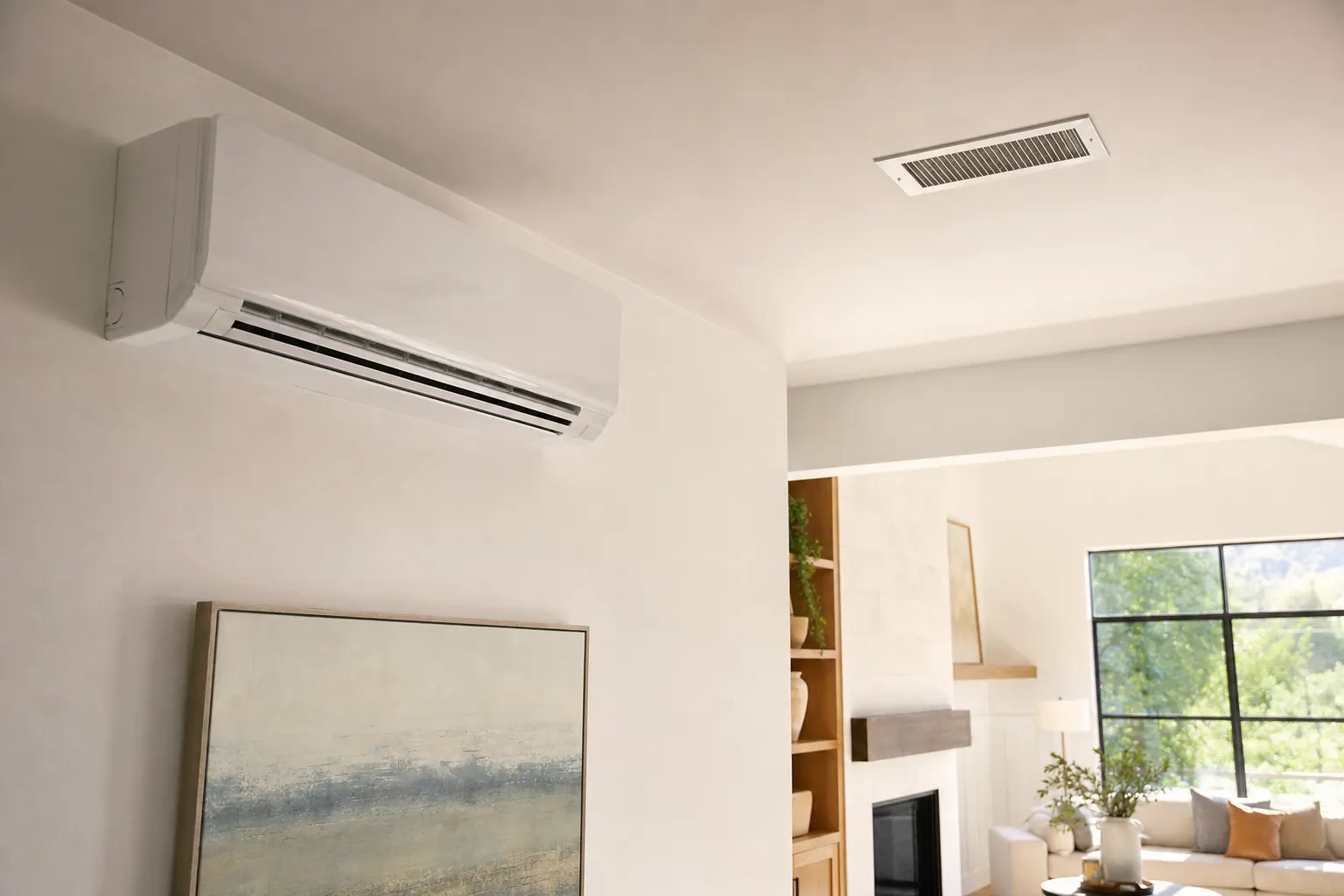
Weak airflow is a moving-air problem first, not automatically a cooling or heating problem. In a ductless wall head, the most common reason is that the indoor section cannot move enough air across its coil because the blower wheel or coil is dirty, the fan is slowing down, or the discharge vane is not opening the way it should. If the room temperature is drifting and the air stream at the unit feels faint even on high fan, the issue is usually inside the indoor head rather than outside at the condenser.
What you can tell from simple observations
If airflow has faded gradually, buildup on the blower wheel or indoor coil is more likely than a sudden electrical failure. If it started suddenly, listen for whether the fan sounds weaker than usual or does not change much between low, medium, and high speed; that pattern often points to a fan motor, capacitor, or control issue. If only one zone is affected in a multi-zone system, compare that head to the others on fan-only mode: one weak head usually means a problem local to that indoor unit, while all heads blowing weakly can suggest a systemwide control problem or widespread maintenance neglect.
Watch the front louvers when the unit starts. If the vane barely opens, opens unevenly, or clicks and stops, the fan may be fine but the air cannot leave the unit properly, which makes the airflow feel weak in the room. Also look at the space around the top and front of the head: a mini-split that is crowded by shelving, curtains, or dust-clogged intake areas can lose noticeable airflow because it cannot pull enough return air through the unit.
What happens during a service visit
A technician will usually verify the complaint at the indoor head, check actual fan-speed response, inspect the blower wheel and evaporator face, and test whether the louvers are opening correctly. They may measure motor amperage and voltage, inspect the indoor control board, and determine whether the fan is mechanically restricted or electrically underperforming. If buildup is heavy, the fix is often a deep cleaning of the indoor assembly; if the fan is not reaching speed, the motor, capacitor where applicable, or control components may need replacement.
What affects repair cost
Cost depends mostly on whether the problem is dirt buildup, a mechanical airflow restriction, or an electrical part failure. A basic diagnostic visit often falls around $99-$250, a thorough mini-split indoor cleaning is commonly about $200-$600 per head, and replacing an indoor fan motor or related control parts can run roughly $300-$1,200 depending on brand, access, and parts availability. Multi-zone systems cost more to diagnose when only one head is weak because each indoor unit and its controls may need to be compared separately.
Cost ranges are estimates developed from standardized project scopes and reviewed pricing inputs. Government labor and regional cost data are used where applicable. See our Pricing Methodology for the exact sources, calculations, and review date. Actual prices vary by property, scope, materials or equipment, location, and provider.
When to turn the system off
- Stop if you smell gas, see smoke or sparks, or hear a carbon-monoxide alarm
- Stop if water reaches powered equipment or a breaker trips again
- Stop if loud grinding, booming, or heavy ice appears
When to call for help
- Call when the symptom continues after the safe checks
- Call promptly when comfort is lost for the whole home
- Describe when it started and any water, ice, noise, odor, alert, or breaker activity
Cost guidance
What could this cost to fix?
Price depends on the actual cause, equipment, access, and local labor. Compare the national ranges in the HVAC Repair Cost guide, or check service availability for your system.
Find local help for Mini-Split Repair
We will keep this problem and recommended service selected while you answer a few quick availability questions.
Browse HVAC help by stateFrequently asked questions
Mini-split airflow is weak: common questions
Why is my mini-split running but barely blowing air?
Why is only one mini-split head blowing weakly when the others seem normal?
Can weak airflow from a mini-split get worse over time?
How long does mini-split airflow repair usually take?
Is weak airflow from a ductless unit expensive to fix?
Sources and review standard
Last updated July 18, 2026. Last reviewed July 18, 2026. HVAC Rescue reviews problem pages for homeowner-safe boundaries, service routing, source quality, and unsupported claims. No named technical reviewer is shown unless a qualified HVAC reviewer has completed that review.