Reviewed July 25, 2026
HVAC Rescue Editorial Team
Editorial StandardsWhy does my thermostat read the wrong temperature?
Usually because it is measuring a bad spot, not because the whole house is actually that temperature. A thermostat only knows the air around its own sensor. If that air is warmed by sun, cooled by a draft, heated by kitchen appliances, or affected by a cold exterior wall, the reading can be off by several degrees. That bad reading can make the system start too often, shut off too soon, or run longer than needed.
That is why placement matters so much. The thermostat should represent the average conditions in the living area, not the hottest or coldest pocket in the house. Before assuming the furnace, heat pump, or air conditioner is failing, it is worth looking at where the thermostat sits and what happens around it during the day. Many comfort complaints that sound like equipment trouble are really control-location problems.
What bad thermostat placement actually does to your system
A thermostat in the wrong place creates ghost readings: numbers that are real at the wall but not representative of the house. Say afternoon sun hits the thermostat and warms it from 72°F room air to 76°F at the sensor. The air conditioner may run even though the rooms feel fine. Put that same thermostat near a supply register, and cold air may hit it first, making the system shut off before bedrooms or back rooms are comfortable.
This can also cause short cycling. Short cycling means the equipment turns on and off more often than it should, often in bursts of just a few minutes. A thermostat in a hallway with poor air mixing, near a drafty door, or on an exterior wall can react too quickly to local temperature swings. Short cycling wastes energy, increases wear on contactors and blower components, and usually makes humidity control worse in cooling season because the system does not run long enough to remove as much moisture.
For many homes, a healthy cooling cycle may last roughly 10 to 20 minutes under moderate conditions, and longer on very hot days. Heat cycles vary by equipment type and outdoor temperature. The point is not an exact number. The point is that if the system repeatedly starts, runs for only a few minutes, shuts off, then starts again because the thermostat is being fooled, the control location deserves attention before major parts get blamed.
The worst places for a thermostat
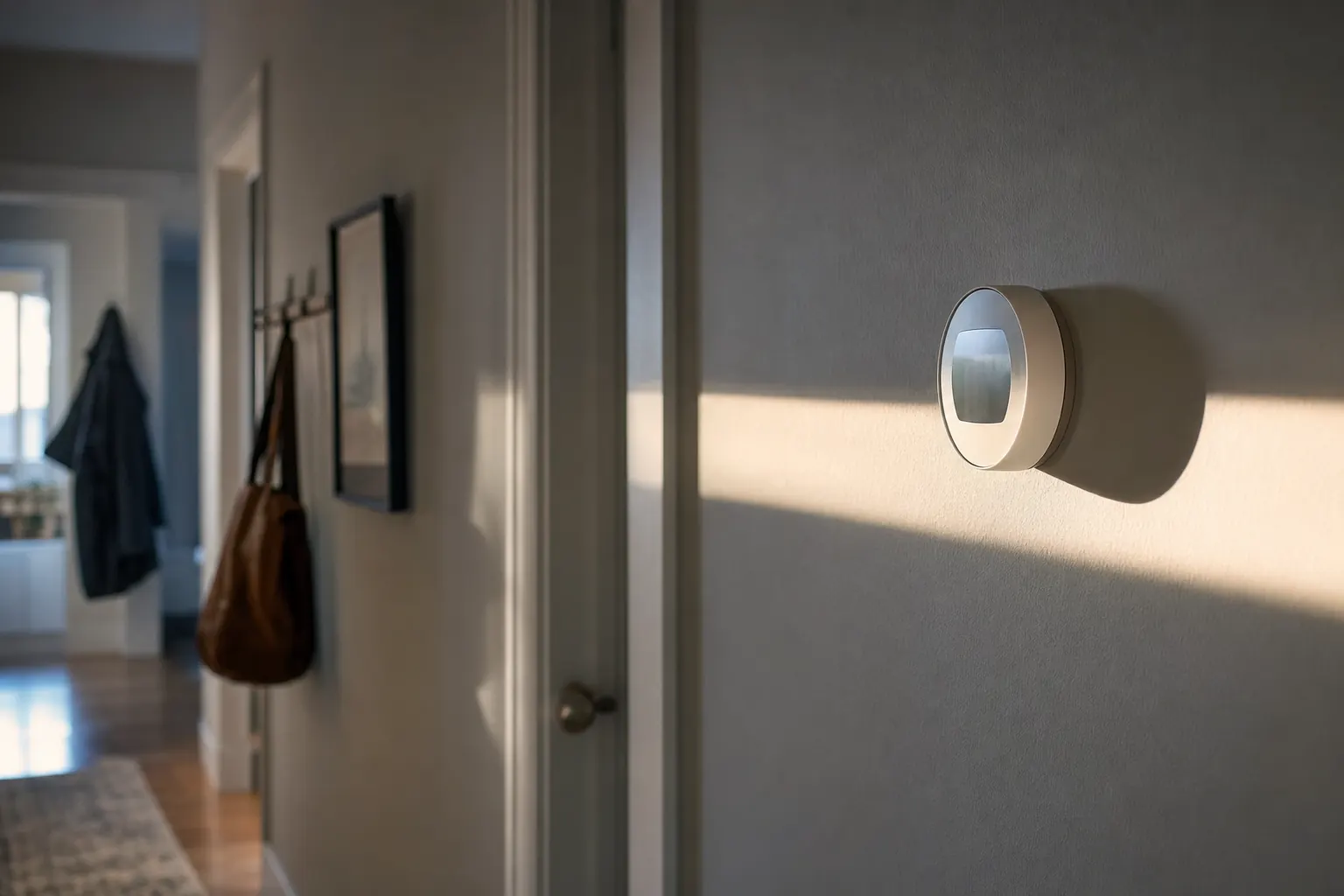
Some locations cause trouble over and over. Direct or even partial sun is a common one, especially on walls near windows, sidelights, or glass doors. Exterior walls are another problem because they can be cooler in winter and warmer in summer than the room air. Kitchens often look central on a floor plan, but they are bad control locations because ovens, ranges, dishwashers, and even morning coffee routines can raise local temperature quickly.
Hallways are mixed. A central hallway can be a good thermostat location if it has normal airflow and is not next to a return grille, supply register, attic hatch, exterior door, or stairwell that acts like a chimney. But many hallways are narrow, stagnant, or connected to pressure imbalances when bedroom doors close. Drafts from leaky windows, recessed wall cavities, and unsealed wire penetrations behind the thermostat can also distort readings, even if the location looks fine from the front.
- Avoid placing a thermostat in direct sunlight or on a wall that gets regular solar gain for part of the day.
- Avoid locations within the direct throw of a supply register or too close to a large return grille.
- Avoid exterior walls, walls shared with garages, and spots above or beside lamps, TVs, appliances, or other heat sources.
- Avoid kitchens, foyers by exterior doors, and stair landings where temperature changes are fast and localized.
- Prefer an interior wall in a frequently used living area, typically about 52 to 60 inches above the floor, with normal air circulation.
How to tell a placement problem from a bad thermostat sensor
Start with patterns. Placement problems usually show up at certain times or under certain conditions. If the thermostat reads high only from 3 p. m. to 6 p. m. , suspect sun. If it reads low on windy days or when the front door opens often, suspect drafts. If it spikes during cooking or after the dryer runs, suspect a location issue. Sensor failure is usually less tied to time of day and more consistently wrong, erratic, or obviously inaccurate no matter what is happening in the room.
A simple check is to place a reliable digital room thermometer near the thermostat, not touching the wall, and compare readings after 15 to 20 minutes. Many thermostats allow a calibration offset of a few degrees, often around plus or minus 3°F to 5°F depending on model. But calibration only helps if the sensor is slightly off. It does not fix a bad location. If the thermostat and nearby thermometer match each other but both differ from the rest of the house, placement is the more likely issue.
Also watch the system behavior. A failing sensor may show wild jumps, blank screens, incorrect mode changes, or readings that do not match reality in any season. Battery-powered models may act strangely when batteries are weak. Smart thermostats can also be affected by software settings, occupancy features, remote sensors, or learning schedules that people forget are enabled. The goal is to separate control logic and sensor accuracy from the physical location on the wall.
What you can check before calling for a relocation
First, look for obvious local influences. Is there a supply register blowing at the thermostat? Does sun hit it during part of the day? Is it mounted above a lamp, on a cold outside wall, or near a kitchen entry? Remove decorative covers or shelves that trap heat around it. If the thermostat uses batteries, replace them with fresh ones. If it is a smart thermostat, review settings for remote averaging, schedule changes, geofencing, or eco modes that can make the displayed number seem inconsistent.
Second, compare temperatures in a measured way. Use one or two decent digital thermometers and check the thermostat area, the nearest main living area, and a problem room over several hours. Write down outdoor conditions and what was happening in the house, such as cooking, opening doors, or strong sun. This gives a contractor something concrete to evaluate. It also helps answer the key question: is the thermostat wrong everywhere, or is the wall around it different from the rooms you care about?
Third, look behind the thermostat only if you are comfortable removing the front cover or faceplate according to the manufacturer instructions. Low-voltage thermostat wiring is different from line-voltage work, but if anything is unclear, stop and have a qualified technician handle it. Sometimes the issue is an unsealed hole in the drywall where wires come through. Air from inside the wall cavity can cool or warm the sensor. Sealing that opening can improve accuracy without moving the thermostat.
What relocating a thermostat actually involves
Relocating a thermostat is usually straightforward in concept and variable in effort. The ideal new spot is an interior wall in a commonly used area with stable airflow and no direct heat source. The work may involve moving the low-voltage cable to the new location, patching the old wall opening, and setting up or reconfiguring the thermostat. In some homes, the existing cable can be fished through walls fairly easily. In others, finished walls, masonry, fire blocking, or multi-story framing make the wire route harder.
For a battery-powered wireless thermostat or a communicating system with remote sensors, there may be more than one solution. Sometimes a contractor can leave the main thermostat where control wiring already exists and instead use remote room sensors or averaging features to make decisions based on a better part of the house. That can solve comfort problems with less wall repair. In other cases, especially when the current wall is fundamentally wrong, physically moving the thermostat is the cleaner long-term fix.
Cost varies widely by house construction and thermostat type. Minor low-voltage relocation with an accessible wire path is a different labor scope from installing a new smart thermostat. Difficult wire fishing, wall repair, trim work, or thermostat replacement at the same time expands the project. Remote sensor add-ons, if compatible, are an additional equipment scope. Estimates should spell out wiring, patching, programming, and whether a new thermostat is required rather than substituting a device-replacement range for relocation work.
How to decide between recalibrating, replacing, or relocating
Recalibration makes sense when the thermostat is in a good location and consistently off by a small amount compared with a reliable thermometer. Replacement makes sense when the display is failing, readings jump around, batteries leak, controls behave erratically, or the model lacks features you need, such as remote sensors or better scheduling. Relocation makes sense when the thermostat is faithfully measuring a bad spot. If local conditions around the wall are the problem, replacing the thermostat alone often changes very little.
A good contractor conversation should cover the house layout, where people spend time, which rooms are uncomfortable, sun exposure, register locations, and whether doors are often closed. Ask what evidence points to placement versus sensor failure. Ask whether sealing the wall opening, adding a compatible sensor, changing airflow balancing, or relocating the thermostat is most likely to help. The best answer is not always the most invasive one, but it should explain why the thermostat is making the system behave the way it is.
If the home has persistent hot and cold rooms even after thermostat issues are addressed, the thermostat may only be part of the story. Duct design, insulation gaps, return-air problems, oversized equipment, and zoning issues can all create comfort complaints. Still, thermostat placement is one of the cheaper and more overlooked causes, and it is often worth ruling out early because the fix can be much simpler than replacing major HVAC equipment.
Sources and fact-checking
Reviewed July 25, 2026. We favor primary government and standards sources for safety, efficiency, and regulatory claims. These references support the technical and consumer guidance on this page.
- Guide to installing air-source heat pumpsU.S. Department of Energy Building Science EducationThermostat placement on an interior wall away from direct sunlight, appliances, and drafts.
- Smart thermostats key product criteriaENERGY STARCertified smart-thermostat capabilities, temperature accuracy, standby power, and measured energy-savings criteria.