Quick summary
Match what you notice to a safe next step
These observations can narrow the starting service, but they do not confirm which part has failed.
What you notice
Clogged condensate drain line or trap
What it may point to
Cooling removes humidity, and if the drain line backs up, the water overflows the pan and ends up on the floor, in a closet, or through a ceiling instead of draining outside.
Safe next action
Turn the system off if water is spreading and note the source
What you notice
Indoor evaporator coil icing, then thawing
What it may point to
If you saw weak airflow, frost, or an unusually long run time before the leak, the coil may have frozen and is now shedding far more water than the pan can handle.
Safe next action
Leave cooling off and inspect the filter
What you notice
Cracked rusted drain pan or loose condensate connection
What it may point to
Water can leak only while the system is actively cooling, often from one side of the cabinet, because the pan or fitting is letting normal condensate escape before it reaches the drain.
Safe next action
Do not touch wet equipment; shut power off only if safely accessible
What you notice
Condensate pump failure or blocked pump tubing
What it may point to
If your air handler is in a basement, attic, or interior closet without gravity drainage, a bad pump can let water rise in the reservoir and spill near the unit.
Safe next action
Protect the area from damage and request an inspection
Safe things to check
- Confirm the thermostat mode and setpoint
- Inspect the air filter and replace it if visibly dirty
- Make sure visible supply and return vents are open
Do not attempt
- Do not handle, vent, or add refrigerant
- Do not open sealed electrical or equipment panels
- Do not bypass a safety switch or force repeated restarts
A few quick questions
Refine the best next step
Question 1 of 3
- 1How much of the home is affected?
- 2What is the system doing right now?
- 3When did this begin?
What this symptom can mean
Use the evidence you can observe
What water around a heat pump or air handler usually means
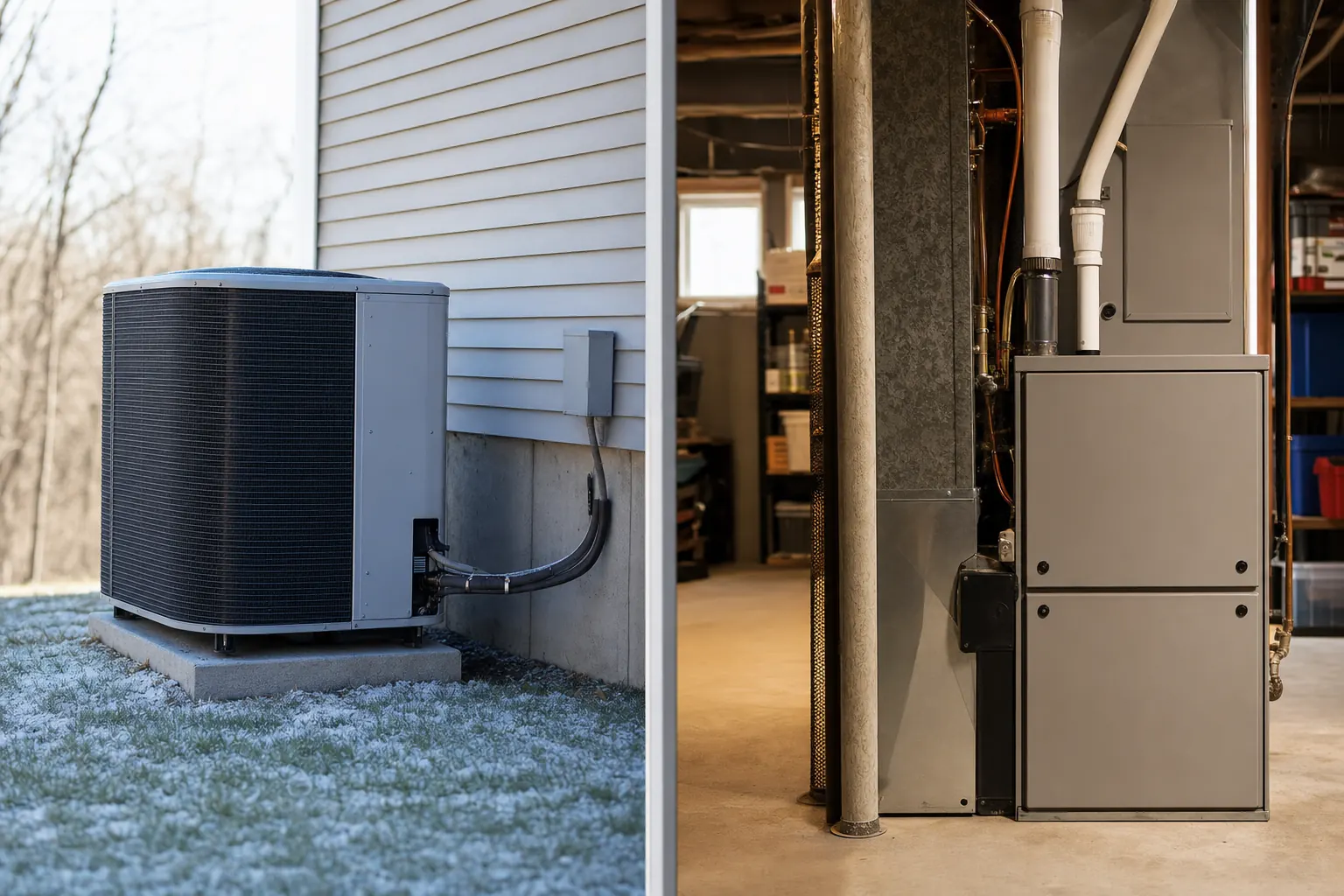
Water near the indoor part of a heat pump system is usually condensate that failed to leave through the normal drain path. In cooling mode, the indoor coil pulls moisture from the air, and that water should fall into a pan and flow out through a drain or pump. When you see puddling at the air handler, staining on nearby drywall, or drips through a ceiling, the moisture is no longer being contained and routed correctly.
How to tell the likely causes apart
A small amount of water appearing near a drain termination or beside the cabinet, with otherwise normal cooling, points first to a partially blocked drain line or trap. Water that shows up after weak airflow, poor cooling, or visible ice on copper lines or inside the cabinet more often means the indoor coil froze and later thawed. If the leak is steady only while cooling runs and seems to come from one corner or seam of the unit, a cracked pan, loose fitting, or leveling issue becomes more likely. If the unit is above a pump reservoir and you hear no pump operation, or the pump tank is full, a failed condensate pump is a common culprit.
Water near wiring, a disconnect, or powered equipment changes the priority from inconvenience to electrical safety. Shut the system off at the thermostat, and if you cannot keep water away from energized components, leave it off until a technician can inspect it. If moisture has spread into walls, ceilings, or multiple rooms, you are dealing with both an HVAC drainage problem and a building-damage issue, so quick service matters.
What a technician will usually check
A service visit for this symptom usually starts with confirming exactly where the water is escaping: drain line, pan, coil cabinet, pump, or insulation. The technician will clear and flush the condensate drain, inspect the trap and safety switch, look for a cracked or rusted pan, test the condensate pump if one is installed, and check whether the air handler is pitched correctly. If there are signs of icing, the visit also includes checking airflow across the indoor coil and testing for sealed-system problems such as low refrigerant, because a freeze-thaw leak will return if the root cause is not corrected.
What affects the repair cost
The least expensive fixes are usually drain-related, such as clearing a clogged condensate line or replacing simple tubing. Condensate-pump replacement depends on access and wiring. Drain-pan replacement is a different scope because some pans are hard to reach or require partial coil removal, and it should not inherit a generic motor or control-board range. If the water started because the evaporator coil froze, the total depends on why it froze; airflow corrections can stay moderate, while refrigerant leak diagnosis and sealed-system repairs can become substantially larger projects.
This symptom is different from a heat pump that simply is not heating or cooling, because the visible water is the clue that condensate management or coil icing is involved. Even if the puddle seems small, repeated leaking can damage insulation, sheetrock, flooring, and framing, and hidden moisture can linger after the HVAC issue is fixed. Stopping the system promptly is often the best way to limit both electrical risk and water damage while you arrange heat pump repair.
When to turn the system off
- Stop if you smell gas, see smoke or sparks, or hear a carbon-monoxide alarm
- Stop if water reaches powered equipment or a breaker trips again
- Stop if loud grinding, booming, or heavy ice appears
When to call for help
- Call when the symptom continues after the safe checks
- Call promptly when comfort is lost for the whole home
- Describe when it started and any water, ice, noise, odor, alert, or breaker activity
Cost guidance
What could this cost to fix?
Price depends on the actual cause, equipment, access, and local labor. Compare the national ranges in the HVAC Repair Cost guide, or check service availability for your system.
Find local help for Heat Pump Repair
We will keep this problem and recommended service selected while you answer a few quick availability questions.
Browse HVAC help by stateFrequently asked questions
Water is leaking around the heat pump or air handler: common questions
Why is my heat pump leaking water only when the AC is running?
Is water around my air handler normal or is any puddle a problem?
Why is there water under my heat pump after I saw ice on the lines?
How long does it take to fix a leaking condensate line or pump?
Can a leaking air handler cause ceiling or wall damage even if the system still runs?
Sources and review standard
Last updated July 18, 2026. Last reviewed July 18, 2026. HVAC Rescue reviews problem pages for homeowner-safe boundaries, service routing, source quality, and unsupported claims. No named technical reviewer is shown unless a qualified HVAC reviewer has completed that review.