Quick summary
Match what you notice to a safe next step
These observations can narrow the starting service, but they do not confirm which part has failed.
What you notice
Leak at a gas pipe joint, union, sediment trap, or shutoff valve near the equipment
What it may point to
The fuel supply piping is releasing gas before it even reaches the burners, which can allow explosive gas to collect around the furnace or boiler room.
Safe next action
Leave the area and contact the appropriate emergency authority from outside
What you notice
Failed or leaking gas valve on the furnace or boiler
What it may point to
Gas can seep through the valve body or connections even when the appliance is not actively heating, so the smell may persist when the system is off.
Safe next action
Stay out until the home has been cleared as safe
What you notice
Loose or damaged appliance connector or manifold tubing
What it may point to
The final section carrying gas into the equipment may be cracked, corroded, or improperly tightened, creating a strong odor right at the cabinet.
Safe next action
Get outside and contact emergency services immediately
Safety comes first
Leave the affected area and follow the immediate safety instruction before troubleshooting or contacting ordinary HVAC service.
Safe things to check
- Get everyone outside before doing anything else
- Call the gas utility or emergency services from outside
- Wait for the home to be cleared before returning
Do not attempt
- Do not adjust gas valves, burners, ignition parts, or venting
- Do not open sealed electrical or equipment panels
- Do not bypass a safety switch or force repeated restarts
A few quick questions
Refine the best next step
Question 1 of 2
- 1Is everyone outside and away from the equipment?
- 2Have you contacted the appropriate emergency authority?
What this symptom can mean
Use the evidence you can observe
What this smell physically means
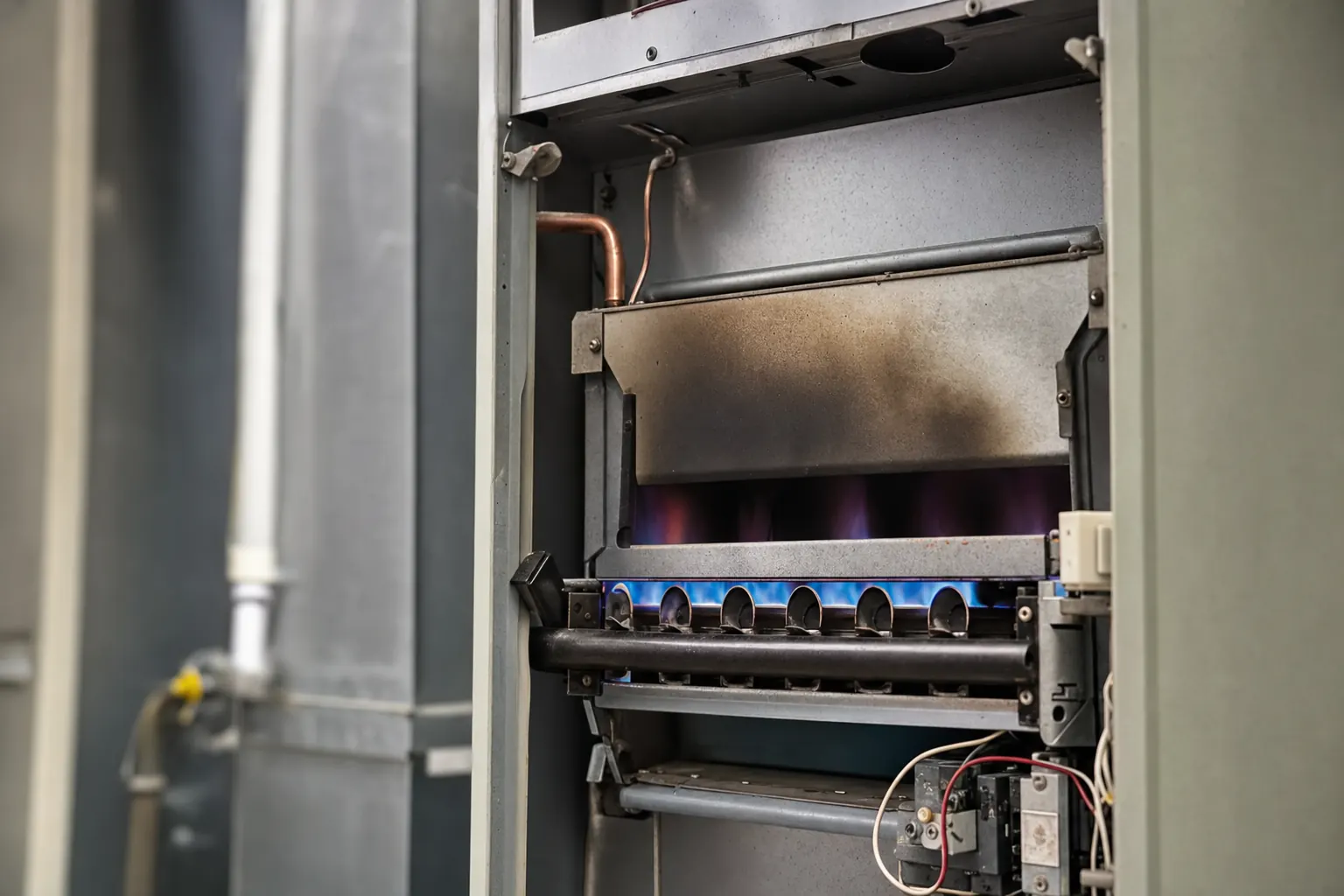
A sulfur or rotten-egg smell near a furnace or boiler means fuel gas is escaping somewhere it should not. In a heating system, that usually points to a leak in the gas piping or gas valve, or to unburned gas being released because the burners are not lighting correctly. If anyone has headache, dizziness, nausea, or confusion, treat it as an immediate evacuation situation and call the gas utility or emergency services from outside.
Clues homeowners notice before leaving
If the odor is present even when the equipment is not running, a piping connection, shutoff valve, connector, or gas valve leak is more likely than an ignition issue. If the smell shows up only when heat starts, especially with a whoosh, bang, or repeated failed starts, delayed ignition or a burner problem moves higher on the list. If the smell stopped after shutdown, that does not mean the danger is gone; gas can dissipate temporarily and return on the next call for heat.
What not to do
Do not switch lights on or off, do not use the thermostat, do not try to relight anything, and do not stay inside to search for the source. Even a small spark can ignite accumulated gas. Leave the building, keep others out, and make the call from outside or from a neighbor's home.
What a service visit usually involves after the area is declared safe
After the gas utility or fire department says re-entry is safe, the technician typically confirms whether the leak is in the home's gas piping, at the furnace or boiler gas train, or in the burner section. Common steps include a combustible gas leak test, inspection of the shutoff and connector, checking manifold pressure, evaluating ignition sequence, and examining burners, crossover ports, and the heat appliance's gas valve. If the utility locked out the meter or tagged the appliance, repairs usually must be completed before service is restored.
What affects repair cost
Cost depends mainly on where the gas is escaping and whether the problem is a simple external fitting or a failed control inside the appliance. In many US markets for 2025-2026, tightening or replacing an accessible connector, valve, or small section of piping may run about $150-$600, while a furnace or boiler gas valve replacement often falls around $350-$900 installed, and burner/ignition repairs are often in the $200-$800 range. If corrosion, obsolete parts, code updates, permit requirements, or utility red-tag conditions are involved, the total can climb further.
Cost ranges are estimates developed from standardized project scopes and reviewed pricing inputs. Government labor and regional cost data are used where applicable. See our Pricing Methodology for the exact sources, calculations, and review date. Actual prices vary by property, scope, materials or equipment, location, and provider.
When to turn the system off
- Do not operate or approach the equipment
- Keep everyone outside until the authority clears the home
When to call for help
- Call when the symptom continues after the safe checks
- Call promptly when comfort is lost for the whole home
- Describe when it started and any water, ice, noise, odor, alert, or breaker activity
Cost guidance
What could this cost to fix?
Price depends on the actual cause, equipment, access, and local labor. Compare the national ranges in the HVAC Repair Cost guide, or check service availability for your system.
Find local help for Emergency HVAC Repair
We will keep this problem and recommended service selected while you answer a few quick availability questions.
Browse HVAC help by stateFrequently asked questions
Gas smell near a furnace or boiler: common questions
Why do I smell gas only when the furnace or boiler starts?
The gas smell went away after the system shut off. Is it still dangerous?
What if someone feels dizzy or nauseated when the gas smell happens?
Will the gas utility fix the furnace or boiler if they find the leak?
How long does a gas-leak repair near a furnace or boiler usually take?
Sources and review standard
Last updated July 18, 2026. Last reviewed July 18, 2026. HVAC Rescue reviews problem pages for homeowner-safe boundaries, service routing, source quality, and unsupported claims. No named technical reviewer is shown unless a qualified HVAC reviewer has completed that review.