Reviewed July 25, 2026
HVAC Rescue Editorial Team
Editorial StandardsStart with safety, not troubleshooting
Some furnace problems are inconvenient. Others are emergencies. If you smell gas, a carbon monoxide alarm sounds, or you notice smoke or a burning-electrical smell, everyone should leave the building immediately and call the gas utility or emergency services from outside. Do not stay inside to reset the furnace, open panels, or search for the source. Furnaces involve gas, combustion, venting, and electricity, and those hazards can become serious very quickly.
Every home with a fuel-burning furnace should have working carbon monoxide detectors near sleeping areas and on each level of the house, installed according to the manufacturer instructions and local code. Test them regularly and replace batteries as required. Carbon monoxide cannot be seen or smelled, and symptoms such as headache, nausea, dizziness, or unusual fatigue can be mistaken for illness. If a CO alarm sounds, treat it as an emergency first and a furnace problem second.
Weak heat, cold air, or rooms that never get comfortable
The most obvious repair sign is poor heat. The furnace may run, but the air feels cool or only mildly warm, the home never reaches the thermostat setting, or certain rooms stay stubbornly cold. Sometimes the problem is the furnace itself. Sometimes it is airflow, duct leakage, a thermostat issue, or an undersized or aging system that can no longer keep up in very cold weather. The pattern matters: a house that was comfortable in past winters but now struggles usually needs attention.
Before calling, there are a few safe homeowner checks. Make sure the thermostat is set to HEAT, the setpoint is several degrees above room temperature, and the fan is on AUTO rather than ON if you are trying to judge heating cycles. Replace a dirty filter if you have not changed it recently. Confirm the furnace service switch is on and that the breaker has not tripped. If those basics do not restore normal heating, a qualified technician should check ignition, flame sensing, limit controls, blower performance, and other internal components.
- If supply air suddenly feels cooler than it did in prior winters, the problem may be anything from a restricted filter to a failing igniter, weak flame, or blower issue.
- If one level of the house is warm and another is cold, the cause may be duct leakage, damper problems, airflow imbalance, insulation shortcomings, or a furnace that is not moving enough air.
- If the thermostat reaches setting during mild weather but not during colder nights, the system may be losing capacity, the filter may be too restrictive, or the home may have airflow or envelope issues that need diagnosis.
- If heat is inconsistent after a recent thermostat replacement, installation or compatibility problems can also be part of the picture.
Homeowners often ask whether lukewarm air automatically means the furnace is failing. Not always. Many furnaces deliver air that feels warm but not hot at the register, especially when blended with room air and measured by hand rather than with instruments. What matters is whether the furnace cycles normally and actually raises indoor temperature. If it runs for long stretches and the house still drifts colder, that is a practical sign that repair is needed.
Strange noises usually get worse, not better
Most furnaces make some normal sound: a brief startup sequence, the blower coming on, and steady airflow through the ducts. A furnace that begins making new noises is telling you something has changed. Banging, booming, rattling, squealing, scraping, buzzing, or repeated clicking all point to different kinds of faults. The useful question is not just what the noise sounds like, but when it happens: at ignition, while the blower is running, when the unit shuts down, or continuously.
A loud boom or bang at ignition deserves prompt professional evaluation because delayed ignition and combustion problems can damage components and create safety concerns. Squealing may indicate a worn blower motor bearing or belt on older belt-driven equipment. Rattling can be as minor as a loose panel, but it can also signal a loose wheel, failing inducer assembly, or vibration from deteriorating mounts. Repeated clicking without ignition can indicate trouble in the startup sequence. None of these problems improve by being ignored.
Noises can also come from expanding and contracting ductwork, especially in metal trunk lines that pop as they warm up. That is different from noise originating inside the furnace cabinet. If the sound is louder at the furnace, more frequent than before, or paired with poor heat, short cycling, or a fault light, it is time for a service call. Catching a worn motor or loose component early is often simpler than waiting until it takes out related parts.
Short cycling, long run times, and rising utility bills
A furnace should run in cycles that make sense for the weather. Short cycling means it starts, runs briefly, shuts off, and starts again too soon without adequately heating the house. That behavior increases wear on ignition components, motors, and controls while using more energy. A clogged filter is a common cause, but it is far from the only one. Restricted airflow, limit trips, thermostat problems, oversized equipment, blocked vents, and failing sensors can all contribute.
The opposite pattern matters too. If the furnace runs almost constantly and still cannot hold temperature, it may be losing heating capacity or the home may be losing heat faster than before. An abrupt increase in gas or electric bills without a clear weather explanation is another clue. Utility costs naturally rise in colder months, but if your usage jumps while comfort drops, the system may be operating inefficiently due to poor combustion, airflow restrictions, a struggling blower, or repeated failed ignition attempts.
- Short cycles of only a few minutes, repeated over and over, usually point to a problem worth diagnosing rather than normal operation.
- A furnace that runs nearly nonstop during moderate weather is different from one that runs long on the coldest night of the year; context matters.
- Repeatedly resetting the thermostat to force more heat does not solve an underlying airflow or safety-control problem and can make diagnosis harder.
- If recent repairs have not lasted, ask for a broader diagnostic approach instead of replacing the same symptom part again.
Frequent repairs are their own warning sign. One isolated repair on an otherwise dependable furnace is normal. Several service calls in one or two heating seasons can indicate a bigger issue: age-related wear, neglected maintenance, venting problems, poor setup, or a unit near the end of its useful life. Typical 2025-2026 repair estimates vary widely by part and region, but many common furnace repairs fall in roughly the low hundreds to over $1,500, while major component failures can push the replace-versus-repair discussion.
Cost ranges are estimates developed from standardized project scopes and reviewed pricing inputs. Government labor and regional cost data are used where applicable. See our Pricing Methodology for the exact sources, calculations, and review date. Actual prices vary by property, scope, materials or equipment, location, and provider.
Pilot, ignition, airflow, and other performance clues
Modern furnaces usually use electronic ignition rather than a standing pilot, but the startup sequence still needs several things to happen in order: the inducer starts, the pressure switch proves draft, ignition occurs, burners light properly, the flame is sensed, and then the blower delivers heat. Trouble in any part of that chain can show up as no heat, intermittent heat, clicking, brief burner operation followed by shutdown, or a furnace that tries to start several times before locking out.
Airflow issues are just as important as ignition issues. A furnace can overheat and trip safety limits when it cannot move enough air across the heat exchanger. Dirty filters are the simplest cause, but closed supply registers, blocked return grilles, a dirty blower wheel, collapsing ductwork, or an undersized return system can also restrict airflow. Homeowners can safely replace filters and make sure registers and returns are open and unobstructed, but internal diagnosis belongs to a qualified licensed technician.
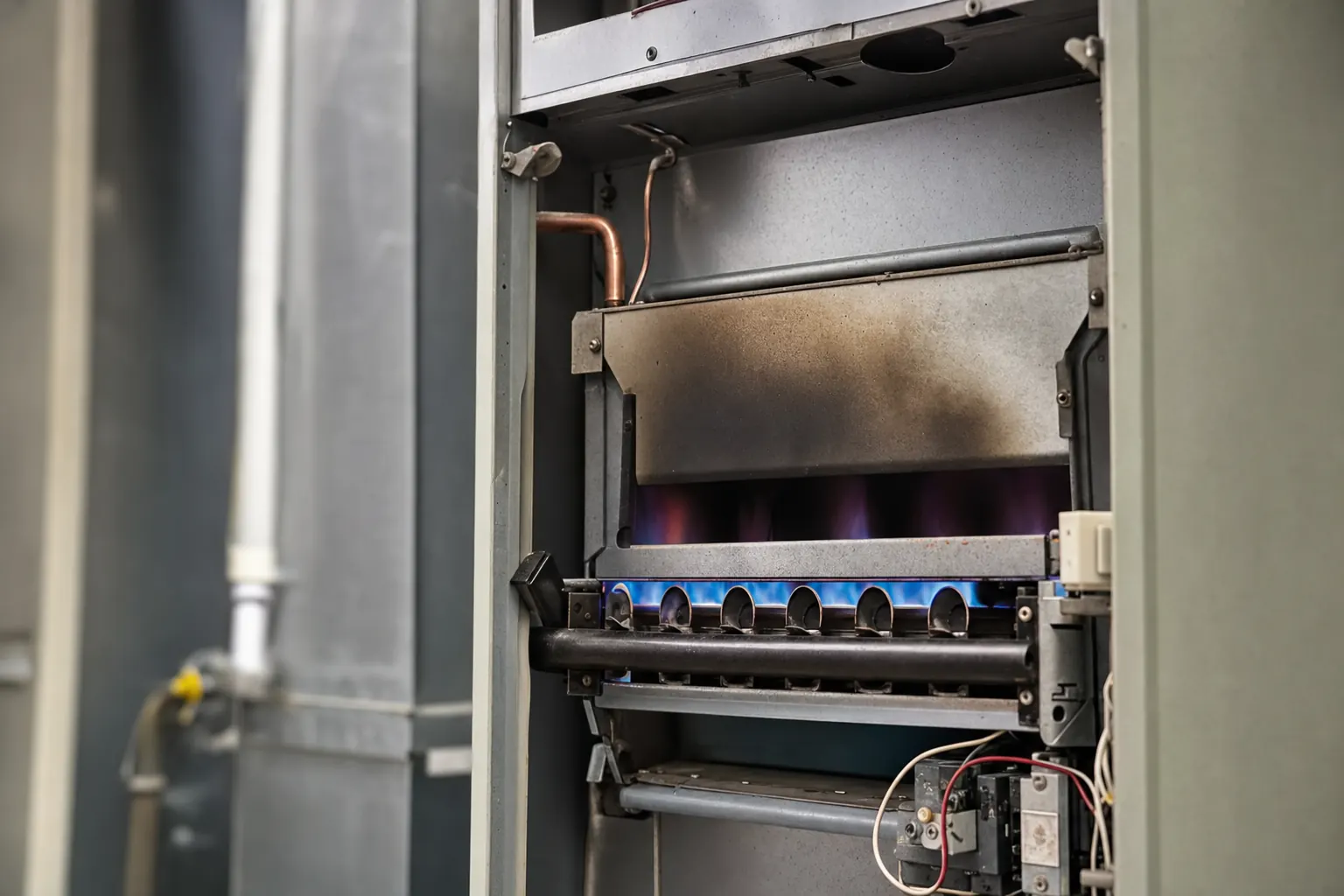
Pay attention to visible clues around the furnace too. Rust, water around the unit, soot, scorch marks, or corrosion at vent connections are not normal signs. High-efficiency furnaces can produce condensate, so some moisture may come from a blocked drain, cracked hose, or condensate pump issue. Older atmospheric furnaces should not show soot. Water and combustion byproducts around a furnace often point to problems that affect both reliability and safety, which is why they should be evaluated rather than monitored casually.
Age, visible wear, and when repair starts to make less sense
Furnaces do not fail on a birthday, but age matters. Many systems can last around 15 to 20 years with proper installation and maintenance, while some fail sooner and some run longer. As furnaces age, you may see more nuisance shutdowns, weaker blower performance, noisier startup, or increasing repair frequency. A unit that still heats can nevertheless be nearing the point where each new part buys only limited time. That does not mean replacement is automatic, but it should become part of the conversation.
Contractors often weigh three things: the seriousness of the current fault, the condition and age of the rest of the system, and the cost of the repair relative to replacement. Compare replacement using the standardized furnace-replacement scenarios linked from this guide, with efficiency, fuel type, sizing, venting changes, region, and installation complexity defining the applicable scope. A modest repair on a 7-year-old furnace is a different decision than a major repair on an 18-year-old unit with a history of problems.
If a technician finds a cracked heat exchanger or a serious venting or combustion safety issue, the discussion changes from convenience to safety. A cracked heat exchanger diagnosis should be explained clearly and supported by findings, because it is significant. In general, a furnace with major safety-related defects, escalating repairs, and advanced age is often a stronger candidate for replacement than continued patchwork. The right choice depends on diagnosis, not on age alone.
What to check safely and when to call for professional help
Homeowners can do a few useful checks without getting into unsafe territory. Confirm the thermostat settings, replace the filter with the correct size and orientation, open blocked supply registers and return grilles, and check that the breaker and furnace switch are on. Note the symptoms carefully: what the thermostat says, whether the blower runs, whether the furnace starts and stops quickly, what noises you hear, and whether the problem affects the whole house or only certain rooms. That information helps a technician diagnose faster.
Call for professional service if the furnace blows cold air after the basic checks, struggles to maintain temperature, makes new or loud noises, short cycles, shuts down intermittently, trips the breaker, shows rust or water issues, or has needed repeat repairs. If the house is getting colder and the system cannot keep up, do not wait for a full breakdown during a cold snap. HVAC Rescue can help homeowners find independent HVAC contractors for diagnosis and repair options in their area.
If the problem is not an emergency but heat is unreliable, acting early usually gives you more options. The first available appointment during a severe cold wave is often after many other households have already called. Early diagnosis can mean a simple control, sensor, drain, or airflow correction instead of a failure that stresses multiple parts. A furnace rarely goes from perfect to dead without warning; the value is in taking the warning signs seriously while the house is still warm enough to plan the next step.
Sources and fact-checking
Reviewed July 25, 2026. We favor primary government and standards sources for safety, efficiency, and regulatory claims. These references support the technical and consumer guidance on this page.