Quick summary
Match what you notice to a safe next step
These observations can narrow the starting service, but they do not confirm which part has failed.
What you notice
Dirty, rusted, or misaligned burners
What it may point to
Burners that are partially plugged or not lighting evenly can produce a lazy yellow flame and soot, which means fuel is not burning cleanly and carbon monoxide risk can rise.
Safe next action
Turn the heating equipment off and arrange qualified furnace service
What you notice
Blocked flue, vent connector, or heat exchanger passages
What it may point to
If combustion gases cannot move out properly, the flame can lose its normal sharp blue shape and start sooting, and exhaust can spill back into the home.
Safe next action
Keep the furnace off and do not clean or adjust burner parts
What you notice
Insufficient combustion air in the furnace area
What it may point to
A furnace starved for air can burn yellow instead of blue, especially in tight utility rooms or after other exhaust equipment starts, leading to soot buildup and unsafe combustion.
Safe next action
Leave the home and contact the proper emergency authority from outside
What you notice
Cracked burner assembly or damaged heat exchanger affecting flame pattern
What it may point to
Airflow where it does not belong can pull, roll, or flutter the flame, turning parts of it yellow and causing soot while also creating a serious carbon monoxide hazard.
Safe next action
Get everyone outside and contact emergency services
Safe things to check
- Confirm the thermostat mode and setpoint
- Inspect the air filter and replace it if visibly dirty
- Make sure visible supply and return vents are open
Do not attempt
- Do not adjust gas valves, burners, ignition parts, or venting
- Do not open sealed electrical or equipment panels
- Do not bypass a safety switch or force repeated restarts
A few quick questions
Refine the best next step
Question 1 of 3
- 1How much of the home is affected?
- 2What is the system doing right now?
- 3When did this begin?
What this symptom can mean
Use the evidence you can observe
What a yellow furnace flame or soot actually means
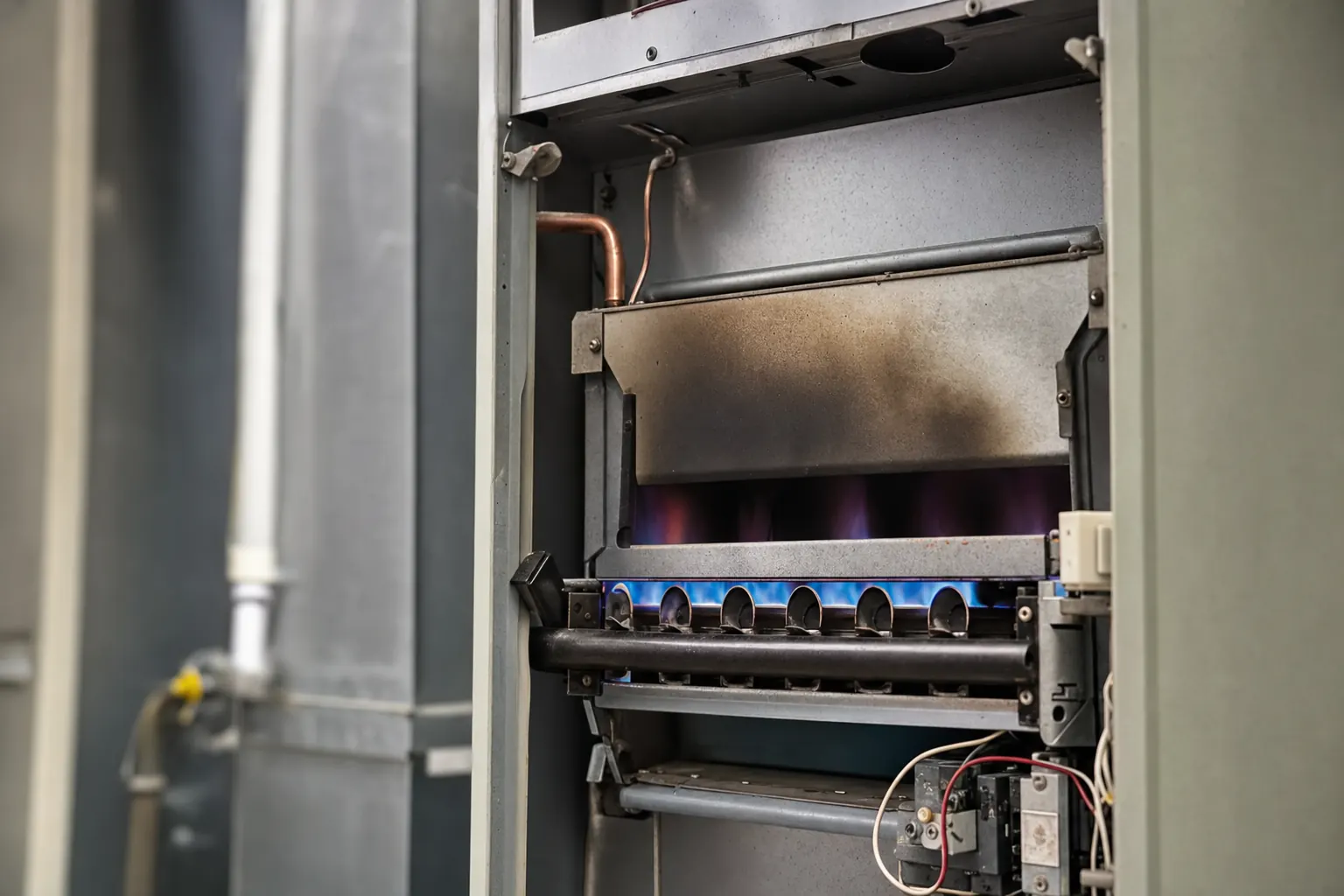
A properly adjusted natural gas furnace burner usually burns mostly blue, with a steady, well-defined flame. When the flame stays yellow or orange and you see black soot on the furnace cabinet, around the burner area, or on nearby surfaces, the fuel is not burning completely. That is a combustion problem, not a cosmetic issue, and it can produce carbon monoxide along with soot.
Because this symptom involves possible combustion gas spillage, the safe response is to leave the building and call the gas utility or emergency services from outside, especially if there is an odor, a CO alarm, or anyone has headache, dizziness, nausea, or confusion. Do not keep running the furnace to see if the flame clears up. A yellow flame that appears once and then returns is still unsafe until the cause is identified.
What homeowners can notice that helps separate the likely causes
Soot concentrated right at the burner compartment often points to dirty or misfiring burners. Soot near vent joints, at the draft hood on older equipment, or above the furnace can suggest a venting problem or blocked flue. If the yellowing starts when a laundry room door is closed, a kitchen exhaust fan runs, or another fuel-burning appliance is on, lack of combustion air becomes more likely. If the flame appears to flutter, roll out, or change when the blower starts, technicians become concerned about a damaged heat exchanger or burner crossover problem.
What happens during a service visit
A qualified technician will typically shut the furnace down, inspect the burner flames directly, and test for carbon monoxide in the flue and around the equipment. They will check burner condition, ignition carryover, gas pressure, vent draft, and whether the flue or heat exchanger passages are restricted. On a condensing furnace, they may also inspect intake and exhaust piping for blockage; on an older atmospheric furnace, they will pay close attention to draft and spillage.
If the problem is limited to dirty burners or a burner adjustment, the repair is often straightforward. If testing shows vent blockage, damaged burner parts, unsafe CO readings, or evidence of a cracked heat exchanger, the furnace may need to remain off until repaired or replaced. Typical 2025-2026 U.S. costs are often about $150-$500 for diagnostic work and burner cleaning/adjustment, roughly $200-$900 for venting-related corrections depending on access and parts, and commonly $1,500-$4,000 or more if a heat exchanger or major furnace replacement becomes necessary.
Cost ranges are estimates developed from standardized project scopes and reviewed pricing inputs. Government labor and regional cost data are used where applicable. See our Pricing Methodology for the exact sources, calculations, and review date. Actual prices vary by property, scope, materials or equipment, location, and provider.
When to turn the system off
- Stop if you smell gas, see smoke or sparks, or hear a carbon-monoxide alarm
- Stop if water reaches powered equipment or a breaker trips again
- Stop if loud grinding, booming, or heavy ice appears
When to call for help
- Call when the symptom continues after the safe checks
- Call promptly when comfort is lost for the whole home
- Describe when it started and any water, ice, noise, odor, alert, or breaker activity
Cost guidance
What could this cost to fix?
Price depends on the actual cause, equipment, access, and local labor. Compare the national ranges in the Furnace Repair Cost guide, or check service availability for your system.
Find local help for Furnace Repair
We will keep this problem and recommended service selected while you answer a few quick availability questions.
Browse HVAC help by stateFrequently asked questions
Furnace flame is yellow or soot is visible around the equipment: common questions
Is any yellow color in a furnace flame normal?
Why is there black soot on or around my furnace?
Can a blocked chimney or vent make my furnace flame yellow?
What does it mean if the yellow flame comes with headaches or a carbon monoxide alarm?
Will this usually be a cleaning issue or a furnace replacement?
Sources and review standard
Last updated July 18, 2026. Last reviewed July 18, 2026. HVAC Rescue reviews problem pages for homeowner-safe boundaries, service routing, source quality, and unsupported claims. No named technical reviewer is shown unless a qualified HVAC reviewer has completed that review.