Quick summary
Match what you notice to a safe next step
These observations can narrow the starting service, but they do not confirm which part has failed.
What you notice
Cracked or failed furnace heat exchanger
What it may point to
Combustion gases can leak from the burner path into the air moving through your duct system, creating a true carbon monoxide hazard whenever the furnace runs.
Safe next action
Leave the area and contact the appropriate emergency authority from outside
What you notice
Blocked, disconnected, or deteriorated vent pipe or chimney
What it may point to
Exhaust that should leave the house can spill from the furnace or boiler area instead, especially when the burner starts or while the blower is running.
Safe next action
Stay out until the home has been cleared as safe
What you notice
Backdrafting from another fuel-burning appliance on the same flue
What it may point to
The alarm may be reacting to a water heater, boiler, or fireplace exhausting into the home, even if the furnace is the equipment that just shut down.
Safe next action
Get outside and contact emergency services immediately
Safety comes first
Leave the affected area and follow the immediate safety instruction before troubleshooting or contacting ordinary HVAC service.
Safe things to check
- Get everyone outside before doing anything else
- Call the gas utility or emergency services from outside
- Wait for the home to be cleared before returning
Do not attempt
- Do not adjust gas valves, burners, ignition parts, or venting
- Do not open sealed electrical or equipment panels
- Do not bypass a safety switch or force repeated restarts
A few quick questions
Refine the best next step
Question 1 of 2
- 1Is everyone outside and away from the equipment?
- 2Have you contacted the appropriate emergency authority?
What this symptom can mean
Use the evidence you can observe
A sounding carbon monoxide alarm means treat the air as unsafe now
Carbon monoxide is a combustion byproduct, not a normal heating smell or comfort issue. If the alarm is sounding now, or if anyone has headache, dizziness, nausea, sleepiness, or confusion, get everyone outside immediately and call 911 or the gas utility from outside. Do not stay inside to check the furnace, reset equipment, or silence the alarm and keep using the heat.
What this symptom points to in HVAC equipment
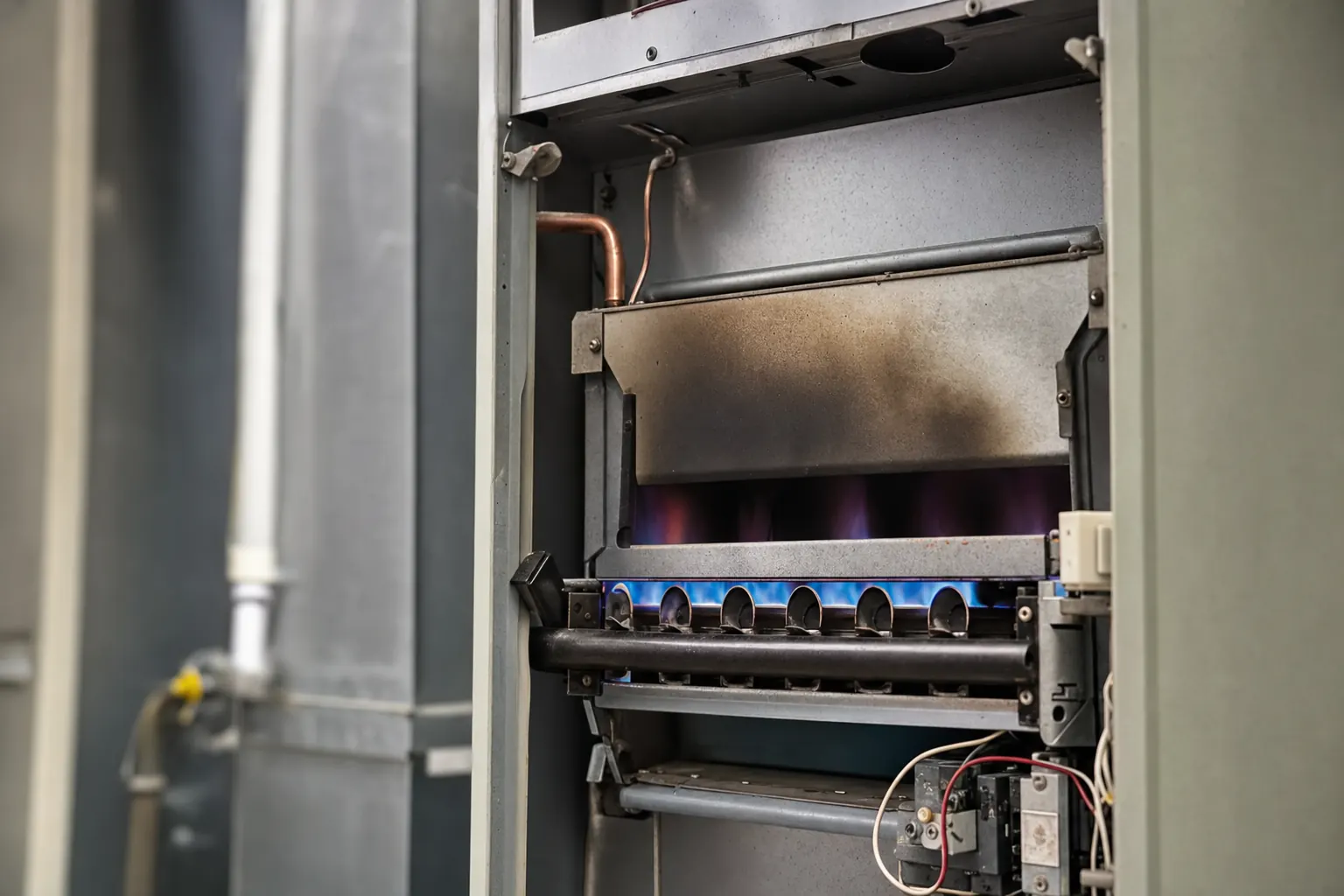
On a heating system page, a carbon monoxide alarm most strongly points to exhaust from a furnace or boiler not staying contained and vented outdoors. A cracked heat exchanger can let burner gases mix with household air, while a blocked or loose vent can dump exhaust near the appliance. If the warning appeared when heat started and stopped after the system shut down, that pattern strongly suggests a combustion or venting problem tied to the heating cycle.
If the alarm continues even with the furnace off, the source can still be HVAC-related, but it may also be another fuel-burning appliance using the same flue, such as a water heater or boiler. That is why this symptom cannot be sorted out safely by watching a few cycles or trying basic homeowner fixes. Emergency responders or the gas utility should clear the structure first, and a qualified HVAC technician should inspect the venting and combustion system before the equipment is used again.
How technicians usually separate the likely causes
After the home is declared safe to enter, a service visit typically focuses on combustion analysis, vent integrity, draft testing, inducer operation, burner condition, and heat exchanger inspection. On condensing furnaces, technicians often check for blocked intake or exhaust piping, failed pressure-switch operation, and condensate issues that can affect venting. On conventional furnaces or boilers, they usually inspect the metal flue, chimney draft, rusted sections, disconnected joints, and signs of flame rollout or soot.
What affects repair cost and what outcomes are common
Costs depend heavily on whether the issue is a venting repair or a major combustion-component failure. A basic carbon monoxide/combustion diagnostic visit is often in the roughly $150 to $450 range, while vent pipe or chimney-connector repairs may fall around $250 to $1,500 depending on access and materials. If the problem is a failed inducer assembly, repair can commonly run about $500 to $1,800; if a heat exchanger is cracked, many homeowners face either a very expensive major repair or full furnace replacement, often several thousand dollars.
Cost ranges are estimates developed from standardized project scopes and reviewed pricing inputs. Government labor and regional cost data are used where applicable. See our Pricing Methodology for the exact sources, calculations, and review date. Actual prices vary by property, scope, materials or equipment, location, and provider.
When to turn the system off
- Do not operate or approach the equipment
- Keep everyone outside until the authority clears the home
When to call for help
- Call when the symptom continues after the safe checks
- Call promptly when comfort is lost for the whole home
- Describe when it started and any water, ice, noise, odor, alert, or breaker activity
Cost guidance
What could this cost to fix?
Price depends on the actual cause, equipment, access, and local labor. Compare the national ranges in the HVAC Repair Cost guide, or check service availability for your system.
Find local help for Emergency HVAC Repair
We will keep this problem and recommended service selected while you answer a few quick availability questions.
Browse HVAC help by stateFrequently asked questions
Carbon monoxide alarm is sounding: common questions
Why did my carbon monoxide alarm go off only when the heat turned on?
My carbon monoxide alarm stopped after the furnace quit. Is it safe to go back inside?
Can a furnace really cause headaches and dizziness in the house?
What will an HVAC technician check after a carbon monoxide alarm event?
Could the alarm itself be bad instead of there being carbon monoxide?
Sources and review standard
Last updated July 18, 2026. Last reviewed July 18, 2026. HVAC Rescue reviews problem pages for homeowner-safe boundaries, service routing, source quality, and unsupported claims. No named technical reviewer is shown unless a qualified HVAC reviewer has completed that review.