Reviewed July 22, 2026
HVAC Rescue Editorial Team
Editorial StandardsYes. Properly selected cold-climate heat pumps can heat homes in sub-zero weather, but low-temperature output is model-specific and must be compared with the home's calculated load. To earn the ENERGY STAR Cold Climate designation, current criteria require a qualifying heat pump to deliver at least 70 percent of its nominal heating capacity at 5 degrees Fahrenheit and achieve a coefficient of performance of at least 1. 75 at that test point. Some models publish operating data below 0F, but minimum operating temperature is not the same as enough capacity to heat a particular home.
The honest caveats are about economics and design, not survival. Every heat pump loses capacity and efficiency as the temperature falls, so the questions worth asking are more specific: which model, sized how, with what backup plan, and at what electricity price. This guide walks through each one — including what mass adoption in Maine, one of the coldest states in the country, shows about real-world winter performance.
Why the Answer Changed
Many older heat pumps used single-speed compressors and lost output quickly as outdoor temperature fell, increasing reliance on electric resistance backup. Modern cold-climate designs often use variable-speed, inverter-driven compressors and other low-ambient strategies to retain more heating capacity. Compare ENERGY STAR certification and the manufacturer's extended performance tables at temperatures near your local design condition rather than relying on a product family name or a single seasonal efficiency rating.
What Actually Happens as It Gets Colder
A heat pump does not create heat; it moves heat from outdoor air into the house, and even 0F air holds extractable heat. As the temperature drops, two curves cross: the unit's heating capacity falls at the same time the home's heat loss rises. Efficiency slides too. A system producing 3 to 4 units of heat per unit of electricity in mild weather (a COP of 3 to 4) typically delivers a COP around 2 at 5F and drifts toward 1. 5 in deep sub-zero cold. Even then it is still well ahead of electric baseboard or space heaters, which never exceed a COP of 1.
Two normal cold-weather behaviors surprise new owners. First, defrost cycles: in humid air below about 40F, frost builds on the outdoor coil, and the unit periodically reverses itself for a few minutes to melt it. A plume of steam and water dripping from the outdoor unit are normal. Second, supply-air temperature: a heat pump typically delivers air at 85 to 105F, versus 120 to 140F from a gas furnace. The house gets just as warm, but the airflow feels cooler at the register, and long, steady, low-speed runs are how these systems are designed to operate — not a sign of trouble.
Balance Point and Backup Heat
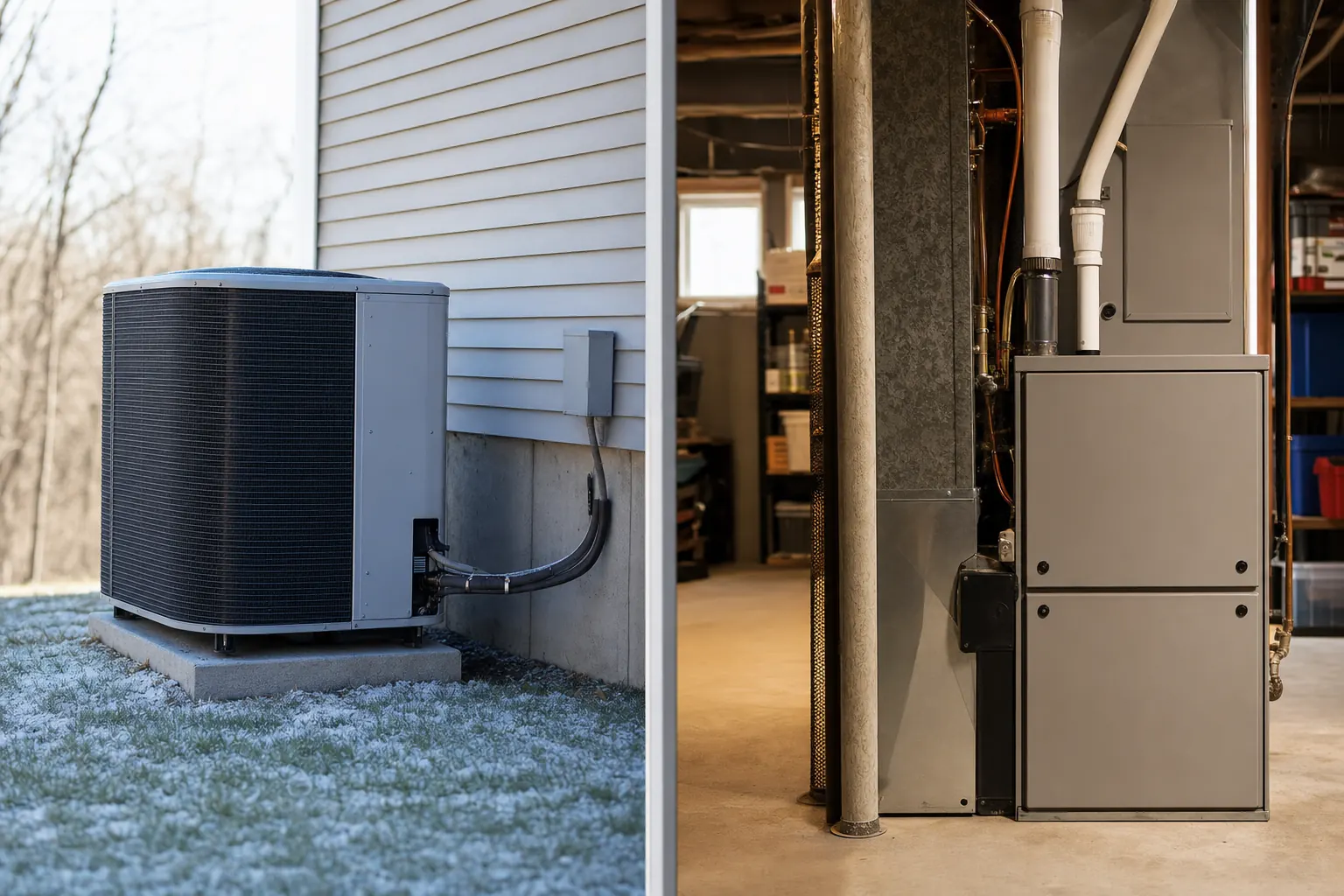
The balance point is the outdoor temperature at which the heat pump's output exactly matches the home's heat loss. Above it, the heat pump carries the house alone; below it, something has to help. Standard-efficiency heat pumps often hit their balance point around 25 to 35F. A properly sized cold-climate unit in a reasonably tight house can push it into the single digits or below zero. This is a calculable number — it comes from a load calculation plus the manufacturer's extended performance tables — so ask an installer for it in writing rather than accepting a guess. Below the balance point, one of three backup arrangements takes over:
- Electric resistance strips (auxiliary heat): common in all-electric air handlers. Resistance heat delivers about one unit of heat per unit of electricity, while an operating heat pump can deliver more than one, so extended strip-heat use can materially raise consumption. The installed strip capacity and controls should come from the home's load and the heat pump's low-temperature output.
- Dual fuel: a heat pump paired with a gas or propane furnace, with the thermostat switching to the furnace below a set changeover temperature — commonly somewhere between 25 and 40F, chosen by comparing your fuel prices. Popular where natural gas is cheap and winters are long.
- An existing system kept as backup: many cold-state homeowners run a heat pump as primary heat and keep an oil boiler, furnace, or wood stove for the deepest cold snaps — the standard pattern across much of Maine.
Weighing a cold-climate heat pump, or need an existing one checked before winter? HVAC Rescue can connect you with independent HVAC professionals in your area.
(866) 373-0169What Maine's 100,000 Heat Pumps Show
Maine is a useful stress test: winter design temperatures sit below zero across much of the state, and most homes historically heated with oil or propane. The state set a goal of 100,000 new heat pumps by 2025 — and hit it in 2023, two years early, according to the Governor's office, which then set a new target of 175,000 additional installations by 2027. Efficiency Maine's installation data show adoption running broad and deep in rural and northern Maine, not just along the milder coast. Two lessons travel well. First, cold-climate units keep producing heat through below-zero snaps; Maine homeowners commonly keep an existing oil system or wood stove as backup for the coldest stretches, not for everyday use. Second, the economics were compelling there precisely because heat pumps were displacing oil and propane — fuels they beat easily on running cost. If the technology works at scale through Maine winters, cold weather itself is not the obstacle for most of the country.
Will It Cost More Than Gas to Run?
This is where the real trade-off lives, and it comes down to three numbers: your electricity price, your gas price, and the seasonal efficiency your unit actually achieves. A 95-percent-efficient gas furnace delivers about 27. 8 kWh of heat per therm, which gives a quick rule of thumb: a heat pump breaks even when its seasonal COP is about 28 times your electricity price (in dollars per kWh) divided by your gas price (in dollars per therm). At recent national averages — roughly $0. 16 to $0. 17 per kWh and $1. 30 to $1. 50 per therm — the breakeven COP lands around 3 to 3. 4, which makes a good cold-climate heat pump roughly a wash with inexpensive natural gas over a heating season. Where electricity is cheap, as in parts of the Pacific Northwest at $0. 10 to $0. 12 per kWh, the heat pump clearly wins. Where electricity is expensive and gas is cheap, the furnace can cost less to run in the coldest months. Against oil, propane, or electric resistance heat, the heat pump wins by a wide margin almost everywhere.
Cost ranges are estimates developed from standardized project scopes and reviewed pricing inputs. Government labor and regional cost data are used where applicable. See our Pricing Methodology for the exact sources, calculations, and review date. Actual prices vary by property, scope, materials or equipment, location, and provider.
One 2026 note on price: the federal 25C tax credit that covered up to $2,000 of a qualifying heat pump installation expired for systems installed after December 31, 2025. Plenty of state and utility incentives continue — income-qualified rebates under the federally funded, state-run Home Electrification and Appliance Rebates program can reach $8,000 where states have launched it, and programs such as Efficiency Maine and Mass Save still offer substantial rebates — so check your state energy office before pricing a project.
Sizing and Installation Quality Decide the Outcome
Many cold-weather performance complaints begin with design shortcuts: no load calculation, equipment selected from nominal capacity instead of low-temperature output, an undersized electrical or backup-heat plan, or an outdoor unit placed where snow and defrost water interfere with operation. Good practice includes an ACCA Manual J load calculation, equipment selected from extended performance tables near the local design temperature, a stated balance point, deliberate auxiliary-heat or dual-fuel controls, and an outdoor unit mounted with suitable clearance and drainage.
- 1
Pull your real fuel prices
Find dollars per kWh on your electric bill and dollars per therm (or per gallon of oil or propane) on your fuel bill. These two numbers drive the running-cost math more than anything else.
- 2
Check performance at 5F, not the nameplate
Ask for the model's rated heating capacity near your local winter design temperature, verify any ENERGY STAR Cold Climate claim, and compare that output with the home's calculated load.
- 3
Get the balance point in writing
A contractor who has run a Manual J load calculation can tell you the outdoor temperature at which the unit stops covering the whole house — and exactly what takes over below it.
- 4
Choose the backup strategy deliberately
All-electric with auxiliary strips, dual fuel with a furnace, or an existing system kept in place. Set the changeover or lockout temperature based on your fuel prices, not the factory default.
- 5
If you already own one, set it up for winter
Keep 12 to 18 inches around the outdoor unit clear of snow and drifts, leave room beneath it for defrost water to drain, avoid deep overnight thermostat setbacks that trigger auxiliary heat, and have the system serviced before the season.
If an existing heat pump is not keeping up — indoor temperatures falling while it runs constantly, an auxiliary-heat indicator that never turns off, or ice on the outdoor coil that defrost cycles never clear — those are service calls, not verdicts on the technology. A technician can check refrigerant charge, defrost operation, and control settings, and tell you whether the real issue is the equipment, the sizing, or the house itself.
Sources and fact-checking
Reviewed July 22, 2026. We favor primary government and standards sources for safety, efficiency, and regulatory claims. These references support the technical and consumer guidance on this page.
- Heat pumpsU.S. Department of EnergyHeat-pump operation, system types, climate considerations, and backup heat.
- Heat pump equipment key product criteriaENERGY STARCurrent cold-climate heat-pump efficiency, capacity-retention, and low-ambient performance criteria.
- ENERGY STAR heating and cooling guidanceENERGY STAREfficiency, replacement planning, qualified equipment, and contractor questions.