
Reviewed July 27, 2026
HVAC Rescue Editorial Team
Editorial StandardsGetting thermostat problems diagnosed correctly
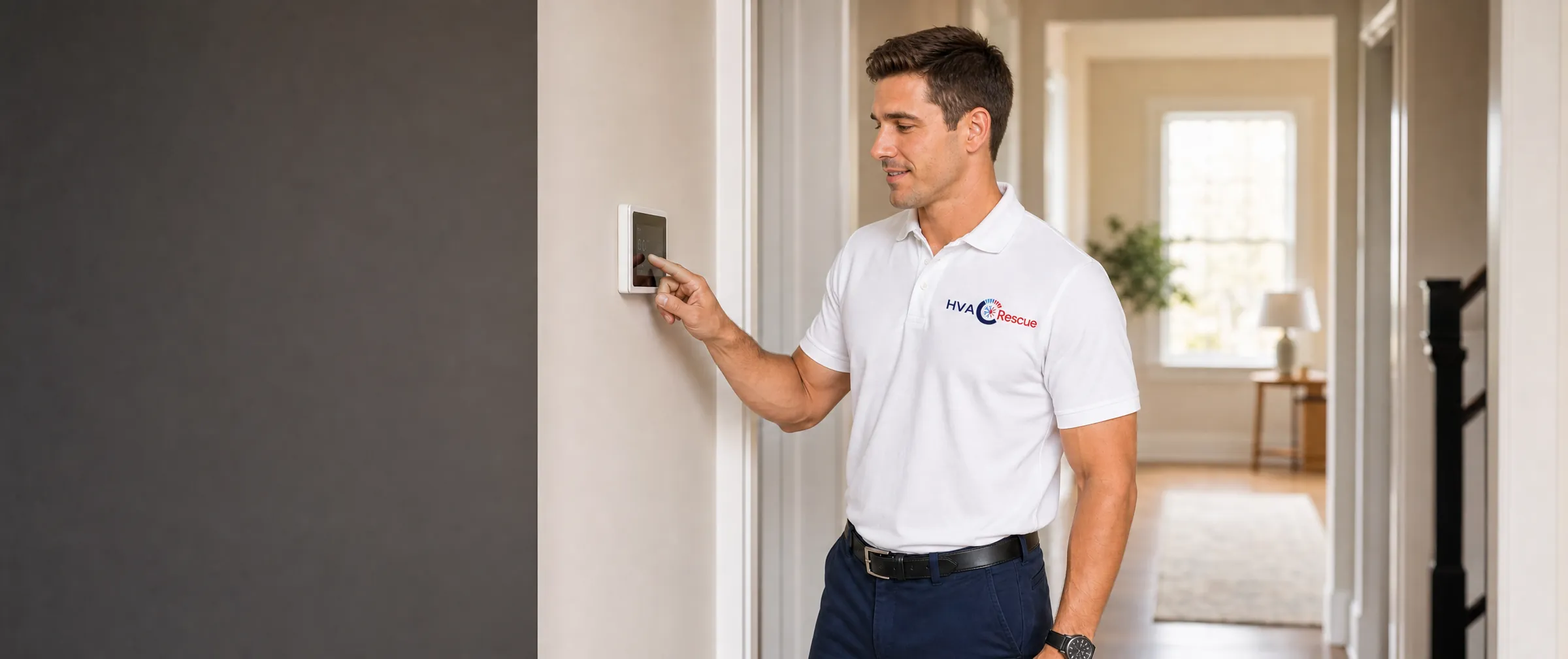
Thermostat repair is the right starting point when the wall control seems to be the problem. Common signs include a blank screen, buttons that do nothing, settings that will not hold, a room temperature reading that feels wrong, or a system that will not start even though the thermostat appears to be on. In many homes, the heating and cooling equipment is still capable of running, but the thermostat is not sending the right signal or is not reading conditions correctly.
This is different from thermostat installation or replacement, which focus on adding a new control or swapping an old one out. It is also narrower than general HVAC repair. If the thermostat is clearly acting up, thermostat repair helps sort out whether the fault is in the control itself, its power or wiring, or the system it commands.
Thermostat Repair in Alaska: what’s different here
Alaska’s very-cold climate makes thermostat repair especially important because heating is the main HVAC priority for most of the year. Coastal areas may deal with damp conditions, while Interior regions face the most severe cold, so thermostat performance matters across very different home environments.
In Alaska, a blank, unresponsive, or inaccurate thermostat can leave a furnace or boiler cycling poorly during a season when every heating call matters. Long heating demand, uneven room temperatures, and aging equipment can all make thermostat issues more noticeable, especially when homes are sealed tightly against winter weather.
Because Alaska winters can be severe, it is smart to address thermostat problems quickly rather than waiting for a complete no-heat situation. A qualified HVAC professional can diagnose whether the issue is the thermostat itself or part of a larger heating-system problem, which is especially important with furnaces and boilers that must keep working through long cold spells.
- Heating control is critical across Alaska’s long winter season.
- Thermostat issues can quickly affect furnaces and boilers in deep cold.
- Interior and coastal Alaska homes can face different heating challenges.
- Reliable thermostat repair helps support comfort and efficiency.
Thermostat Repair decisions for Alaska homes
Determine whether the symptom originates in settings, sensing, placement, batteries, low-voltage power, wiring, zoning, controls, or the HVAC equipment. For Alaska, the relevant state focus is equipment mix, operating modes, utility programs, seasonal control modes equipment and backup-heat context. Repair settings, connections, power, sensing, or compatible control faults when supported; replace the thermostat only when the control itself is failed, obsolete, incompatible, or no longer useful.
Repairing vs. Replacing a Thermostat
Many thermostat issues turn out to be simple fixes, such as fresh batteries, restored power, or a corrected setting. In other cases a loose wire or a minor fault can be repaired without replacing the unit at all.
When a thermostat is old, damaged, or no longer reading temperatures accurately, replacement is often the more dependable choice, and it can be a good time to consider a programmable or smart model. An HVAC professional can tell you whether your thermostat is worth repairing or better replaced for reliable control.
Repair often makes sense when
- The problem is a setting, battery, or power issue
- A single loose wire or connection is the cause
- The thermostat is fairly new and otherwise reliable
- A minor fault can be corrected without a full replacement
Consider replacement when
- The thermostat is old and reads temperatures inaccurately
- The display or controls are physically damaged
- Repairs would cost close to a replacement
- You want to upgrade to a programmable or smart thermostat
How much does thermostat repair cost in Alaska?
Thermostat repair scope in Alaska varies with the fault, wiring, power supply, equipment compatibility, controls, accessories, and diagnostic work. The factors below define the work:
- Whether the problem is limited to the thermostat or tied to a larger HVAC control issue
- If the thermostat is battery powered, hardwired, programmable, or smart-enabled
- Whether the issue involves simple reconfiguration or deeper troubleshooting
- The condition of the low-voltage wiring behind the thermostat
- Whether a blown fuse, breaker issue, or power interruption affected the control
- The age and model of the thermostat, since repairing older units can be less practical than replacing them
- Whether the thermostat controls a basic system, multiple stages, or a heat pump
- If access to the thermostat wiring or equipment controls is unusually complex
- Whether testing shows the heating or cooling equipment is also part of the problem
- Provider availability and demand in your area
Get thermostat repair help in Alaska
One quick call connects you with HVAC pros who service your area. No pressure, no obligation.
Alaska climate & seasonal demand
Heating is the central concern across Alaska, where systems must run reliably through long, severe winters. Furnaces, boilers, and cold-climate heating equipment are essential, and any failure during deep cold is a serious matter. Cooling is rarely a priority, so the focus stays on dependable warmth, fuel efficiency, and steady airflow.
Cooling needs are minimal in most of Alaska, with only brief mild stretches in summer. Many homes rely on natural ventilation rather than mechanical cooling.
The heating season is long and demanding, and a reliable system is critical through deep winter cold. Regular maintenance helps reduce the chance of a failure when temperatures are at their lowest.
Thermostat repair in Alaska often becomes most urgent during the long heating season, when even a small control issue can affect comfort and safety. Short summers usually mean cooling is not the focus, so homeowners are more likely to notice thermostat problems when the system should be delivering steady heat through deep cold.
A thermostat that is working correctly helps support fuel efficiency, steadier airflow, and more even temperatures from room to room. In Alaska homes, that can make a real difference because heating systems are expected to run reliably for extended periods without wasting energy or creating cold spots.
- Furnaces and boilers strained by long, intense heating demand
- No-heat emergencies during severe cold snaps
- Frozen or poorly insulated lines and equipment
- Inconsistent heat distribution between rooms
- Aging heating systems losing efficiency
- Indoor air quality issues from tightly sealed winter homes
Before you call: what to have ready
Before requesting service, check whether the thermostat display is blank, whether the settings match your comfort needs, and whether the batteries need replacing if your model uses them. It also helps to note what the heating system is doing, since that information can help the technician diagnose the issue faster. For Thermostat Repair in Alaska, relate this guidance to the actual equipment, property, and written scope.
Questions to ask before approving work
- Are you licensed and insured for HVAC work in this state?
- Will a technician give a written, itemized estimate before any work starts?
- Is the diagnostic fee waived or credited if I approve the repair?
- For a new system, will you run a Manual J load calculation to size it correctly?
- What parts and labor warranties come with the repair or installation?
- Are your technicians NATE-certified or manufacturer-trained?
- Can you pull the required permits and schedule any needed inspection?
- Do you offer financing or maintenance plans, and what do they cover?
What happens during service
- 1
Connect with a local pro
Reach out and we help connect you with HVAC professionals that service your area. Availability may vary by location and provider, and the local pro handles scheduling and pricing directly.
- 2
Describe the thermostat issue
Share what the thermostat is doing, whether that is a blank display, unresponsive controls, wrong temperature readings, or the system not following settings.
- 3
Review the symptoms on site
The technician evaluates the thermostat, the visible wiring, and how the heating and cooling system is responding to determine whether the issue is isolated or part of a broader control problem.
- 4
Check power and configuration
Basic causes such as batteries, power loss, tripped breakers, incorrect modes, or scheduling conflicts are checked before moving into deeper diagnostic work.
- 5
Inspect wiring and control signals
If needed, the pro examines low-voltage connections and tests whether the thermostat is communicating properly with the HVAC equipment.
- 6
Complete the appropriate repair
Depending on the findings, the repair may involve correcting settings or system configuration, repairing or reseating low-voltage connections, replacing a blown control fuse, restoring power to the control circuit, or reprogramming the thermostat for your equipment.
- 7
Test system operation
After the repair, the technician verifies that heating and cooling respond correctly, temperature control is working as expected, and the thermostat is operating reliably.
Thermostat Repair in Alaska: common questions
How does Thermostat Repair in Alaska differ from warmer states?
Can homeowners in Anchorage or Fairbanks wait on a thermostat issue?
What should I do if my thermostat is blank in Alaska?
Do Alaska homes need thermostat repair even if they rarely use cooling?
Sources and fact-checking
Reviewed July 27, 2026. We favor primary government and standards sources for safety, efficiency, and regulatory claims. These references support the technical and consumer guidance on this page.
- Smart thermostats key product criteriaENERGY STARCertified smart-thermostat capabilities, temperature accuracy, standby power, and measured energy-savings criteria.
- Guide to installing air-source heat pumpsU.S. Department of Energy Building Science EducationThermostat placement on an interior wall away from direct sunlight, appliances, and drafts.
- ENERGY STAR heating and cooling guidanceENERGY STAREfficiency, replacement planning, qualified equipment, and contractor questions.