Quick summary
Match what you notice to a safe next step
These observations can narrow the starting service, but they do not confirm which part has failed.
What you notice
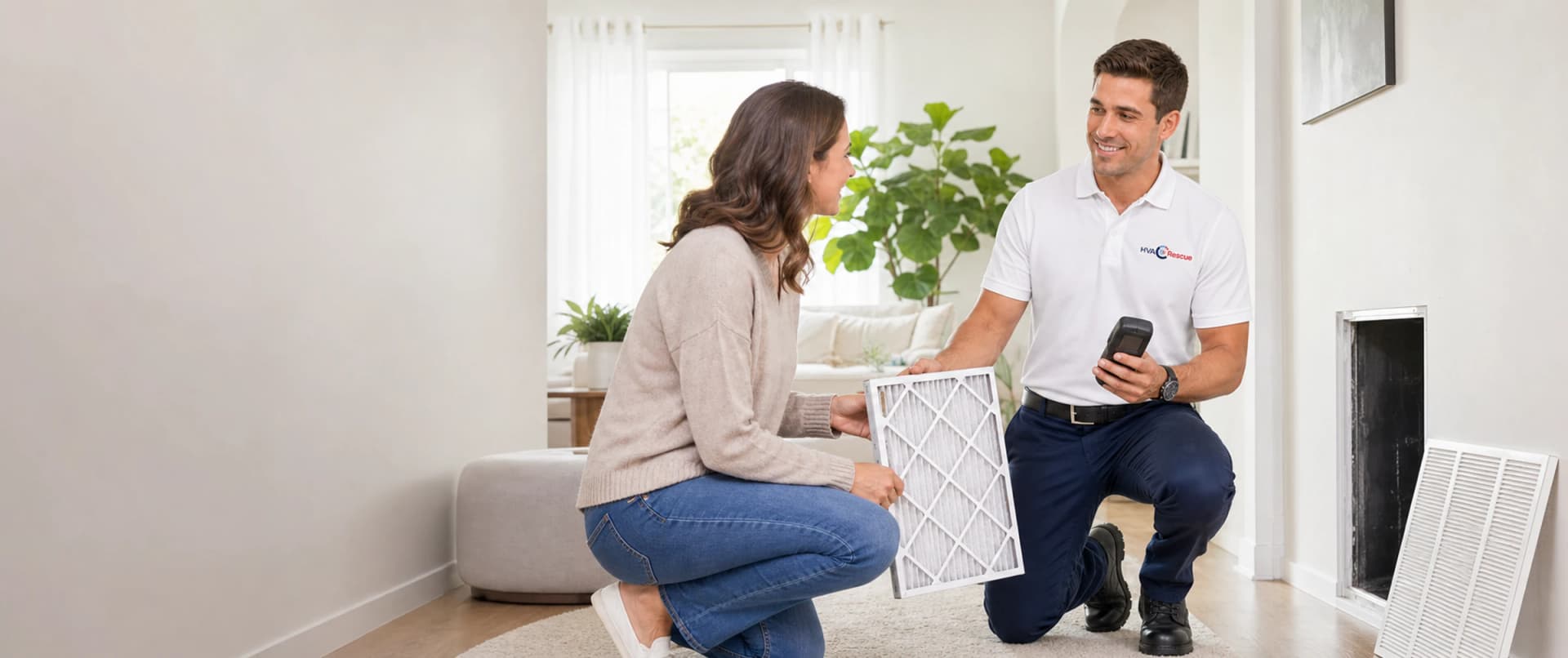
Packed or overdue purifier filter media
What it may point to
When the filter is saturated with dust, smoke particles, or pet hair, the purifier fan cannot pull enough air through it, so airflow drops sharply and the unit may run louder, overheat, or shut itself down.
Safe next action
Check the filter and look for visible moisture without opening equipment
What you notice
Blocked return grille, cabinet intake, or supply opening at the purifier
What it may point to
Furniture, storage boxes, lint buildup, or a collapsed flex connection can choke the purifier even if the filter itself is clean, leaving the home stale because very little room air is actually moving through the device.
Safe next action
Turn the system off and request prompt service
What you notice
Failed blower wheel, fan motor, or run capacitor in the purifier
What it may point to
If the purifier has power but little or no air movement, the fan assembly may be spinning too slowly, failing to start, or stopping after a few minutes, which usually points to a mechanical or electrical part inside the unit.
Safe next action
Stop the furnace or boiler and arrange qualified inspection
What you notice
Control board, transformer, or power-supply fault
What it may point to
An in-duct or powered whole-home purifier can appear dead when its low-voltage control circuit, internal fuse, transformer, or board fails, so the purifier will not energize even though the rest of the HVAC system still runs.
Safe next action
Check filter condition and whether ventilation controls are enabled
Safe things to check
- Check the filter and visible control setting
- Look for visible moisture around accessible drains
- Note which rooms and times of day are affected
Do not attempt
- Do not open sealed electrical or equipment panels
- Do not bypass a safety switch or force repeated restarts
A few quick questions
Refine the best next step
Question 1 of 3
- 1How much of the home is affected?
- 2What is the system doing right now?
- 3When did this begin?
What this symptom can mean
Use the evidence you can observe
What low airflow from an air purifier usually means
This symptom points to a problem inside the air purifier’s own air path or power train, not just a general indoor air quality complaint. A purifier that is moving less air than normal, cycling off, or not running at all is usually restricted by a loaded filter, starved by a blocked intake, or unable to spin its fan correctly. If the home feels stale without a strong odor, that often means the purifier is simply not processing enough room air to make a noticeable difference.
How to tell the likely causes apart
A musty or damp odor with weak airflow often shows up when the purifier has become so restricted that air circulation has dropped and stagnant air is lingering in the home; the purifier itself may not be drying or cleaning the air effectively anymore. If the unit powers on but the airflow at its outlet is weak, the filter or grille blockage is more likely than a complete electrical failure. If there are lights or display indicators but no fan sound, or the fan hums and never gets up to speed, the motor, capacitor, or blower wheel is more suspect.
A hot electrical smell or melting-plastic odor is different. That points away from a simple maintenance issue and toward overheating wiring, a failing motor winding, or a damaged circuit board. If you smell that kind of odor, leave the building and call emergency services from outside. Soot or black residue near heating equipment while the purifier is underperforming can mean the purifier is no longer trapping fine particles properly, but residue around fuel-burning equipment can also involve combustion issues, which should be evaluated promptly by a qualified technician.
What a technician usually checks on a service visit
On a service visit, the contractor will first identify what type of purifier you have: portable room unit, in-duct media purifier, electronic air cleaner, or powered whole-home purifier with its own fan section. They typically inspect the filter media, pressure drop across the purifier if applicable, intake and discharge openings, fan wheel condition, motor amperage, capacitor value, line and low-voltage power, board status lights, and any safety switches. If the unit is tied into the duct system, they may also check whether the purifier is receiving airflow from the furnace or air handler when it is supposed to.
What affects repair cost
Cost depends heavily on whether the fix is simple replacement media or an electrical failure inside the purifier. In 2025-2026, a basic diagnostic visit often lands around $99-$250, replacement media or cartridges are commonly about $20-$250 depending on purifier type, and clearing obstructions or cleaning accessible fan parts may add modest labor. Motor, capacitor, transformer, or control-board repairs can range from roughly $150-$900+, and some older portable or whole-home purifiers are more economical to replace than to rebuild if proprietary electronic parts have failed.
Cost ranges are estimates developed from standardized project scopes and reviewed pricing inputs. Government labor and regional cost data are used where applicable. See our Pricing Methodology for the exact sources, calculations, and review date. Actual prices vary by property, scope, materials or equipment, location, and provider.
When to turn the system off
- Stop if you smell gas, see smoke or sparks, or hear a carbon-monoxide alarm
- Stop if water reaches powered equipment or a breaker trips again
- Stop if loud grinding, booming, or heavy ice appears
When to call for help
- Call when the symptom continues after the safe checks
- Call promptly when comfort is lost for the whole home
- Describe when it started and any water, ice, noise, odor, alert, or breaker activity
Cost guidance
What could this cost to fix?
Price depends on the actual cause, equipment, access, and local labor. Compare the national ranges in the HVAC Repair Cost guide, or check service availability for your system.
Find local help for Indoor Air Quality
We will keep this problem and recommended service selected while you answer a few quick availability questions.
Browse HVAC help by stateFrequently asked questions
Air purifier has low airflow or is not working: common questions
Why does my air purifier turn on but barely blow any air?
Can an air purifier make the house smell musty if it stops moving air?
Why does my whole-home air purifier seem dead while the furnace and AC still work?
Is black dust near my furnace related to the purifier not working?
How long do air purifier fan motors and control boards usually last?
Sources and review standard
Last updated July 18, 2026. Last reviewed July 18, 2026. HVAC Rescue reviews problem pages for homeowner-safe boundaries, service routing, source quality, and unsupported claims. No named technical reviewer is shown unless a qualified HVAC reviewer has completed that review.