Reviewed July 25, 2026
HVAC Rescue Editorial Team
Editorial StandardsHow long do boilers last in real homes
Most homeowners asking this want a straight answer: a traditional cast-iron boiler often lasts about 20 to 30 years, and sometimes longer in mild-duty systems with clean water and consistent maintenance. A modern condensing boiler usually lands closer to 12 to 20 years. That shorter range does not always mean it is a worse product. Condensing boilers are more efficient and more complex, with tighter heat exchangers, control boards, fans, sensors, and condensate parts that create more possible failure points.
Actual life depends less on the brand name stamped on the jacket and more on operating conditions. Oversizing, frequent short cycling, untreated make-up water, leaks that constantly add fresh oxygen, poor venting, neglected combustion service, and bad near-boiler piping can cut years off the equipment. A boiler that runs quietly, heats evenly, and has a stable service history at 18 years old may still be a sensible repair candidate. Another boiler can be an obvious replacement at 12 years if the heat exchanger is leaking or the parts failures are piling up.
Why cast-iron and condensing boilers age differently
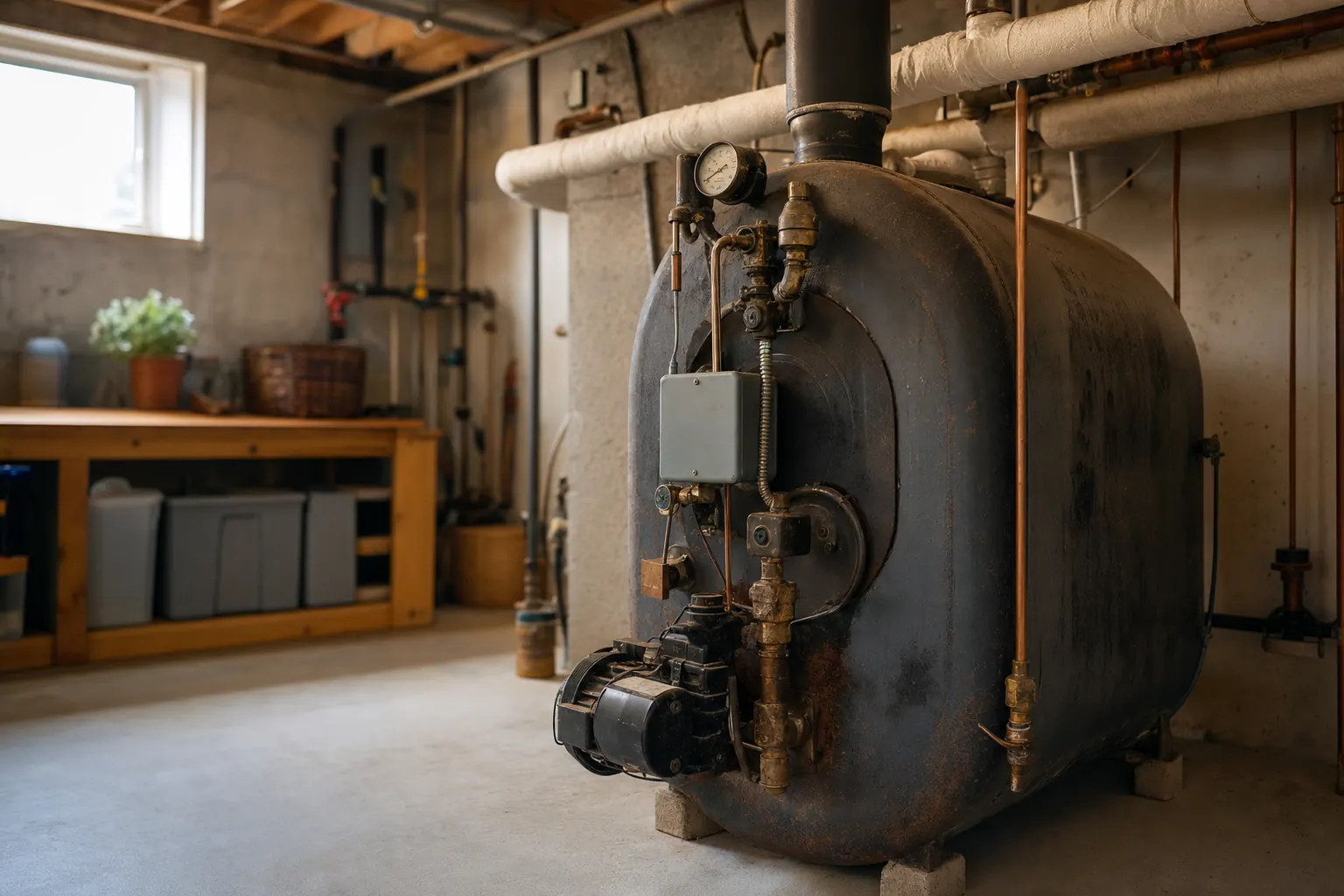
Cast-iron boilers are heavy, simple, and tolerant of imperfect conditions. Their sections hold up well if return water temperatures stay in the proper range and the system is not constantly taking in fresh water. Many are atmospheric or induced-draft designs with comparatively simple controls. They are not highly efficient by current standards, but there is less to break. That is why it is common to see a 25-year-old cast-iron unit still operating, especially in older homes with baseboard or radiators.
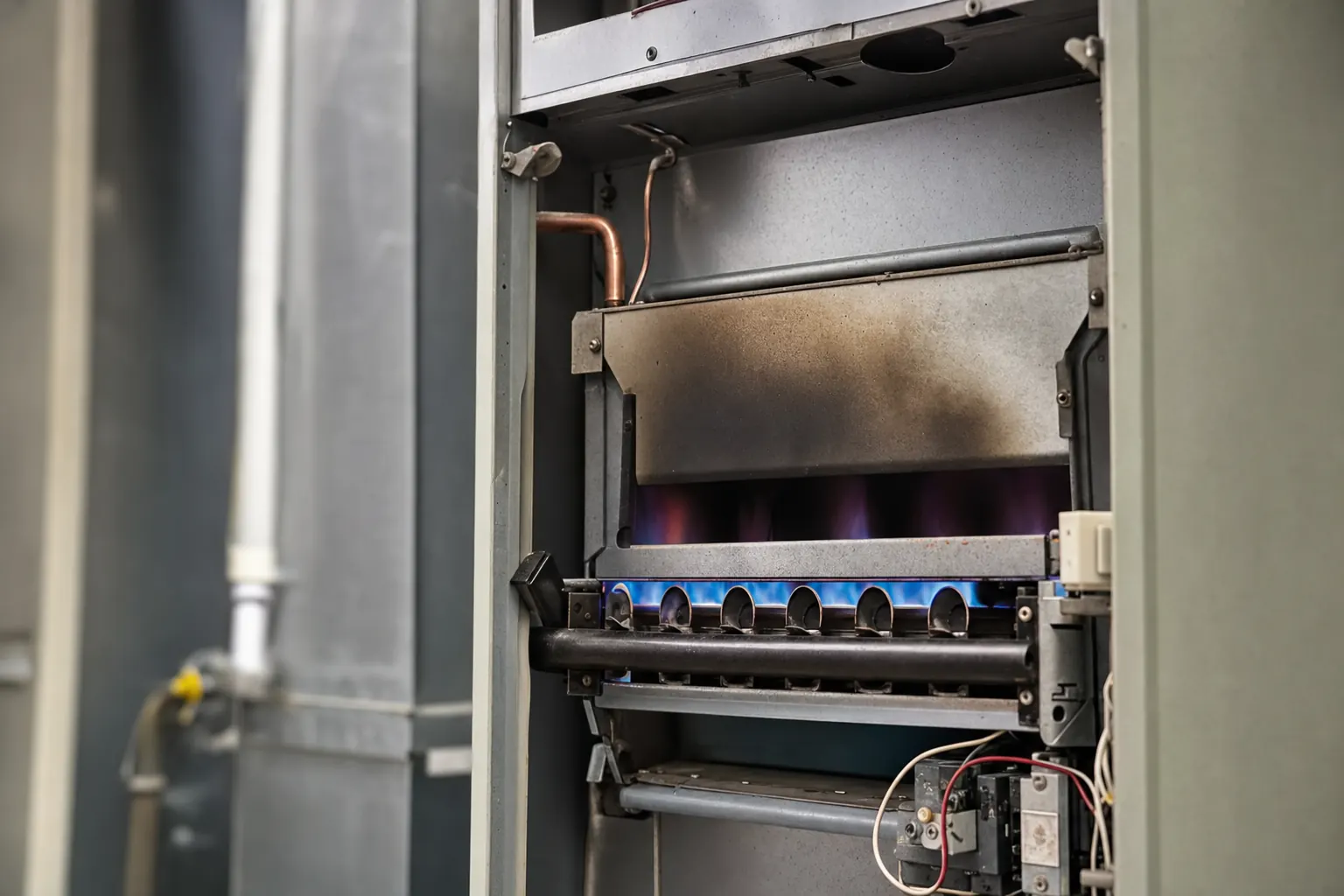
Condensing boilers extract more heat from the exhaust by cooling flue gases enough to produce acidic condensate. That boosts efficiency, often into the mid-90 percent AFUE range, but it also means the heat exchanger, drain path, venting setup, fan, sensors, and controls all matter more. These boilers usually do best with lower water temperatures and systems designed or adjusted to let them condense regularly. If installed on a system that forces high temperatures most of the winter, the efficiency advantage shrinks while the complexity remains.
- A cast-iron boiler can often justify repair deeper into its life if the block is sound and replacement parts remain available.
- A condensing boiler can still be the better ownership choice because lower fuel use may offset a shorter lifespan.
- Boilers in hard-water areas or systems with chronic leaks usually wear out sooner because fresh water brings minerals and oxygen into the system.
- A right-sized boiler that runs long, steady cycles usually lasts longer than an oversized unit that starts and stops constantly.
Failures that usually end a boiler
The failure that most often decides the matter is a cracked or leaking heat exchanger, boiler block, or cast-iron section. Once the pressure vessel itself is compromised, replacement is usually the practical path. On a cast-iron boiler, a leaking section can sometimes be replaced, but labor is heavy and the rest of the unit is still the same age. On many condensing models, a failed heat exchanger can cost so much in parts and labor that replacing the whole boiler makes more financial sense.
Another boiler-ending issue is severe corrosion from long-term water problems. If the unit has a history of relief-valve discharge, chronic make-up water, rusted sections, leaking fittings, and system sludge, repairing one visible problem may only expose the next one. Some older boilers also reach a point where critical controls or combustion components are discontinued. A boiler is not automatically done because a part is hard to get, but repeated downtime waiting for scarce components is a real ownership cost.
Vent and combustion issues can also push a replacement decision, especially if the existing setup no longer meets code or the chimney liner, vent connector, combustion air arrangement, or condensate disposal would need major corrective work. Those are licensed-technician items, not homeowner projects. Sometimes the boiler itself is still repairable, but once the required venting and safety upgrades are added to the bill, replacement becomes the cleaner long-term move.
Failures that are often worth repairing
Not every no-heat call means the boiler is at the end. Many failures involve replaceable components rather than the boiler body. Common examples include circulator pumps, expansion tanks, pressure-reducing feed valves, air vents, ignition parts, flame sensors, pressure sensors, low-water cutoffs, relays, zone valves, thermostats, and some control boards. On a reasonably young boiler with a sound heat exchanger, these repairs can be normal ownership rather than a sign of terminal decline.
Context matters. Replacing a circulator on a 9-year-old cast-iron unit is different from replacing a circulator on a 24-year-old boiler with rust at the sections and an unreliable gas train. The same part can be a routine repair in one case and money thrown at a dying system in another. A useful question for the contractor is not just, "Can this be fixed? " but "What else is likely next, given the condition of the boiler and system water? "
- Single-component failures with no sign of heat-exchanger leakage are often repairable, especially under about 15 years old.
- A repair is usually easier to justify if parts are common, the boiler has been reliable, and combustion test results are good.
- A repair is harder to justify if multiple zones have issues, the boiler has chronic pressure swings, or the cabinet and piping show long-term water damage.
- Annual repair spending matters. Two moderate repairs in two years can still be cheaper than replacement, but repeated no-heat events change the picture.
Signs replacement is now the cheaper path
Replacement usually becomes the cheaper path when the boiler has both age and structural problems, or age and repeated expensive component failures. A common rule of thumb is to look harder at replacement once a cast-iron boiler is past about 20 years or a condensing boiler is past about 15 years and now needs a major repair. That does not mean every older boiler should be scrapped. It means a large bill on old equipment deserves a whole-life cost discussion, not just a part swap.
Watch for this pattern: one year it is an expansion tank, next year a circulator, then ignition lockouts, then water on the floor, then pressure problems that never stay solved. None of those alone always kills a boiler, but together they often show a system entering the expensive phase of ownership. If the boiler cannot maintain stable temperature, struggles to heat the home on colder days, or the contractor finds combustion numbers drifting outside proper range, replacement deserves serious attention.
Fuel savings can also tip the math. If an older atmospheric boiler runs around 80 to 84 percent AFUE and a replacement condensing model may deliver 90 to 95 percent under the right system conditions, lower gas use can help offset the installed cost over time. The size of that savings depends heavily on local fuel rates, climate, and how often the new boiler will actually condense. It is worth asking for realistic operating assumptions rather than optimistic best-case claims.
What replacement and major repair typically cost
For 2025-2026 budgeting, a straightforward residential boiler repair may range from about $300 to $1,500, while larger repairs such as control boards, circulators, gas-train-related diagnosis by a licensed technician, or multiple component replacements can run higher. Heat exchanger work, section replacement, or extensive leak-related labor can climb into several thousand dollars quickly. Exact cost depends on boiler type, accessibility, local labor rates, venting complexity, and whether additional hydronic components are involved.
Cost ranges are estimates developed from standardized project scopes and reviewed pricing inputs. Government labor and regional cost data are used where applicable. See our Pricing Methodology for the exact sources, calculations, and review date. Actual prices vary by property, scope, materials or equipment, location, and provider.
The standardized high-efficiency condensing gas-boiler replacement scenario used by this site ranges from about $6,500 to $14,750 or more, with the active pricing table supplying the current canonical range. Simpler cast-iron replacements on existing piping may be a smaller scope. Primary-secondary piping, pumps, zone controls, venting changes, condensate neutralizers, indirect water-heater integration, or chimney and gas-line modifications can push a condensing-boiler project higher. If near-boiler piping is messy, if there are multiple zones, or if old components around the boiler also need upgrading, the price can move up fast.
The useful comparison is not repair cost versus replacement cost in one moment. It is expected repair cost over the next three to five years, plus fuel use, plus reliability risk in winter. A $1,200 repair on a 10-year-old boiler may be perfectly rational. The same $1,200 on a 23-year-old unit with a rusty section and recurring low-water cutoff issues may simply delay a replacement you are likely to make soon anyway.
How to decide without guessing
Ask the contractor to separate the problem into two buckets: the immediate failed part, and the overall condition of the boiler and hydronic system. You want to know the boiler age, combustion test results, whether there is any evidence of leakage from the block or heat exchanger, whether system water quality is poor, whether make-up water is entering too often, and whether important parts are still readily available. This turns the conversation from "replace or repair" into a more useful risk assessment.
It also helps to ask what kind of replacement actually fits the house. Some homes with older high-temperature baseboard systems may still do well with cast iron. Others can benefit from a condensing boiler if radiation, controls, and water temperatures allow efficient operation. Ask whether the current boiler is oversized, whether outdoor reset would improve efficiency, and what surrounding components should be replaced at the same time. Good replacement decisions are system decisions, not just box-for-box swaps.
- Ask for the exact failed component and whether the pressure vessel or heat exchanger is still sound.
- Ask for the boiler age and a realistic estimate of remaining life if repaired today.
- Ask for a repair option and a replacement option in writing, including venting and piping changes if needed.
- Ask whether the new boiler choice matches your emitters, such as radiators, baseboard, or radiant floor heat.
- Ask what maintenance the replacement would require each year, especially for a condensing boiler.
Sources and fact-checking
Reviewed July 25, 2026. We favor primary government and standards sources for safety, efficiency, and regulatory claims. These references support the technical and consumer guidance on this page.