
Reviewed July 27, 2026
HVAC Rescue Editorial Team
Editorial StandardsStart with the need
When ductwork repair is the right next step
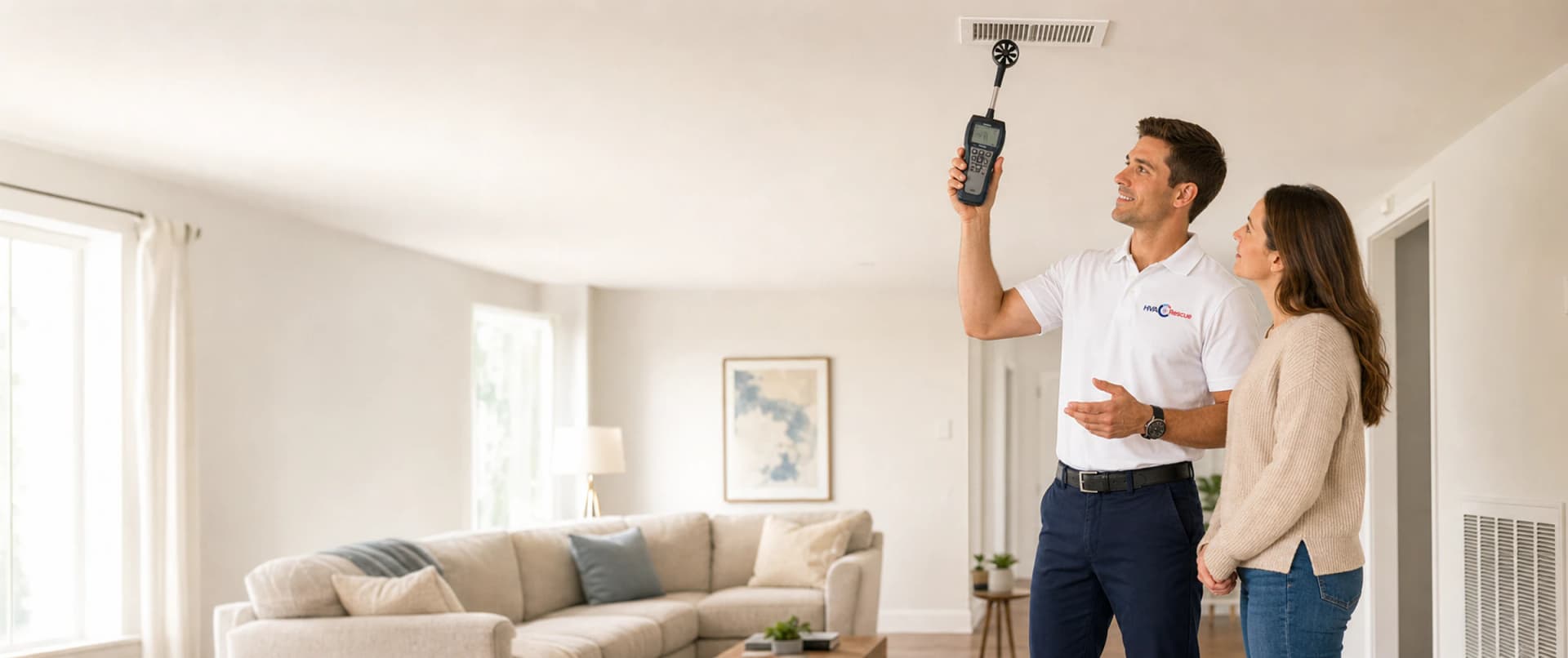
In Fishers, a sound ductwork repair plan separates the observable need from assumptions about equipment failure. Determine whether measured leakage, restriction, damage, insulation, or return-path problems explain the room-comfort complaint before repairing ducts. Uneven upstairs comfort in two-story Fishers homes. Ductwork repair should pair a physical inspection with airflow and pressure measurements so equipment, filter, coil, balancing, and layout problems are not mislabeled as duct leakage.
Ductwork repair should pair a physical inspection with airflow and pressure measurements so equipment, filter, coil, balancing, and layout problems are not mislabeled as duct leakage.
Understand the possibilities
What can shape a ductwork repair diagnosis
Leaking duct joints
Gaps at seams, joints, and connections let conditioned air escape before it reaches the rooms. That can leave distant rooms uncomfortable and force longer run times that show up as higher bills.
Crushed or disconnected runs
A crushed flex duct or a branch that has come apart can sharply reduce airflow to one area of the home. The usual symptom is a room or group of rooms with much weaker air from the vent than the rest of the house.
Poor duct sizing
If the original duct layout or sizing is off, some rooms may never get enough supply air or enough return airflow. The result is uneven temperatures even when vents are open and the system seems to be running normally.
Aging duct materials
Older duct materials can sag, tear, separate, or break down over time. As the duct system deteriorates, airflow can become uneven and dust may collect around vents or in rooms served by the damaged sections.
Damaged insulation
Missing or worn duct insulation in unconditioned spaces makes it harder to deliver air at the intended temperature. Air may arrive warmer in summer or cooler in winter, especially in rooms farthest from the equipment.
Homeowner-safe boundary
Ductwork Repair safety boundaries
Homeowner checks should stay simple and visual. The goal is to rule out obvious airflow blockers and gather useful observations, not to open equipment, take ducts apart, or work in unsafe spaces.
- 1
Open all room vents
Confirm that supply vents and registers are fully open in the rooms that feel wrong. If a closed or blocked vent is the cause, airflow may improve right away. If it does not, the problem may be farther back in the duct system.
- 2
Replace the air filter
A dirty filter can reduce airflow through the whole system and make some rooms feel especially weak. After replacing it, note whether airflow improves evenly or whether only certain rooms still lag behind.
- 3
Check accessible ducts
In safely reachable areas such as an unfinished basement or other open space, look only for obvious disconnected or badly damaged duct sections. Visible separation or crushed material strongly suggests air is being lost before it reaches the room.
- 4
Note dust and weak rooms
Write down which rooms have the weakest airflow and whether you see excess dust around nearby vents. That pattern helps separate a housewide equipment issue from a duct delivery problem affecting specific areas.
Stop and use the appropriate emergency or professional help for
- Avoid unsafe attic or crawlspace entry and do not disturb suspect insulation, contamination, standing water, damaged wiring, or smoke-affected duct material.
- Escalate when ductwork is associated with an immediate safety risk or dangerous loss of comfort.
- Escalate when duct is associated with an immediate safety risk or dangerous loss of comfort.
- Escalate when airflow is associated with an immediate safety risk or dangerous loss of comfort.
- Escalate when uneven rooms is associated with an immediate safety risk or dangerous loss of comfort.
- Escalate when air leak is associated with an immediate safety risk or dangerous loss of comfort.
Call for professional ductwork repair when basic checks do not explain the comfort problem or when the evidence points to hidden leaks, damage, or imbalance. A qualified technician can inspect accessible ductwork and confirm whether sealing, repair, or rebalancing is the next step.
Rooms stay off target
If some rooms remain too hot or too cold even with open vents and a clean filter, the issue may be air loss, restriction, or poor balance in the duct system. The system usually does not need to be shut off unless another serious safety hazard is present.
Airflow is weak
Weak airflow in one part of the home matters because it points to a delivery problem, not just a temperature setting issue. This is a common reason to have the duct path inspected for crushed, disconnected, or leaking sections.
Hidden leaks suspected
If bills rise without a clear cause, dust increases, or accessible ducts do not explain the problem, leaks may be in hidden runs or connections. Professional testing and inspection can narrow the fault without guessing.
Visible duct damage
A duct that is obviously disconnected, torn, or badly crushed can waste conditioned air and make nearby rooms uncomfortable. Professional repair is appropriate because sealing methods, support, and rebalancing affect whether the fix actually lasts.
Diagnosis before scope
How ductwork repair should be evaluated
- Step 1
Identify the symptom
Note which rooms are affected and how airflow differs.
- Step 2
Run safe checks
Confirm open vents and a clean filter first.
- Step 3
Connect with a pro
HVAC Rescue helps connect you with ductwork professionals that service your area.
- Step 4
Inspect the ducts
The technician checks accessible ductwork for leaks, damage, and balance.
Relevant local context
Ductwork Repair conditions that matter locally in Fishers
For ductwork repair, select only local facts about attic crawlspace layout insulation moisture and return paths; omit unrelated parts of the generic city HVAC profile.
Relevant local scenario
Consider a Fishers home with this documented context: Weak airflow in bonus rooms and finished basements. The service need may involve this goal or symptom: Rooms that are always too hot or cold. The local condition changes what should be observed and measured, but it does not prove why the equipment is behaving that way or justify a part replacement without diagnosis.
Property and access
Nickel Plate District homes and townhomes often need careful airflow balancing because layouts can be compact but layered
Planning consideration
To prepare for ductwork repair in Fishers, gather the system history, access constraints, observed need, and project goals. The selected city consideration is this: Use zoning or targeted airflow fixes in larger two-story homes to reduce wasted runtime. At the state level, indiana homes need dependable heating for cold winters and solid cooling for hot, humid summers. Furnaces carry the winter load, while air conditioning manages summer heat and moisture. The full range Repair accessible, limited defects when the layout and material remain serviceable; compare redesign or replacement when condition, access, sizing, contamination, or distribution makes spot work inadequate.
A balanced decision
Repair or replace?
Repair may be reasonable when
Many duct issues are localized and can be corrected by sealing joints, reconnecting sections, adding support, and restoring insulation. Targeted repair is often the practical choice when the system is otherwise in good shape.
- Leaks are concentrated at a handful of joints or connections
- The ducts are correctly sized for the system and the home
- Insulation is intact across most of the runs
- The existing layout delivers reasonably balanced airflow
- Damage is from a specific event, such as a crushed section
- The duct material is sound apart from the problem areas
Replacement deserves evaluation when
When ductwork is widely deteriorated, badly undersized, or built from materials that are failing throughout, repairing one section at a time can become a losing battle. A professional can help you weigh whether replacing some or all of the duct system makes more sense.
- Leaks and damage are spread across many sections
- Ducts are clearly undersized or restrict airflow throughout
- Old materials are brittle, crumbling, or failing in multiple spots
- Insulation is degraded along most of the system
- The layout creates chronically uneven room temperatures
- Repeated patch repairs have not solved the comfort problems
What can affect ductwork repair cost?
Ductwork repair can range from a single accessible patch to whole-home sealing; access, materials, leakage extent, insulation, testing, and whether runs need replacement shape the scope. ENERGY STAR reports that a typical home can lose 20 to 30 percent of the air moving through its duct system through leaks, holes, and poorly connected joints.
Quotes vary because duct systems vary. The final price depends on how large the system is, how many vents and HVAC systems are involved, the duct material and condition, how contaminated or neglected the system is, how difficult the ductwork is to reach, and what cleaning method or add-on services are included in the scope.
| Duct Repair | Typical range |
|---|---|
| Patch a single hole or reconnect a jointPer-repair pricing on accessible ducts; most companies also charge a service-call or diagnostic fee | $175 – $600 |
| Targeted leak sealing (mastic and foil tape)Hand-sealing leaks at accessible joints, boots, and plenum connections | $300 – $1,250 |
| Whole-house manual duct sealingEvery accessible joint sealed with mastic or UL 181 foil tape; typical for an average-size home | $1,000 – $4,100 |
| Aeroseal (aerosolized interior sealing)Seals leaks from inside the ducts, including runs you can't reach; large or complex homes can exceed $6,000 | $1,800 – $5,225 |
| Replace one crushed or damaged branch runRemoving and re-running a single flex-duct branch, including materials and labor | $375 – $950 |
| Attic or crawlspace repairs with difficult accessTight crawlspaces, deep attics, and rodent or moisture damage push labor time up | $800 – $3,825 |
Cost ranges are estimates developed from standardized project scopes and reviewed pricing inputs. Government labor and regional cost data are used where applicable. See our Pricing Methodology for the exact sources, calculations, and review date. Actual prices vary by property, scope, materials or equipment, location, and provider.
See the full duct repair cost guide for the complete breakdown, then call to get a real quote for your home.
What to expect
From symptom to a clear next step
A qualified technician should narrow the problem by comparing the rooms that feel wrong with the airflow the system is actually delivering. That may include checking accessible duct sections for leaks, disconnections, restrictions, damage, and balance problems before deciding what needs sealing, repair, or adjustment.
- Step 1
Connect with a local pro
Reach out and we help you connect with HVAC professionals that service your area. Availability may vary by location and provider, and the local pro handles scheduling and pricing directly.
- Step 2
Inspection and diagnosis
A technician inspects accessible duct runs, checks connections, and looks for leaks, damage, and insulation problems that affect airflow and efficiency.
- Step 3
Pinpoint the problem areas
Using their findings, the pro identifies which joints, sections, or runs are losing air or restricting flow, and explains what they observed.
- Step 4
Repair recommendation
You receive a clear explanation of the recommended work, whether that is sealing, reconnecting, re-supporting, or repairing specific sections.
- Step 5
Sealing and repair
The technician seals joints, reconnects loose sections, secures sagging runs, and addresses damaged material so air stays inside the ducts.
Common questions
Ductwork Repair in Fishers: questions and answers
Why does local context matter for ductwork repair in Fishers?
What information should I gather for ductwork repair in Fishers?
How do I know if my ducts are leaking?
Can leaky ducts really raise my energy bills?
Is duct sealing the same as duct cleaning?
Technical and safety guidance is supported by the sources below. Local context is limited to the service-relevant city facts selected by the repository and is not evidence that a particular component has failed.
Sources and fact-checking
Reviewed July 27, 2026. We favor primary government and standards sources for safety, efficiency, and regulatory claims. These references support the technical and consumer guidance on this page.
- Duct sealingENERGY STARHow duct leakage affects comfort and energy use, and appropriate sealing materials.
- HVAC ducted returnsU.S. Department of Energy Building Science EducationReturn-air pathways, room pressure balance, drafts, and temperature differences between rooms.
- Should you have the air ducts in your home cleaned?U.S. Environmental Protection AgencyWhen duct cleaning may be warranted, limitations, and consumer cautions.
- How to avoid a home improvement scamFederal Trade CommissionWritten estimates, contractor verification, payment cautions, and fraud warning signs.