Quick summary
Match what you notice to a safe next step
These observations can narrow the starting service, but they do not confirm which part has failed.
What you notice
Thermostat mislocation, miswiring, or incorrect installer settings
What it may point to
If cycling started right after a thermostat replacement, the control may be sensing heat too quickly, using the wrong cycle rate, or intermittently dropping the cooling call, so the system shuts off before the house actually cools.
Safe next action
Replace a visibly dirty filter and note cycle length
What you notice
Low refrigerant causing a low-pressure safety shutdown
What it may point to
The AC can start normally, run a few minutes, then trip a pressure safety and stop; left alone, this usually gets worse and can damage the compressor.
Safe next action
Confirm the mode, setpoint, and fan setting
What you notice
Oversized air conditioner
What it may point to
A system that is too large cools the thermostat area very fast and turns off in short bursts, which often leaves rooms uneven, sticky, and less comfortable even though the AC seems to run often.
Safe next action
Leave the equipment off and arrange service
What you notice
Condensate safety switch or float switch opening intermittently
What it may point to
If the unit stops after running briefly and then restarts later, a partially draining condensate system may be opening a safety circuit that cuts cooling to prevent overflow.
Safe next action
Note which zones are calling and which rooms are affected
Safe things to check
- Confirm the thermostat mode and setpoint
- Inspect the air filter and replace it if visibly dirty
- Make sure visible supply and return vents are open
Do not attempt
- Do not handle, vent, or add refrigerant
- Do not open sealed electrical or equipment panels
- Do not bypass a safety switch or force repeated restarts
A few quick questions
Refine the best next step
Question 1 of 3
- 1How much of the home is affected?
- 2What is the system doing right now?
- 3When did this begin?
What this symptom can mean
Use the evidence you can observe
What short cycling actually means
An air conditioner that turns on, runs only a few minutes, and shuts off before completing a normal cooling run is short cycling. On a hot day, a typical central AC often runs 10 to 20 minutes or longer per cycle, so repeated 2- to 5-minute cycles usually mean the system is being told to stop early or a safety control is forcing it off. That is different from an AC that runs constantly, leaks water, blows warm air, or simply makes noise but keeps operating.
What your observations can tell you
If the problem began right after a thermostat change, the thermostat is the first thing to suspect: wrong terminal wiring, a cycle-rate setting, a temperature sensor issue, or a thermostat mounted where it warms up quickly can all end a cooling call too soon. If the system stops right after a click, hum, sharp odor, or breaker trip, that points more toward an electrical fault such as a failing contactor, weak capacitor, overheated compressor, or overloaded circuit. If only one zone starts and stops wrong while the rest of the house behaves normally, the issue is often in the zone controls rather than the entire air conditioner.
Short cycling that shows up during hotter weather, especially if cooling has been getting weaker over time, raises concern for low refrigerant or another sealed-system problem. In that case, the AC may start, pressures drift out of range, and a safety switch stops the unit after a few minutes. A partially blocked condensate drain can also mimic short cycling if a float switch opens the low-voltage control circuit; the system may stop and then restart after water slowly drains away.
What a technician usually checks on this call
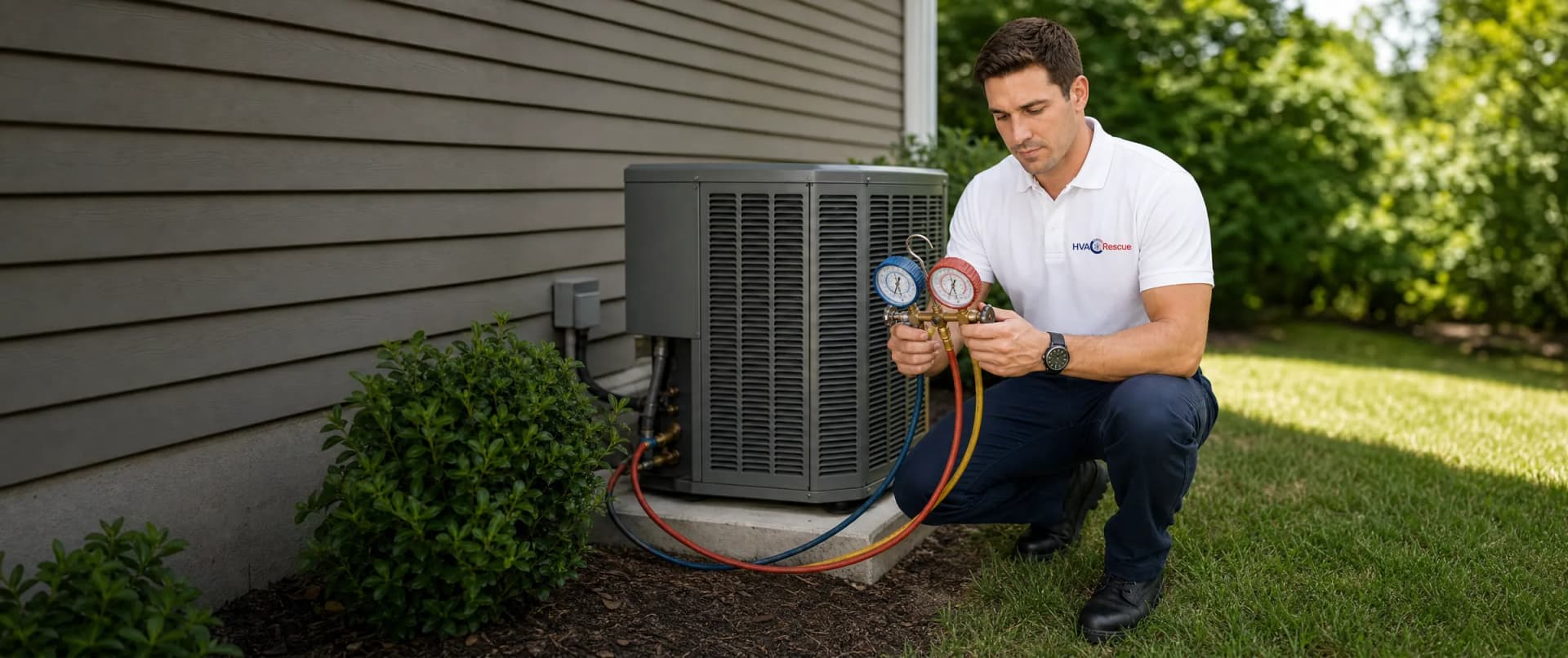
A service visit for short cycling usually starts with confirming the sequence: whether the thermostat is still calling for cooling when the unit stops, whether the indoor blower and outdoor condenser stop together, and whether any safety switch opens during the cycle. The technician will inspect thermostat wiring and setup, measure voltage and amperage, check the contactor and capacitor, look for fault codes, and verify condensate safeties. If refrigerant loss is suspected, they will test operating pressures and temperatures and inspect for leak evidence rather than simply adding refrigerant.
What affects repair cost
Cost depends heavily on why the cycle is being cut short. Thermostat setup or low-voltage wiring corrections are often on the lower end, while a new thermostat commonly falls around $150 to $500 installed depending on type and wiring needs. Electrical repairs such as a capacitor, contactor, or minor control work often land around $150 to $600, whereas refrigerant leak diagnosis and repair can range from a few hundred dollars into the thousands if the evaporator coil, line set, or compressor is involved. If the system is simply oversized, the real fix is not a tune-up but equipment redesign or replacement, which is a much larger project.
Cost ranges are estimates developed from standardized project scopes and reviewed pricing inputs. Government labor and regional cost data are used where applicable. See our Pricing Methodology for the exact sources, calculations, and review date. Actual prices vary by property, scope, materials or equipment, location, and provider.
Because repeated short cycles add hard starts and heat to motors and the compressor, this is a schedule-soon problem rather than one to ignore for weeks. A homeowner can safely observe the pattern and reset a tripped breaker once, but repeated breaker trips, electrical-burning odor, or smoke are stop-using-the-system conditions. HVAC Rescue is a referral service, not the repair company, so diagnosis, parts, timing, and final pricing come from the independent contractor who evaluates the system.
When to turn the system off
- Stop if you smell gas, see smoke or sparks, or hear a carbon-monoxide alarm
- Stop if water reaches powered equipment or a breaker trips again
- Stop if loud grinding, booming, or heavy ice appears
When to call for help
- Call when the symptom continues after the safe checks
- Call promptly when comfort is lost for the whole home
- Describe when it started and any water, ice, noise, odor, alert, or breaker activity
Cost guidance
What could this cost to fix?
Price depends on the actual cause, equipment, access, and local labor. Compare the national ranges in the AC Repair Cost guide, or check service availability for your system.
Find local help for AC Repair
We will keep this problem and recommended service selected while you answer a few quick availability questions.
Browse HVAC help by stateFrequently asked questions
AC keeps turning on and off: common questions
Why did my AC start short cycling right after I installed a new thermostat?
How long should a central AC normally run before shutting off?
Can a low refrigerant charge make my air conditioner turn on and off every few minutes?
Why is only one zone in my house short cycling while the others seem normal?
Is short cycling bad for the compressor?
Sources and review standard
Last updated July 18, 2026. Last reviewed July 18, 2026. HVAC Rescue reviews problem pages for homeowner-safe boundaries, service routing, source quality, and unsupported claims. No named technical reviewer is shown unless a qualified HVAC reviewer has completed that review.