Reviewed July 25, 2026
HVAC Rescue Editorial Team
Editorial StandardsDo you need a whole-home humidifier?
Usually, yes if your house gets uncomfortably dry every winter and portable units are not keeping up. A whole-home humidifier adds moisture through your forced-air system so humidity reaches many rooms without refilling multiple tanks. The best candidates are homes where winter indoor relative humidity regularly falls below about 30%, people wake with dry throat or bloody noses, wood floors or furniture shrink seasonally, or static shocks are common. The wrong candidate is a house that already gets window condensation or has moisture problems in walls, attics or crawlspaces.
The short version is this: bypass humidifiers are the cheapest and simplest, fan-powered units deliver more moisture for a moderate price, and steam humidifiers give the most precise humidity control but cost the most to buy and run. For many homes in moderate winter climates, a bypass or fan-powered unit is enough. In colder climates, the right answer depends as much on how tightly the house is built and how cold it gets outside as on the humidifier itself, because too much humidity can cause condensation, mold and rot.
What a whole-home humidifier actually does
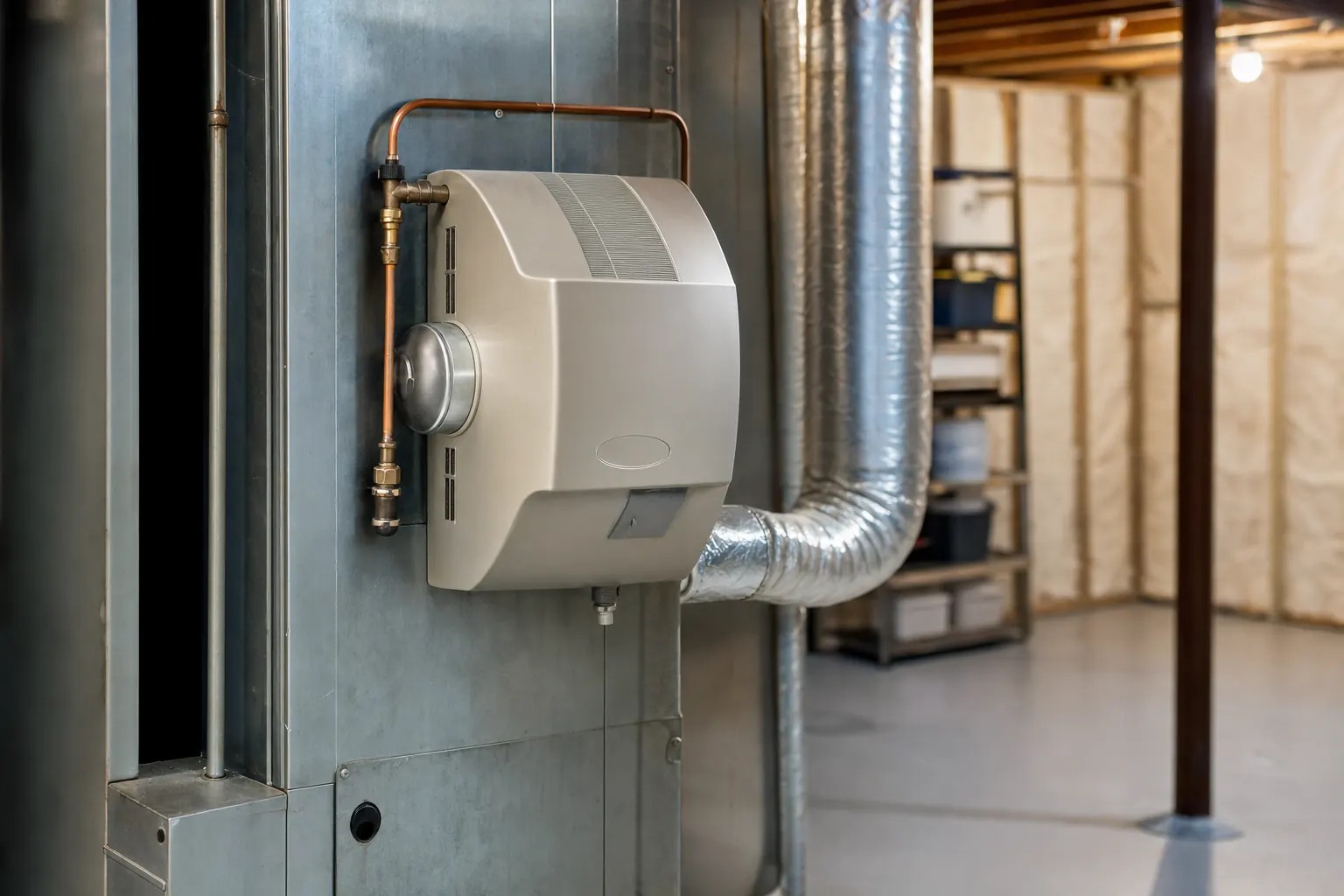
A whole-home humidifier is installed on or near the supply or return ductwork of a central forced-air system. It introduces water vapor or moisture into the air stream while the blower runs, then a humidistat turns the unit on or off to maintain a target relative humidity. Most systems are controlled by a simple wall humidistat, a thermostat with humidity control, or an outdoor-reset control that lowers indoor humidity targets automatically as outdoor temperatures drop.
The comfort case is straightforward. Air that is too dry can make skin, lips, throat and nasal passages feel irritated, and many people perceive 68°F air as more comfortable when humidity is in a normal winter range than they do at the same temperature with very dry air. The house materials case is also real: repeated winter drying can widen gaps in hardwood flooring, stress trim joints and dry out wood furniture. But humidification is not automatically healthy in every amount. The goal is balanced humidity, not maximum humidity.
- Most homeowners aim for about 30% to 40% indoor relative humidity in winter, not 45% to 50% regardless of conditions.
- As outdoor temperatures fall, safe indoor humidity usually has to fall too, especially in older or leakier windows.
- A humidifier cannot fix air leakage, poor insulation or existing mold problems, and it can make those problems worse if set too high.
- Homes without ductwork cannot use a standard duct-mounted whole-home humidifier unless a compatible air handler or ducted distribution system exists.
Bypass, fan-powered and steam humidifiers compared
A bypass humidifier is the simplest common type. Water flows over an evaporative pad, and a portion of the furnace blower air is diverted through the humidifier and back to the duct through a bypass duct. These units rely on warm moving air and the furnace blower to evaporate moisture, so output is modest. Typical installed cost in 2025 to 2026 is roughly $500 to $1,200 depending on controls, water line work and local labor. Many published manufacturer ratings land around 12 to 17 gallons per day under test conditions, but real output in a house is often lower.
Cost ranges are estimates developed from standardized project scopes and reviewed pricing inputs. Government labor and regional cost data are used where applicable. See our Pricing Methodology for the exact sources, calculations, and review date. Actual prices vary by property, scope, materials or equipment, location, and provider.
A fan-powered humidifier uses a built-in fan to push more air across the evaporative pad. That usually means higher output than bypass with no need for a separate bypass duct. Typical installed cost is about $700 to $1,500. Published capacities are often around 18 gallons per day, again under specific rating conditions. For many average-size homes, this type hits the practical sweet spot: more output than bypass, less expense and lower electrical demand than steam, and straightforward annual maintenance.
A steam humidifier boils water and injects steam directly into the duct or air stream. It is the most effective option for larger homes, tighter newer homes, or households that want faster response and steadier humidity independent of furnace heat. Typical installed cost is often about $2,000 to $4,500, and sometimes more if electrical work is needed. Published capacities commonly range from roughly 11 to 34 gallons per day depending on model. Steam units usually do the best job in shoulder seasons because they can humidify without depending much on warm supply air, but they have the highest energy use and usually the highest maintenance part cost.
What they cost to buy, run and maintain
Installed price is only part of the decision. Evaporative units, meaning bypass and fan-powered, are cheaper to buy and usually cheaper to operate, but they use water continuously while running and typically send some water to a drain. That is normal for many flow-through designs. Steam units cost more upfront and usually raise electric usage more noticeably because they actively heat water. Run time, electric rates, water rates, indoor setpoint, and climate determine operating cost.
Maintenance matters because output drops when pads, canisters or drain paths foul with mineral scale. For bypass and fan-powered units, the annual service item is usually an evaporative pad or water panel, often replaced once each heating season. Typical replacement cost for the part is around $15 to $60, plus labor if hired out. Steam units commonly use a replaceable steam canister or electrodes, and those parts often cost substantially more, commonly around $80 to $250 or more depending on model. Some systems also need drain cleaning, feed line checks and humidistat calibration.
- Bypass humidifier: about $500 to $1,200 installed, low electrical use, annual pad replacement, moderate water use with drain waste on many models.
- Fan-powered humidifier: about $700 to $1,500 installed, modest electrical use, annual pad replacement, better output than bypass for many homes.
- Steam humidifier: about $2,000 to $4,500 installed, highest electrical use, canister or cylinder maintenance, strongest and most precise output.
How to choose the right type for your house
Start with the house, not the humidifier brochure. A small to mid-size house with a standard furnace, ordinary winter dryness and no special humidity demands often does well with a bypass unit if the duct layout allows it. If the house is larger, has high ceilings, feels very dry despite long furnace run times, or does not have a good place for a bypass duct, a fan-powered unit often makes more sense. If the home is tight, newer, large, or you want humidity control that is less tied to furnace heat cycles, steam is the premium option.
A contractor should also look at the furnace blower, duct configuration, available drain location, water quality and control strategy. Hard water can shorten pad and canister life. Some thermostats can manage humidity directly; others need a separate humidistat. An outdoor temperature sensor or smart control is especially useful in cold climates because it helps prevent over-humidifying on very cold days. Ask how the proposed unit will operate with your existing blower and whether it can call the fan when humidity is needed.
Do not treat capacity ratings as apples to apples. Gallons-per-day numbers are usually laboratory ratings, not a promise for your house. Leakage, insulation, window quality, thermostat settings and how often the heating system runs all affect real-world performance. A larger number is not always better if the house cannot safely hold that humidity level. The best installation is one that can maintain a realistic winter target without driving condensation on windows or cold surfaces.
The cold-climate risk: too much humidity
This is the part many buyers underestimate. In cold weather, indoor moisture wants to migrate toward colder surfaces. If indoor humidity is too high for the outdoor temperature and the window or wall surface is cold enough, water condenses. You may first notice it as fogged windows, wet sashes or frost at the edges of glass. Hidden condensation can be worse because it may occur inside wall cavities, roof assemblies or around poorly insulated framing. Over time, that can contribute to mold growth, peeling paint and wood damage.
That is why a house in Minnesota or northern New England cannot safely hold the same indoor humidity in January that a milder-climate house might hold. There is no perfect chart for every house, but a rough rule is to keep winter humidity lower as outdoor temperatures drop. Older single-pane windows and leaky houses often need lower setpoints than newer homes with better windows and insulation. A reading that sounds comfortable on paper can still be too high if the building envelope is cold.
A good control setup prevents problems. Outdoor-reset humidistats automatically reduce the target as weather gets colder, which is safer than setting one number and forgetting it. Homeowners should also watch the house itself. If glass starts to sweat at 35% relative humidity, your safe level may be closer to 25% to 30% during cold snaps. Comfort complaints can tempt people to keep turning humidity up, but air sealing and insulation upgrades often solve the root problem better than more moisture does.
Installation, maintenance and what to ask a contractor
A proper installation includes more than attaching a box to the duct. The system needs a water supply connection, a drain path, correct airflow orientation, suitable electrical power if required, and controls that match the furnace or air handler. Placement matters because some units perform best on the supply plenum while others may be installed on the return side depending on manufacturer instructions and available space. Steam systems may require a dedicated electrical circuit and more careful condensate and dispersion setup than evaporative types.
Maintenance is not optional. Evaporative pads and steam canisters wear out, and drain lines can clog with mineral deposits. Neglected humidifiers can leak, grow biological film in standing water areas, or simply stop producing useful moisture. Homeowners can usually monitor the humidistat, watch for leaks and replace simple filters or pads only if the manufacturer instructions allow it. Any wiring changes or diagnostic work beyond routine owner maintenance belongs to a qualified technician, especially where line voltage, furnace controls or integrated thermostat wiring are involved.
When comparing bids, ask for the humidifier type and model, rated capacity, control method, where it will be mounted, whether a bypass duct is required, what maintenance parts it uses and how often they are typically replaced. Ask how the installer will prevent over-humidification in very cold weather and whether the proposal includes startup adjustment of the humidistat. Also ask what ongoing water and electricity use to expect in general terms. A clear explanation of those trade-offs is often a better sign than the lowest price alone.
Sources and fact-checking
Reviewed July 25, 2026. We favor primary government and standards sources for safety, efficiency, and regulatory claims. These references support the technical and consumer guidance on this page.
- Use and care of home humidifiersU.S. Environmental Protection AgencyHumidifier types, moisture limits, cleaning, mineral exposure, and safe operating practices.
- What can I do to improve indoor air quality in my home?U.S. Environmental Protection AgencyIndoor moisture control, ventilation, filtration, and recommended relative-humidity ranges.