Reviewed July 25, 2026
HVAC Rescue Editorial Team
Editorial StandardsHow do you lower indoor humidity without overcooling the house?
The short answer is this: indoor humidity drops best when your cooling system runs long enough to pull moisture off the evaporator coil, not just long enough to drop the thermostat temperature a couple of degrees. If your house feels cold and clammy, the usual problem is not that the thermostat is wrong. It is often that the air conditioner is oversized, the fan settings are working against moisture removal, or the house needs dedicated dehumidification instead of more cooling.
A good indoor target is usually 40% to 50% relative humidity, with up to about 55% acceptable in many homes during humid weather. Below roughly 35%, some people notice dry skin, throat irritation, and wood shrinkage. Above 60%, surfaces stay damp longer, mold risk rises, dust mites do better, and the house often feels sticky even when the air temperature is low. If you smell gas, hear a carbon monoxide alarm, or notice smoke or a burning-electrical smell, everyone should leave the building and call the gas utility or emergency services from outside.
Why an oversized AC leaves a house cold and clammy
An air conditioner removes both heat and moisture, but those two jobs do not happen at the same pace. Temperature can drop fast. Moisture removal takes run time. In the first part of a cooling cycle, the indoor coil is getting cold and the system is mostly chasing temperature. Once the coil is fully cold and stays cold, water condenses steadily and drains away. If the unit is oversized, it may satisfy the thermostat in 5 to 10 minutes and shut off before it has done much dehumidifying.
That is why a too-large system can make rooms feel chilly but muggy. The thermostat says the setpoint is met, yet the relative humidity stays high. Oversizing also causes more starts and stops, which can increase wear on components and leave less even temperatures from room to room. Proper sizing is based on a load calculation that considers square footage, insulation, windows, air leakage, orientation, and local climate. A bigger unit is not a comfort upgrade if it cannot stay on long enough to dry the air.
- A properly sized central AC often runs in longer cycles during hot weather, which helps moisture removal.
- An oversized system may cool the thermostat location quickly while leaving other rooms damp and uneven.
- High indoor humidity can persist even if supply air feels very cold at the vents.
- Replacing an old unit with the same tonnage without a fresh load calculation can repeat the same humidity problem.
Why run time matters more than people think
Relative humidity is not just about the weather outside. It is also about how long indoor air contacts a cold coil. During a cooling cycle, warm humid air passes over the evaporator coil, water condenses, and that condensate drains out. Short cycles mean less total moisture removed per hour. Longer cycles usually improve latent removal, which is the moisture side of the cooling job. This is why two houses at the same thermostat setting can feel completely different.
Fan operation matters too. If the thermostat fan is set to ON instead of AUTO, the blower can keep moving air across a wet coil after the compressor shuts off. Some of that moisture can re-evaporate back into the house, especially in humid climates. AUTO usually helps humidity control because the fan stops with the cooling cycle. Variable-speed systems can also help because they can run longer at lower output, which often improves moisture removal compared with a single-stage system that blasts on and off.
A licensed HVAC contractor can also look at airflow across the coil. Airflow that is too high can reduce dehumidification because the air does not stay in contact with the cold coil as long. Airflow that is too low can cause other performance problems. Typical cooling airflow is often around 350 to 400 cubic feet per minute per ton, but the right setting depends on the equipment and the home. This is not a guess-and-tweak item for a homeowner because blower setup affects system performance and equipment safety.
What indoor humidity level should you aim for, and why?
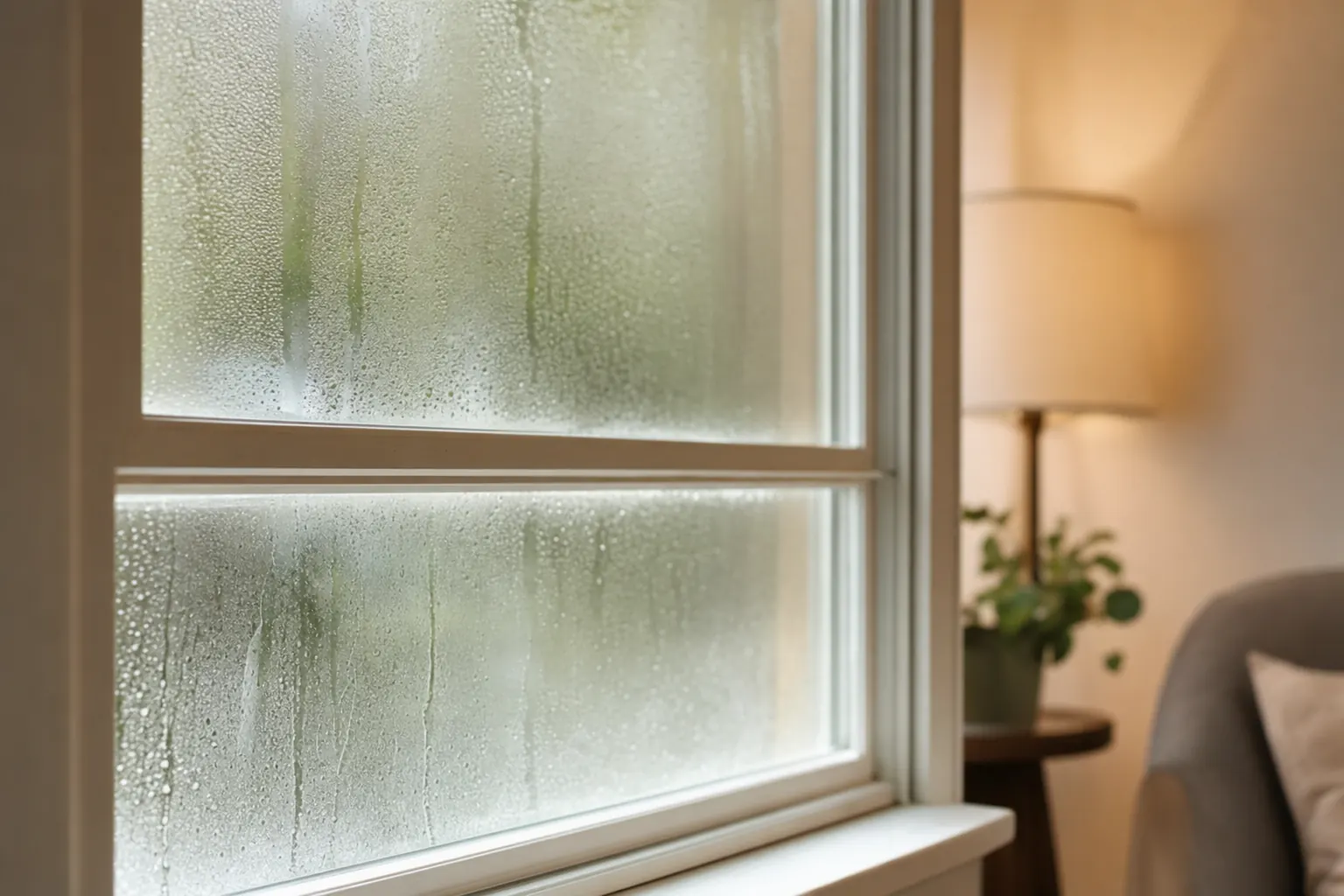
For most homes, 40% to 50% relative humidity is the sweet spot. That range generally feels comfortable at normal summer thermostat settings and helps limit moisture-related problems. If your humidity is consistently 55% to 60%, many people start describing the air as sticky or heavy. Upholstery and bedding may feel damp. Basement odors tend to get worse. Windows can fog more easily in some seasons, and closets and corners can hold onto moisture longer after showers or cooking.
Going too low is not ideal either. Below about 30% to 35%, skin, sinuses, and throats can feel dry, and some wood floors or furniture may shrink or gap more than normal. The right setting may shift slightly by season and climate, but if summer indoor humidity is over 60%, that is usually a clear signal to address moisture control. A small digital hygrometer costs little and gives you a better picture than guessing based on how the room feels.
- 40% to 50% RH is a common target for comfort and moisture control in summer.
- Up to about 55% RH can still be acceptable in some homes during humid weather.
- Over 60% RH raises the risk of mold growth on cooler surfaces and supports dust mites.
- Below 35% RH can feel uncomfortably dry for people and hard on some wood materials.
When a whole-home dehumidifier beats a portable unit
If your AC is correctly sized and working properly but the house still runs humid, a dedicated dehumidifier may be the right answer. A portable unit can help in a single problem room, such as a basement office or one damp bedroom, but it has limits. Portables are noisy, add some heat to the room, need a bucket emptied or a drain managed, and only treat the air that reaches that room. They are often a patch, not a full-house solution.
A whole-home dehumidifier is installed as part of the duct system or as a dedicated ducted unit. It removes moisture without needing the AC to overcool the house first. That matters on mild but humid days, rainy shoulder-season weather, or nights when the temperature is fine but indoor moisture stays high. Many whole-home units can be set to maintain a target RH like 50%, and they can dry the house more evenly than multiple portable units scattered around.
Typical 2025-2026 US pricing for a decent portable dehumidifier is often about $200 to $500, with larger or premium models costing more. Installed whole-home dehumidifiers commonly land around $2,000 to $4,500, though more complex ductwork, condensate drainage, electrical work, or control upgrades can push some projects higher. The better choice depends on scope. One damp basement room may justify a portable. A whole house that is regularly 60% RH or higher despite normal AC operation often points toward a whole-home unit.
Cost ranges are estimates developed from standardized project scopes and reviewed pricing inputs. Government labor and regional cost data are used where applicable. See our Pricing Methodology for the exact sources, calculations, and review date. Actual prices vary by property, scope, materials or equipment, location, and provider.
Other causes of high humidity that are easy to miss
Not every humidity problem is an oversized air conditioner. Outdoor moisture can enter through air leaks around recessed lights, attic hatches, rim joists, crawl spaces, leaky return ducts, or poorly sealed duct boots. Bathroom fans that are weak or rarely used, kitchen exhaust that is recirculating instead of venting outdoors, and dryers with vent issues can all add indoor moisture. Basements and crawl spaces are frequent sources because cool surfaces allow dampness to linger.
Ventilation strategy matters too. Bringing in outdoor air can improve indoor air quality, but in a humid climate that outside air may need conditioning or dehumidification. If a fresh-air intake is dumping moist summer air into the return side of the system without proper controls, indoor RH can climb. Drainage problems also matter. A clogged condensate line, a poorly sloped drain, or water sitting where it should not can contribute to musty conditions, though diagnosis and repair should be handled by a qualified technician when equipment access or electrical components are involved.
- Check whether the thermostat fan is set to AUTO rather than ON.
- Use bath fans during showers and for about 20 minutes afterward if they vent outdoors.
- Run kitchen exhaust during heavy cooking, especially boiling and steaming.
- Keep basement and crawl space moisture in mind, because those areas often drive whole-house humidity.
- Ask for duct leakage, airflow, and load-calculation review if the problem has been there since installation.
How to talk to a contractor about a clammy house
The most useful conversation starts with symptoms and measurements, not just a request for colder air. Tell the contractor what indoor temperature you keep, what relative humidity you are seeing, whether the house feels worse on mild rainy days, and whether the system runs in short bursts. Note if some rooms are much more humid than others, whether the thermostat fan is on AUTO, and whether the issue started with a new system or has always been there. That information helps separate sizing issues from airflow, infiltration, or dehumidification needs.
Ask whether a Manual J load calculation was done or should be updated before replacing equipment. Ask about actual run times, blower settings, duct leakage, and whether the system has any humidity-control mode. If whole-home dehumidification is suggested, ask where it will tie into the ductwork, how condensate will drain, what RH setpoint is recommended, and whether it can operate independently of cooling. If the answer is simply to lower the thermostat more, that is usually not a complete humidity strategy.
A homeowner can gather data safely, but equipment diagnosis belongs to a qualified licensed technician when it involves refrigerant charge, sealed-system performance, internal electrical components, or blower setup changes. The goal is not just a colder number on the wall. The goal is a house that stays around the right temperature and around 40% to 50% relative humidity without feeling damp.
Sources and fact-checking
Reviewed July 25, 2026. We favor primary government and standards sources for safety, efficiency, and regulatory claims. These references support the technical and consumer guidance on this page.
- What can I do to improve indoor air quality in my home?U.S. Environmental Protection AgencyIndoor moisture control, ventilation, filtration, and recommended relative-humidity ranges.
- Use and care of home humidifiersU.S. Environmental Protection AgencyHumidifier types, moisture limits, cleaning, mineral exposure, and safe operating practices.