
Reviewed July 22, 2026
HVAC Rescue Editorial Team
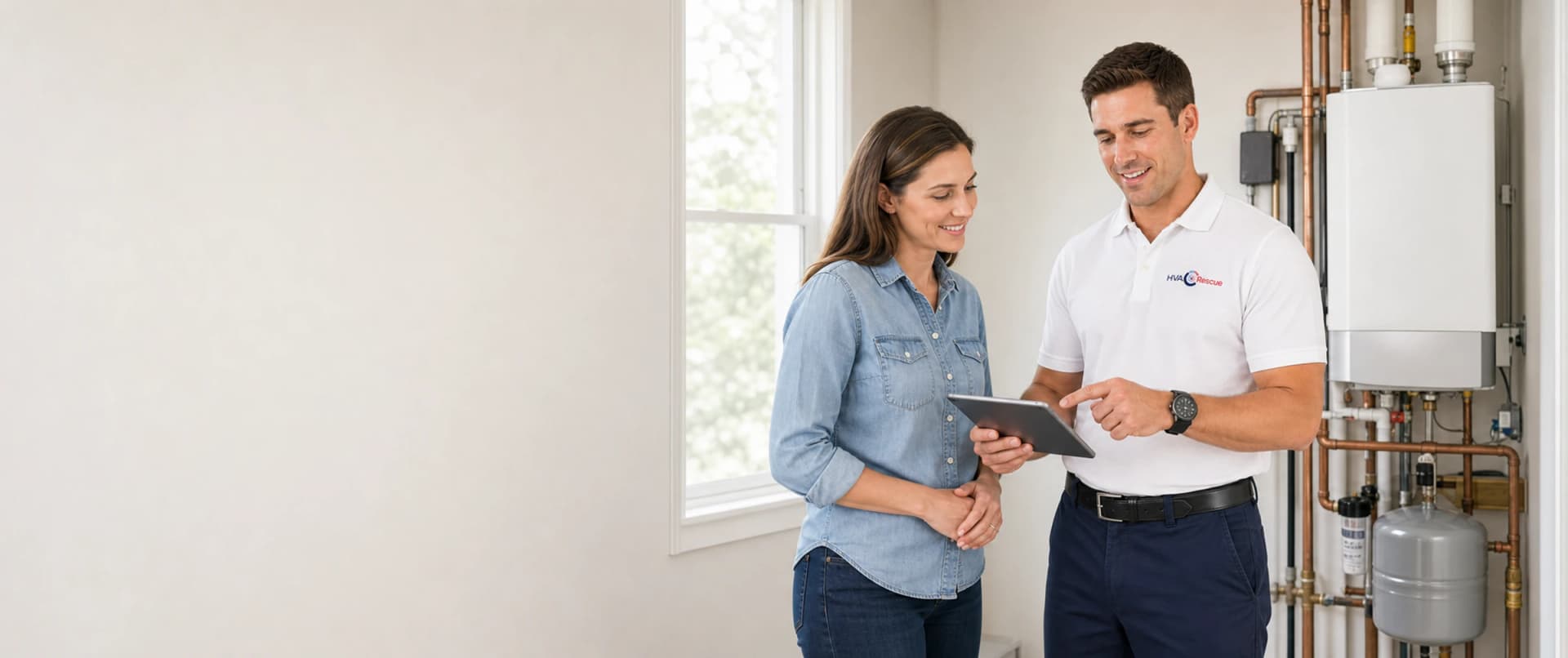
Editorial StandardsReplacing an aging boiler in Florida
Boiler replacement is the right starting point when the boiler itself is old, failing, or becoming too expensive to keep alive. Many boilers last 15 to 30 years, but repeated breakdowns, rising fuel bills, pressure loss, loud kettling, serious corrosion, or a condemned heat exchanger can shift the smarter decision from repair to replacement. It is also the right service when parts for your model are hard to find or you are comparing an oil-to-gas conversion or a move to a high-efficiency condensing boiler.
This page is about replacing an existing boiler in an existing heating system. It is not the same as boiler installation for a brand-new setup, and it is not the same as boiler repair for a problem that may be limited to a thermostat, circulator, zone valve, or expansion tank. Replacement has to account for the old system's age, piping, venting, fuel type, and the condition of the radiators, baseboards, radiant loops, or steam piping already in the home.
Boiler Replacement in Florida: what’s different here
Florida's HVAC planning is dominated by long cooling seasons, heavy humidity, and frequent rain, which means heating equipment often gets less attention until it stops working. Regional differences matter: the Panhandle and North Florida tend to feel heating needs more than Miami or Fort Lauderdale, while coastal moisture and salt air can add wear to equipment and related components over time.
In Florida, boiler replacement often follows long periods of light use that let aging equipment problems go unnoticed until a cold spell arrives. In coastal areas, moisture and salt exposure can contribute to corrosion around mechanical systems, and in older homes, replacement decisions may also involve evaluating how the boiler fits with the rest of an HVAC setup built around cooling first.
In Florida, replacement decisions should be made in the context of the whole home, especially since cooling and moisture control usually matter more than heating output alone.
- Florida homes usually prioritize cooling, so boilers can be overlooked until a cold snap exposes problems.
- North Florida and the Panhandle often have more practical need for reliable heat than far South Florida.
- Coastal moisture and salt air can add wear around mechanical equipment.
- Replacing an aging boiler can improve reliability during brief winter cold spells.
- Scheduling before cooler weather can help avoid seasonal surprises.
Boiler Replacement decisions for Florida homes
Compare a supported boiler repair with replacement using safety, heat-exchanger and vessel condition, leaks, efficiency, reliability, heat loss, fuel, venting, distribution, and full project scope. For Florida, the relevant state focus is design conditions, fuel, efficiency, permits, winter design load fuel hydronic and efficiency context. Replacement is justified by safety, major failure, widespread condition, repeated repairs, or a better complete-system plan; age alone does not prove the existing boiler cannot be repaired.
Repair or replace your system?
Repair often makes sense when
Repair can still be the better choice when the boiler has useful life left and the issue is limited to a serviceable component, so it's worth comparing both options carefully.
- The boiler is under about 15 years old and has been well maintained
- The problem is confined to a repairable control, pump, valve, or similar component
- The heat exchanger and venting are still in sound condition
- The system has not developed a pattern of repeated breakdowns
- Fuel efficiency and comfort remain acceptable overall
- A pro confirms the unit is safe and worth repairing
Consider replacement when
Replacement usually makes more sense when age, safety concerns, repeated repairs, and poor efficiency are all pointing the same direction. A provider serving Florida can help you weigh the tradeoffs for your home and heating setup.
- The boiler is past 15 to 20 years and showing clear wear
- Repairs are becoming frequent or increasingly expensive
- A cracked heat exchanger, major corrosion, or flue issue has been found
- Fuel bills keep rising while performance keeps slipping
- Parts are scarce, obsolete, or no longer practical to source
- You want to upgrade to a properly sized, higher-efficiency system
System & efficiency options for Florida homes
Standard atmospheric boiler replacement
A conventional replacement for homes that are staying with a non-condensing boiler design and compatible venting. It can be a practical option when the goal is dependable heat without a major system redesign, though a provider should confirm that it is appropriate for the existing setup.
High-efficiency condensing boiler
A condensing boiler captures heat from flue gases that older equipment vents away, reaching roughly 90 to 95% AFUE versus about 80% for many older units. It earns those numbers when the system runs cooler return-water temperatures, so radiator sizing, controls, venting, and condensate drainage all belong in the assessment a provider performs.
Combi boiler upgrade
A combi boiler provides space heating and domestic hot water from one appliance, eliminating the storage tank and freeing up space. It fits homes with modest hot-water demand; larger households that run multiple showers at once are often better served by a system boiler with an indirect tank. A provider can run the flow-rate math for your home.
Oil-to-gas boiler conversion
Some homeowners replace an aging oil boiler with a gas-fired model to drop tank and fuel-delivery costs. A conversion adds gas-line, chimney-liner, and permitting work beyond a like-for-like swap, and feasibility depends on utility availability at your property, which an installer can review.
Electric boiler or alternative heat comparison
In some situations, homeowners compare boiler replacement with an electric boiler or with heat pump options. Radiator systems designed for high water temperatures do not always pair well with heat pumps without upgrades, so a provider can explain where those alternatives make sense and where a hydronic boiler remains the better match.
How much does boiler replacement cost in Florida?
Boiler replacement scope in Florida varies with fuel, hot-water or steam distribution, efficiency, removal, venting, piping, controls, water conditions, and access. The factors below define the work.
- The size of the home and the heat load the new boiler must handle
- The type of boiler selected, such as standard, condensing, or combi
- The fuel source involved, including gas, oil, or electric
- Whether the replacement is like-for-like or involves a conversion
- The condition of existing piping, radiators, baseboards, and zones
- Venting or chimney requirements for the new equipment
- Whether pumps, valves, controls, or the expansion tank also need replacement
- Accessibility of the boiler room and removal of the old unit
- Water quality issues, sludge, or system flushing needs
- Electrical, drainage, or condensate work required for the installation
- Permit and code requirements in your area
- Local labor rates and market conditions where you live
| Boiler Replacement | Typical range |
|---|---|
| Standard-efficiency gas boiler (80-85% AFUE)Like-for-like swap, existing venting reused or relined | $4,400 – $9,700 |
| High-efficiency condensing gas boiler (90%+ AFUE)Includes new sidewall venting and condensate handling | $6,300 – $14,300 |
| Combi boiler (heating + domestic hot water)Replaces both the boiler and the water heater in one unit | $6,800 – $15,300 |
| Oil boiler replacementHigher equipment cost; common in Northeast homes without gas service | $5,800 – $13,100 |
| Electric boiler replacementCheaper equipment and install, but higher operating cost in most markets | $3,700 – $9,200 |
| Steam boiler replacementNear-boiler piping, skimming, and venting work add labor | $6,800 – $15,700 |
| Oil-to-gas conversion (full project)New gas boiler plus gas line work and oil tank decommissioning | $9,200 – $20,800 |
Cost ranges are estimates developed from standardized project scopes and reviewed pricing inputs. Government labor and regional cost data are used where applicable. See our Pricing Methodology for the exact sources, calculations, and review date. Actual prices vary by property, scope, materials or equipment, location, and provider.
See the full boiler replacement cost guide for the complete breakdown, then call to get a real quote for your Florida home.
Get boiler replacement help in Florida
One quick call connects you with HVAC pros who service your area. No pressure, no obligation.
Florida: efficiency standards, rebates & the rules that matter
A few national rules and Florida realities shape any heating or cooling project. Knowing them helps you buy the right system and avoid surprises.
Efficiency standards (SEER2)
Florida sits in the DOE's Southeast region, where new split-system central air conditioners must meet a higher minimum of 14.3 SEER2 (versus 13.4 in the North) — so the efficiency floor here is above the national base.
New equipment is moving to lower-GWP refrigerants
EPA technology-transition rules restrict new residential and light-commercial equipment that uses high-global-warming-potential HFCs. Most newly manufactured split systems now use A2L refrigerants such as R-454B or R-32, while existing R-410A systems and qualifying repair components remain serviceable. Ask which refrigerant a proposed system uses and confirm that every indoor and outdoor component is listed as a compatible match.
Rebates & tax credits
For equipment placed in service after December 31, 2025, do not assume the former federal Section 25C HVAC credit still applies. Florida households may have access to a state-administered Home Energy Rebate program, utility incentives, or local financing programs, but availability, income rules, eligible models, and funding vary. Check the U.S. Department of Energy program page, the Florida energy office, DSIRE, and the serving utility before signing a contract; use a tax professional for tax advice.
Licensing, permits & EPA 608
HVAC contractor licensing varies by state and sometimes by city or county. In Florida, confirm your contractor is licensed where required, carries liability and workers'-compensation insurance, and that anyone handling refrigerant holds EPA Section 608 certification. Replacements typically need a local permit and inspection.
Florida specifics
Florida's heat, humidity, and hurricane exposure put cooling and moisture control first, and salt air along the coast is hard on outdoor equipment.
Sources: U.S. DOE — central AC & heat pump regional efficiency standards · eCFR — 10 CFR 430.32 minimum efficiency standards · U.S. EPA — Technology Transitions Program · IRS — Energy Efficient Home Improvement Credit (§25C) · U.S. DOE — Home Energy Rebates · DSIRE — database of state & utility energy incentives · U.S. EPA — Section 608 technician certification
These references support the national regulatory, efficiency, and incentive notes above. State planning context does not represent a local office or guaranteed provider coverage.
Florida climate & seasonal demand
Winters are mild, with only brief cool spells in most of the state. Heat pumps are common and easily handle the light heating demand.
Florida has a hot, humid climate with long summers, mild winters, and frequent rain and thunderstorms. Coastal areas face high moisture and the influence of salt air, and the state sees a real hurricane season.
Because Florida winters are usually brief, many homeowners wait until the first cool snap to discover the boiler is no longer reliable. Planning replacement before winter is still wise, especially in North Florida and the Panhandle, and storm season can also affect scheduling, power availability, and access to service depending on local conditions.
A boiler replacement in Florida is less about surviving a long winter and more about dependable, efficient heat during occasional cold weather without keeping an outdated system in place year after year. For some homes, replacement is also a chance to review whether the current heating setup still makes sense in a state where humidity control and cooling performance drive comfort most of the year.
- Air conditioners running nearly year-round under heavy load
- High humidity overwhelming undersized or aging systems
- Clogged condensate drains causing water backups
- Mold and musty odors from persistent moisture
- Salt air corroding outdoor units near the coast
- Storm-related damage and power disruptions affecting equipment
Before you call: what to have ready
Before scheduling boiler replacement, note the system's age if known, any recent loss of heat, unusual noises, leaks, or uneven heating, and whether the issue appears during only the coolest weather. Homeowners can also safely clear access around the unit and gather past service records, but any work involving gas, burners, electrical components, or internal boiler parts should be handled by qualified professionals. For Boiler Replacement in Florida, relate this guidance to the actual equipment, property, and written scope.
Questions to ask before approving work
- Are you licensed and insured for HVAC work in this state?
- Will a technician give a written, itemized estimate before any work starts?
- Is the diagnostic fee waived or credited if I approve the repair?
- For a new system, will you run a Manual J load calculation to size it correctly?
- What parts and labor warranties come with the repair or installation?
- Are your technicians NATE-certified or manufacturer-trained?
- Can you pull the required permits and schedule any needed inspection?
- Do you offer financing or maintenance plans, and what do they cover?
What happens during service
- 1
Tell us about the boiler
Share what the current system is doing, its approximate age, and why you're considering replacement so we can route your request appropriately.
- 2
Share your location
Let us know where you are in Florida so we can match you with providers that service your area.
- 3
Get connected to a provider
We connect you with an independent provider. Because we are a nationwide connection service, availability may vary by location and provider.
- 4
System assessment and sizing
The provider evaluates the boiler, venting, and distribution system, and runs a heat-loss calculation so the new boiler is sized to the home as it exists now — not to the old nameplate.
- 5
Review equipment options
You discuss boiler type, efficiency, fuel considerations, and whether changes such as a condensing upgrade or combi system make sense.
- 6
Receive an estimate
The provider gives an estimate based on the actual installation scope, including any related piping, venting, or control work.
- 7
Schedule the replacement
Once you choose an option, you coordinate timing directly with the provider handling the work.
- 8
Installation and startup
The old boiler is removed, the new system is installed and vented, the loop is purged and tested, and the provider walks you through basic operation and what to monitor.
Boiler Replacement in Florida: common questions
Does boiler replacement make sense in Florida if winters are usually mild?
Are boiler needs different in Jacksonville or the Florida Panhandle than in Miami?
Can coastal conditions in places like Tampa or Fort Lauderdale affect boiler replacement planning?
Should I replace my boiler before the next cool spell in Florida?
Sources and fact-checking
Reviewed July 22, 2026. We favor primary government and standards sources for safety, efficiency, and regulatory claims. These references support the technical and consumer guidance on this page.
- ENERGY STAR heating and cooling guidanceENERGY STAREfficiency, replacement planning, qualified equipment, and contractor questions.
- Clean heating and coolingENERGY STARCentral-system sizing, efficiency, replacement planning, installation, and maintenance.
- Manual J residential load calculationAir Conditioning Contractors of AmericaRoom-by-room heating and cooling load calculations used for equipment sizing.
- Consumer central air conditioners and heat pumpsU.S. Department of EnergySEER2, EER2, HSPF2, test procedures, and current federal efficiency standards.
- How to avoid a home improvement scamFederal Trade CommissionWritten estimates, contractor verification, payment cautions, and fraud warning signs.