
Reviewed July 22, 2026
HVAC Rescue Editorial Team
Editorial StandardsStart with the need
When AC repair is the right next step
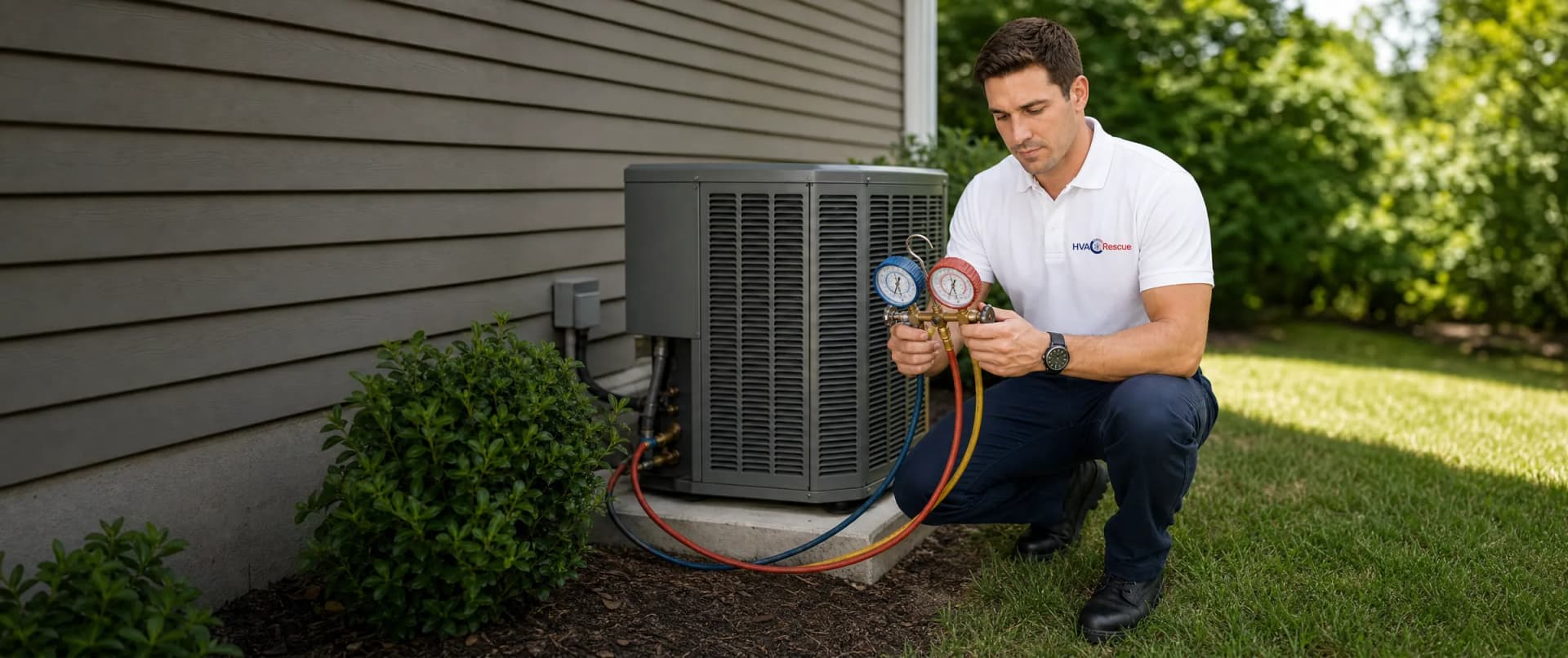
AC Repair in Greenwich should start with the homeowner decision, not a guessed part. Determine why the air conditioner is not removing enough heat or moisture before replacing a part or adding refrigerant. The selected local context is specific: Summer cooling in Greenwich is less about extreme heat than about keeping bedrooms, upper floors, and sun-facing rooms comfortable when humidity builds along the coast. In neighborhoods like Riverside and Old Greenwich, a system that handles moisture well... AC repair should distinguish control, airflow, drainage, electrical, coil, refrigerant, and compressor conditions with measurements instead of treating warm air as a single failure.
AC repair should distinguish control, airflow, drainage, electrical, coil, refrigerant, and compressor conditions with measurements instead of treating warm air as a single failure.
Understand the possibilities
What can shape a ac repair diagnosis
Low refrigerant
A leak can leave the system short on refrigerant, which reduces its ability to move heat. That can show up as warm air, long run times, higher cooling costs, or ice forming on the coil or refrigerant lines.
Blocked airflow
A dirty filter or dirty coils can restrict the air moving across the indoor coil. When airflow drops, rooms may feel stuffy, supply air may seem weak, and the coil can get cold enough to freeze.
Bad outdoor electrical part
A failed capacitor or contactor can keep the outdoor unit from starting or running correctly. The result may be warm air indoors, buzzing outside, clicking without startup, or an outdoor unit that is silent while the indoor fan still runs.
Fan motor trouble
The blower motor indoors and the condenser fan motor outdoors both support cooling. If either one is failing, airflow can drop, the outdoor unit can overheat, or the system may run loudly without cooling the house well.
Thermostat or wiring issue
If the thermostat is not set correctly or the control wiring has a fault, the system may not receive a proper call for cooling. That can cause no cooling, short cycling, or parts of the system running when they should not.
Homeowner-safe boundary
AC Repair safety boundaries
Homeowner checks should stay simple and stop short of opening equipment or testing electrical or refrigerant parts. The goal is to rule out a few common causes, protect the system from further strain, and give a technician a clearer symptom if the problem remains.
- 1
Confirm the thermostat
Set the thermostat to cool and lower than the room temperature. If cooling starts after that change, the issue may have been a setting problem. If nothing changes, the problem is likely elsewhere in the system.
- 2
Replace the air filter
If the filter is dirty, replace it. A clogged filter can cut airflow enough to cause weak cooling or ice on the coil. If airflow improves after a new filter, watch the system closely in case icing returns.
- 3
Look at the outdoor unit
Check whether the outdoor unit is running and make sure debris is not crowding it. If the unit is clear but not running, or if it is making unusual noise, that points to a fault rather than a simple airflow issue.
- 4
Check breaker and ice
If a breaker has tripped, reset it once. If it trips again, leave it alone. If you see ice on the coil or lines, turn the system off and let it thaw before running it again. Repeated icing means the cause still needs diagnosis.
Stop and use the appropriate emergency or professional help for
- Turn cooling off for smoke, arcing, a repeated breaker trip, severe grinding, or water reaching electrical equipment.
- Escalate when cooling is associated with an immediate safety risk or dangerous loss of comfort.
- Escalate when air conditioner is associated with an immediate safety risk or dangerous loss of comfort.
- Escalate when ac is associated with an immediate safety risk or dangerous loss of comfort.
- Escalate when warm air is associated with an immediate safety risk or dangerous loss of comfort.
- Escalate when condensate is associated with an immediate safety risk or dangerous loss of comfort.
- Escalate when humidity is associated with an immediate safety risk or dangerous loss of comfort.
Call for professional diagnosis when the basic checks do not restore normal cooling or when the symptom suggests a failing part, airflow failure, or refrigerant problem. Continued operation can add stress to the system, especially during icing, fan failure, or repeated electrical trouble.
Warm air after checks
If the AC still blows warm air after the thermostat, filter, breaker, and outdoor unit have been checked, the problem is beyond routine homeowner fixes. The system can stay on unless ice forms or the unit begins making severe noise.
Ice keeps coming back
Recurring ice matters because thawing alone does not fix the cause. Turn the system off and leave it off until it can be diagnosed, since running an iced system can worsen airflow and cooling problems.
Outdoor fan not spinning
If the outdoor fan is not spinning, the condenser cannot reject heat normally. Shut the system off to avoid added strain and have the fault checked before running it again.
Buzzing, clicking, or grinding
These sounds can point to failing electrical parts or a motor problem. Grinding is a stronger reason to shut the system off right away, while repeated buzzing or clicking without startup also needs prompt diagnosis.
Diagnosis before scope
How ac repair should be evaluated
- Step 1
Confirm the symptom
Note whether the air is warm, weak, or not flowing, and whether the outdoor unit runs.
- Step 2
Run safe checks
Thermostat, filter, breaker, and a clear outdoor unit.
- Step 3
Connect with a pro
HVAC Rescue helps connect you with AC repair professionals that service your area.
- Step 4
Diagnose the cooling system
The technician checks refrigerant, coils, electrical parts, and airflow.
Relevant local context
AC Repair conditions that matter locally in Greenwich
For AC repair, select only local facts about cooling load humidity condensate and outdoor-unit exposure; omit unrelated parts of the generic city HVAC profile.
Seasonal operating context
Summer cooling in Greenwich is less about extreme heat than about keeping bedrooms, upper floors, and sun-facing rooms comfortable when humidity builds along the coast. In neighborhoods like Riverside and Old Greenwich, a system that handles moisture well can make a bigger difference than one that only pushes colder air.
Relevant local scenario
The local scenario for this AC repair page is specific: Cooling struggles on upper floors during summer in Byram. In a Greenwich home, relate that fact to this observed goal or symptom: AC running but not lowering the temperature. It is a planning clue, not evidence that every home has the same equipment condition or failure.
Property and access
Old Greenwich and Riverside have many older coastal homes that can be harder to balance room to room
Planning consideration
To prepare for AC repair in Greenwich, gather the system history, access constraints, observed need, and project goals. The selected city consideration is this: Choose systems that can handle both cooling and moisture control in coastal Fairfield County. At the state level, summers are warm and humid, so cooling and moisture control both matter during the warm months. The cooling season is shorter than in the South but still meaningful Favor a measured repair when the fault is isolated and the matched system is otherwise sound; compare replacement only when condition, compatibility, repeated failures, or major-component economics support it.
A balanced decision
Repair or replace?
Repair may be reasonable when
Repair is often the practical choice when the system is relatively young, the failure is isolated, and the rest of the unit is in good shape.
- The unit is still within a typical service life and has been maintained
- The problem is a single component, like a capacitor, contactor, or fan motor
- Airflow or drainage issues that don't involve major parts
- A thermostat or control fault rather than a sealed-system failure
- The system still uses a refrigerant that is readily available
- This is the first significant repair the system has needed
Replacement deserves evaluation when
Replacement may be worth discussing when the equipment is aging, repairs are stacking up, or the refrigerant type is being phased out. A professional can help you weigh the trade-offs for your home in Connecticut.
- The system is near or past its expected lifespan
- You've paid for several repairs in a short span of time
- A major component such as the compressor has failed
- The unit runs on an older refrigerant that is being phased down
- Energy bills keep climbing despite repairs and maintenance
- A pro recommends evaluating a higher-efficiency replacement
What can affect AC repair cost?
Air-conditioning repair scope depends on the failed component, system type, diagnosis, access, refrigerant work, labor, and urgency. This guide outlines the common cost drivers and comparison questions.
Repair quotes can vary widely because the failed part is only one piece of the job. On a major cooling repair such as an evaporator coil, the total can change with system size, coil style, warranty status, refrigerant type, the amount of recovery and recharge needed, cabinet access, brand-specific parts, and local labor conditions. That is why an itemized diagnosis matters before approving a larger repair.
| AC Repair Cost | Typical range |
|---|---|
| Minor repair (capacitor, contactor, fuse)Common, affordable fixes. | $225 – $700 |
| Moderate repair (fan motor, drain, thermostat)Mid-range parts and labor. | $425 – $1,675 |
| Major repair (compressor, refrigerant leak)Large repairs; may favor replacement on older units. | $1,625 – $5,900 |
Cost ranges are estimates developed from standardized project scopes and reviewed pricing inputs. Government labor and regional cost data are used where applicable. See our Pricing Methodology for the exact sources, calculations, and review date. Actual prices vary by property, scope, materials or equipment, location, and provider.
See the full AC repair cost guide for the complete breakdown, then call to get a real quote for your home.
What to expect
From symptom to a clear next step
A qualified technician narrows the fault by confirming the complaint and checking system operation before replacing parts. That usually means comparing the symptom with airflow, electrical, and cooling-system checks so the repair matches the actual cause. For a no-cool or weak-cooling call, the important difference is whether the problem starts with airflow, controls, an outdoor component, or the sealed cooling circuit.
- Step 1
Tell us what's happening
Describe what your AC is doing, such as warm air, no airflow, strange noises, or no power, so we can route your request accurately.
- Step 2
Share your location
Let us know where you are in Connecticut so we can match you with HVAC professionals that service your area.
- Step 3
Get connected to a provider
We connect you with an independent cooling provider. Because we are a nationwide connection service, availability may vary by location and provider.
- Step 4
Schedule a diagnostic visit
Coordinate a time directly with the provider for them to inspect the system in person.
- Step 5
On-site diagnosis
The provider examines the equipment, identifies the root cause, and explains what they find.
Common questions
AC Repair in Greenwich: questions and answers
Which local fact is relevant to AC repair in Greenwich?
Which property and system details matter before AC repair in Greenwich?
Why is my AC running but not cooling my Connecticut home?
Does HVAC Rescue send its own technicians in Connecticut?
Can you guarantee same-day AC repair in Connecticut?
Technical and safety guidance is supported by the sources below. Local context is limited to the service-relevant city facts selected by the repository and is not evidence that a particular component has failed.
Sources and fact-checking
Reviewed July 22, 2026. We favor primary government and standards sources for safety, efficiency, and regulatory claims. These references support the technical and consumer guidance on this page.
- Heating and cooling maintenance checklistENERGY STARProfessional tune-up scope, filters, airflow, coils, drains, and safety checks.
- ENERGY STAR heating and cooling guidanceENERGY STAREfficiency, replacement planning, qualified equipment, and contractor questions.
- Section 608 technician certification requirementsU.S. Environmental Protection AgencyFederal certification requirements for work that can release regulated refrigerants.
- How to avoid a home improvement scamFederal Trade CommissionWritten estimates, contractor verification, payment cautions, and fraud warning signs.